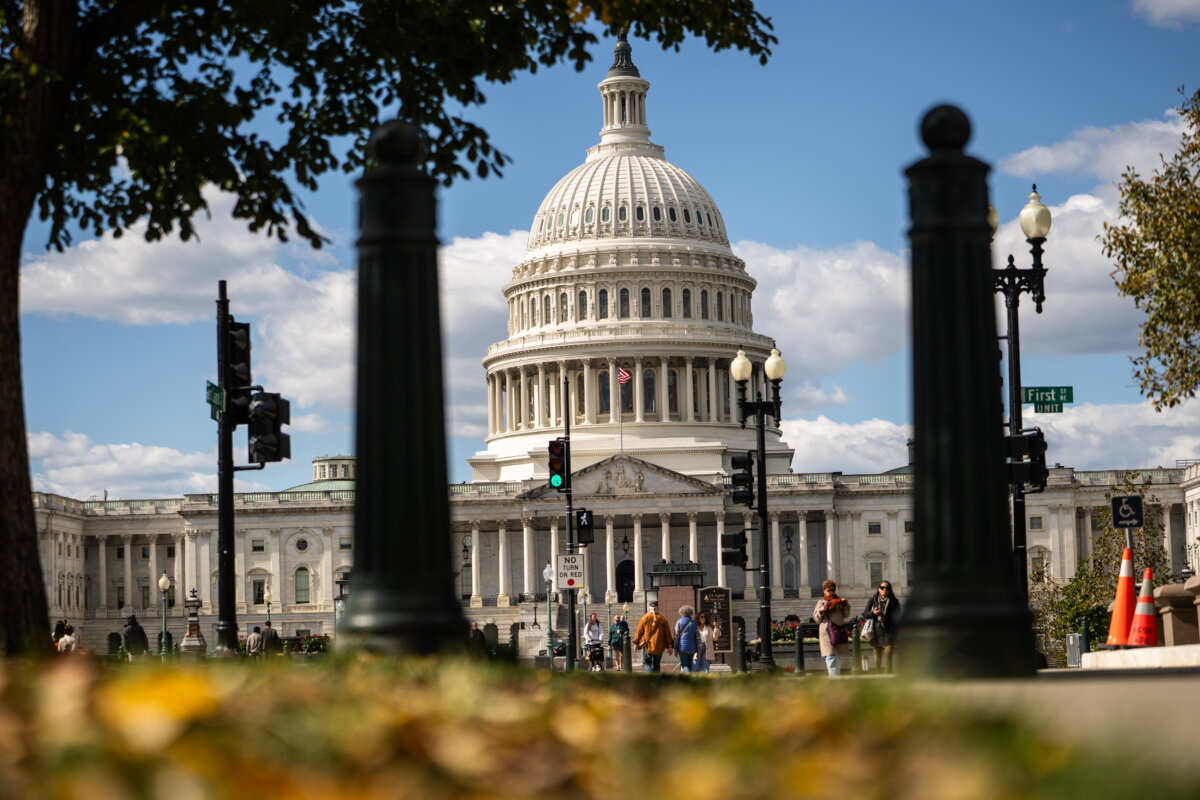


WASHINGTON—Republicans and Democrats showed no signs of agreement as a government shutdown reached 22 days, making it the second-longest in history.
A Republican-backed stopgap funding measure on Oct. 22 again failed to gain the 60 votes needed to end debate in the Senate and bring the matter to an up-or-down vote.
The 54–46 result is nearly identical to the 12 previous votes dating to Sept. 19. Nearly all Republican senators support the measure, and all but a handful of Democrats oppose it.
President Donald Trump said on Oct. 21 that he would meet with Democratic leaders only after they approve the GOP continuing funding resolution to allow the government to temporarily resume full operations at the existing funding level.
Democrats have said the standoff revolves around their effort to make health care more accessible.
However, Sen. Jeff Merkley (D-Ore.) conducted a filibuster beginning late on Oct. 21, calling for resistance to what he called authoritarianism by Trump.
Referring to the demolition underway on the White House East Wing, which houses the office of the first lady, in preparation for construction of a ballroom, Merkley said, “The president’s tearing down part of the symbol of our Republic and building a symbol of a king.”
Press secretary Karoline Leavitt said on July 31 that the White House, despite its history and beauty, is unable to host large events without erecting a tent on the White House lawn, where state dinners are usually held. Currently, only about 200 people can be seated in the East Room.
Trump said last week the ballroom, which will be financed by the president and other private donors, would be able to accommodate up to 999 people.
Merkley’s other criticisms of executive actions target the deployment of National Guard troops to U.S. cities, immigration operations conducted by Immigration and Customs Enforcement officers, and the rescission of program funds authorized by Congress.
“We are fully in the authoritarian moment right now,” Merkley said. “The longer you are in an authoritarian state, it becomes more and more entrenched. And so we have to fight it in every possible way.”
The president has said the deployment of troops is necessary amid increasing threats against federal law enforcement officers working to deter illegal immigration and crime.
Merkley’s comments were echoed by a number of Democratic senators who rose to pose questions during the filibuster.
Commenting on U.S. missile attacks on suspected drug boats, Sen. Andy Kim (D-N.J.) told The Epoch Times, “In general, what we see is them operating with a level of lawlessness.” The Trump administration officials said they confirmed the boats were operated by cartels based in Latin America and were trafficking deadly drugs into the United States.
Yet Kim maintained that health care remains the central issue for Democrats and accused House Speaker Mike Johnson (R-La.) of being responsible for lengthening the shutdown.
“What we want is a way forward to be able to help millions of Americans that are struggling for the health care we’ve been prepared and ready to negotiate,” Kim said. “But when he’s not bringing the House of Representatives back into session, we aren’t able to do that.”
Republicans have accused Democrats of blocking the reopening of the government as a political stunt to convince the left wing of their party that they oppose Trump’s agenda.
“This is about two leaders trying to keep their jobs,” Rep. Mike Simpson (R-Idaho) told reporters on Oct. 22, referring to Senate Minority Leader Chuck Schumer (D-N.Y.) and House Minority Leader Hakeem Jeffries (D-N.Y.).
House Majority Leader Steve Scalise (R-La.), commenting on the potential loss of SNAP benefits if the shutdown extends into November, said, “They’re saying no to 42 million families who will go without food so that Democrats can show their far-left radical base that they’re fighting President Trump.”
Johnson reiterated to reporters on Oct. 22 that he believes the Democrats’ proposal, which includes a complete repeal of the health-related provisions of the One Big Beautiful Bill Act, is a nonstarter for discussions.
Aldgra Fredly and Emel Akan contributed to this report.
 Friends Read Free
Copy
Facebook
Tweet
Friends Read Free
Copy
Facebook
Tweet