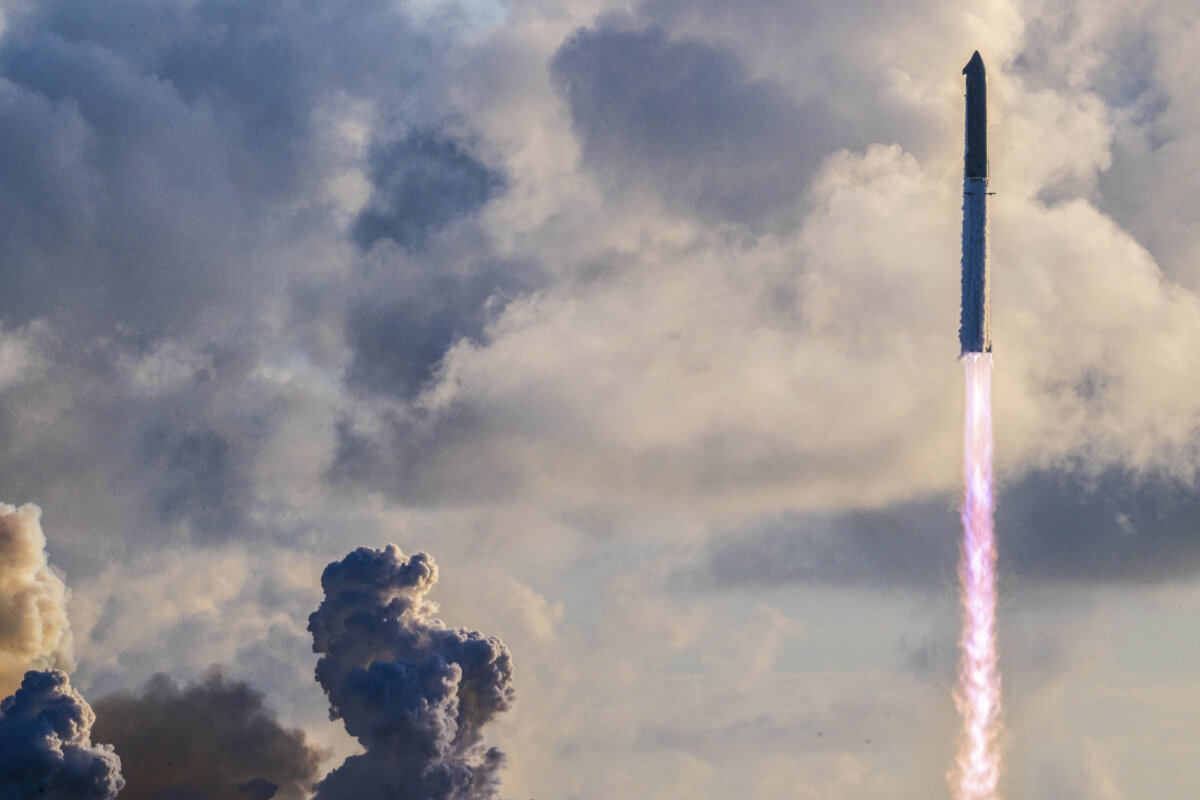

SpaceX’s behemoth Starship flew in low Earth orbit for the first time in its development, making an early return home after successfully deploying more than two dozen Starlink satellites.
Starship lifted off from the Southeast Texas coastline just after 8:45 p.m. ET on Sept. 28 on the might of the Super Heavy’s cluster of 33 Raptor engines.
That booster burned nominally, only losing one engine on its uphill climb. It then had a successful return to Gulf waters just off the coast of its launch site in Starbase, Texas. Once again, it did not return to the launch pad and was not caught by the tower.
Meanwhile, the upper stage Starship successfully lit all six of its vacuum engines as it essentially kicked off the booster in what SpaceX calls “hot staging.” However, seven minutes and 30 seconds into the mission, one of Starship’s six large engines shut down early, resulting in a 30-second delay to the end of the initial launch.
The original flight plan was to deposit the Starship into a suborbital trajectory it flew in previous test flights, aiming for a spot in the Indian Ocean.
This path essentially served as a holding pattern as flight controllers checked out the spacecraft. But after Starship’s engine failed early, it was unclear whether or not a second engine burn to put Starship into a stable orbit would be attempted.
A Go/No-Go poll was taken just more than 20 minutes into flight. After more than 10 minutes of assessments and an initial report of a no-go, Starship was ultimately given the Go for orbital insertion.
This was the 14th test flight of Starship and the first to aim for a stable orbit around the Earth.
A single engine was reignited, and Starship arrived in low Earth orbit after just 26 minutes of flight.
About 35 minutes after launch, Starship began deploying 26 Starlink V3 satellites set to join the telecommunications constellation. The satellites were dispensed at a rate of one per minute and progressed as Starship sailed past the point in the eastern Indian Ocean it had previously targeted to splashdown.
A SpaceX spokesperson said that Starship will be able to deploy up to 60 Starlink satellites at a time, about 20 times the current capacity of the Falcon 9 rocket.
Satellite deployment was completed just more than an hour into the flight, and the spacecraft began powering down some systems in anticipation of its continued coast.
SpaceX originally planned for the entire mission to last about 10 hours, completing six orbits before conducting a controlled splashdown off the coast of Chile. But there were checkpoints marked throughout the flight where flight controllers could decide to bring Starship home early if necessary.
As it reached the first checkpoint around one hour and 27 minutes into the mission, SpaceX decided to bring Starship’s first orbital flight to an early end. Splashdown would be in a pre-cleared area of the northern Pacific Ocean after about three hours of mission time.
Starship’s arrival into low Earth orbit marks a significant milestone in its development. Not only does SpaceX promise Starship to be the first fully reusable rocket, but a variant of the Starship’s upper stage is expected to be one of the two landers NASA astronauts use to land on the lunar surface by 2028.
The first mission to utilize some version of that Starship variant is scheduled to be Artemis III, which will see astronauts rendezvous and dock the Orion spacecraft with it in Earth orbit in 2027.
 Friends Read Free
Copy
Facebook
Tweet
Friends Read Free
Copy
Facebook
Tweet