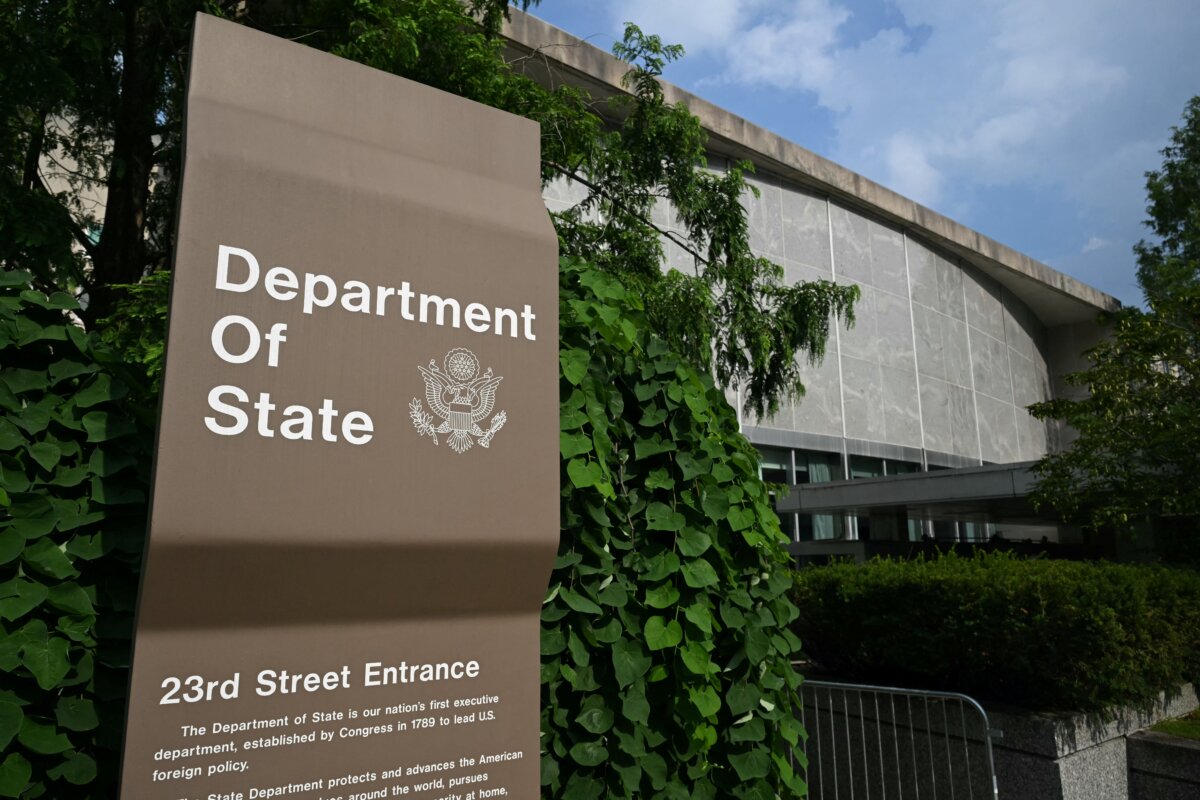

The U.S. State Department has called out the Chinese regime for intimidating and exacting reprisals against targets globally to advance its political goals.
In its long-anticipated international human rights report, published on Aug. 12, the department noted the wide-ranging ways Beijing’s campaign takes form, including assaults, harassment, hacking, anonymous threats, and bullying through proxies.
The victims of the regime’s long-arm tactics, often termed transnational repression, are also broad-based, with the report listing ethnic Uyghurs, spiritual practitioners, dissidents, foreign journalists, and Chinese students and faculty members studying outside China as common targets.
The department cited research by the Washington-based nonprofit Freedom House, which found the Chinese regime responsible for “the most comprehensive and sophisticated” transnational repression campaign in the world, at times co-opting other countries’ institutions to force targeted individuals back to China—where they’re often in danger of persecution.
One of the most prominent episodes took place during Chinese leader Xi Jinping’s visit to San Francisco for the Asian-Pacific Economic Cooperation summit in late 2023. During the multi-day event, protesters organized through Chinese foreign influence programs attacked pro-democracy activists with flagpoles and chemical spray, according to the State Department’s report.
There have been repercussions for these transnational acts of violent repression. In May, the U.S. Justice Department indicted two men for allegedly harassing and surveilling a victim by installing a tracking device on the victim’s car and slashing that person’s tires in an effort to stop the victim from protesting Xi’s trip.
The report noted the case of a former Chinese undercover agent who, after defecting to Australia, revealed his 15-year-long involvement in targeting Chinese dissidents in several countries under orders from Beijing’s secret police operating on foreign soil.
The agent, Eric, in 2024 told The Epoch Times that his handler in 2021 asked him to locate a Thailand-based Falun Gong practitioner who had fled China to escape the Chinese regime’s persecution of his faith. The handler, in assigning him the job, gave him photos showing the name and location of the target’s apartment, as well as several photos of the man and his family. The victim, Li Guixin, confirmed that one of these photos had never previously been posted on the internet.
Threats from the regime have also been experienced by the international media. In June 2024, a French reporter and a French filmmaker received threatening phone calls from a China-based number following the broadcast of their documentary about the attempted forced repatriation of a Chinese dissident, the State Department reported. According to Reporters Without Borders, an unidentified individual hacked into the journalists’ group chat on an encrypted app, sending Chinese-language messages asking them not to release the film.
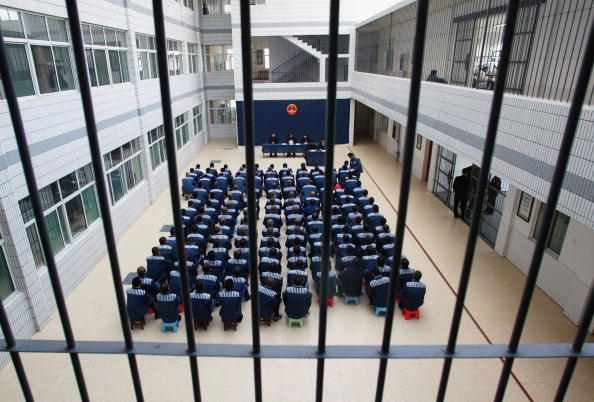
Those reporters weren’t alone in facing Chinese hacking threats. The United States has, in recent years, identified a number of Chinese state-sponsored cyber attackers such as Salt Typhoon and i-Soon—whose victims include The Epoch Times—that pilfer intelligence from Western governments, civil groups, and others deemed to suit the regime’s interests.
Incidents of transnational repression make up one major segment in the State Department report under “Security of the Person,” as well as two other sections focused on “Life” and “Liberty.”
The report also covered forced labor in China’s northwestern region of Xinjiang, where more than 1 million Uyghurs and other ethnic Muslim minorities are detained, with the regime suppressing dissident voices in their communities, with many cases of forced disappearances.
The State Department also cited the seven-year sentence given to former Chinese state media editor and columnist Dong Yuyu on espionage charges, arrests of citizens for sharing political views or facts reflecting public concerns, detention and disappearance of journalists—including Swedish publisher Gui Minhai and Australian journalist Yang Hengjun, both of Chinese descent—and acts of aggression to undermine foreign and local reporting.
The report named dozens of political prisoners: pastors, a Catholic bishop, Falun Gong practitioners, Tibetans, Uyghurs, rights lawyers, scholars, and others.
The report covers the 2024 calendar year, preceding the Trump administration. However, the text underwent revisions in March 2025, which the department said were made to improve readability and better align with the legislative and presidential mandates of the new administration. The revisions pared down the coverage of abuses based on gender identity.
Regarding the section of the report dealing with China, Nina Shea, who has served on the U.S. Commission on International Religious Freedom for more than a decade, told The Epoch Times the information only “scratches the surface of the Chinese Communist Party’s human rights atrocities and violations.”
“I understand the need not to duplicate the annual reports on religious freedom and human trafficking but that leaves a big hole in this report, since religious communities across the board are the largest CCP targets today,” she said.
Shea said the report “would benefit with stand alone sections on China’s surveillance system as a method of control and limitation on individual freedom, as well as ones on the CCP’s social credit system, ideological indoctrination measures, forced ethnic assimilation, and one on forced organ harvesting and other coerced bio- and medical interventions.”
The report should also expand sources to include the various Justice Department cases against Chinese agents and spies in the United States, who have targeted Chinese American members of religious and political groups that the regime has labelled the “five poisons” to the regime, Shea said, calling the omission a “major oversight” in the transnational repression section.
“A fuller picture is needed to accurately describe the totalitarian suppression of human rights under CCP rule today,” she said.
The China report was part of the State Department’s set of Country Reports on Human Rights Practices delivered annually to Congress.
 Friends Read Free
Copy
Facebook
Tweet
Friends Read Free
Copy
Facebook
Tweet