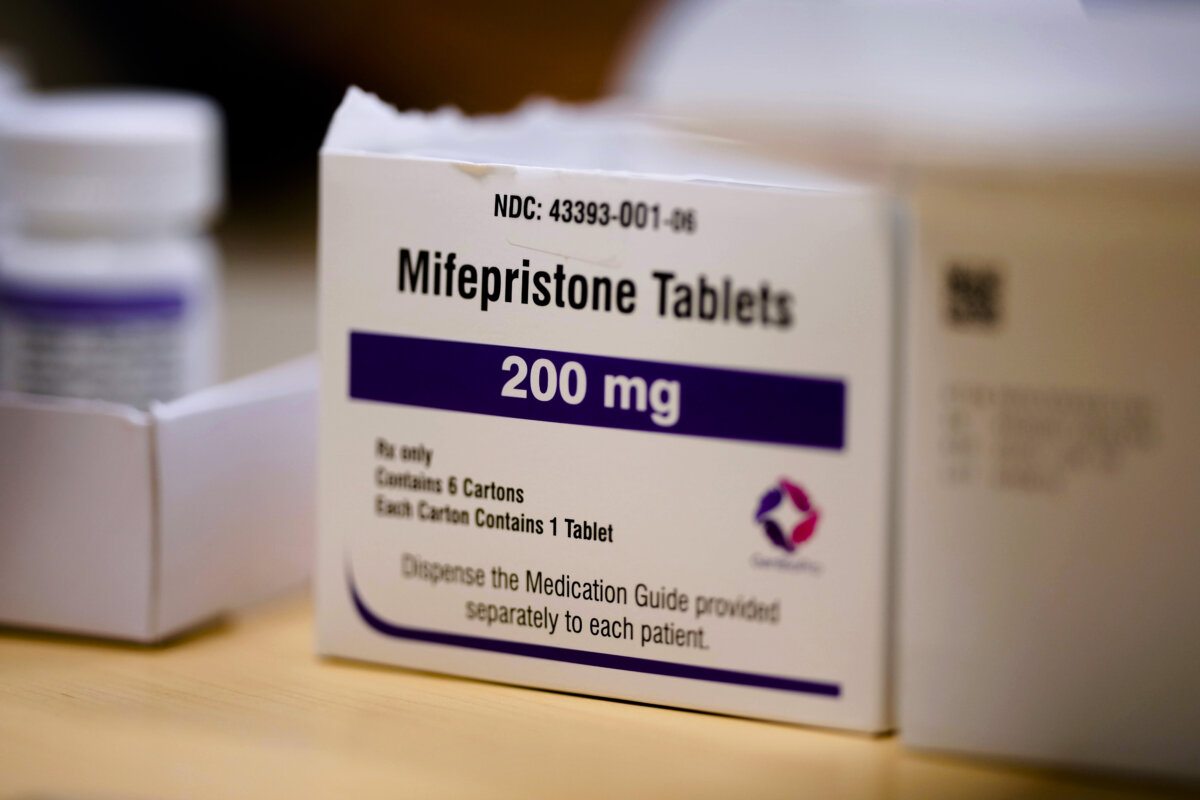

The U.S. Supreme Court on May 14 extended its order allowing a popular abortion pill to continue to be sent in the mail, after a federal appeals court ruling blocked the practice.
The new ruling states that the order allowing access to the pill by mail will remain in effect until an appeal is completed in the appeals court.
The Supreme Court did not provide reasons for its decision.
Justices Clarence Thomas and Samuel Alito dissented.
On May 4, Alito temporarily restored access to the drug mifepristone after the U.S. Court of Appeals for the Fifth Circuit halted its mailing. Alito extended his stay of the Fifth Circuit ruling on May 11, saying that his order would expire at 5 p.m. on May 14.
The new ruling came after the maker of the brand-name version of the drug, Danco Laboratories, and the maker of the generic version, GenBioPro, asked the Supreme Court to block the Fifth Circuit ruling.
A federal court previously paused the underlying lawsuit by Louisiana against the abortion pill to give federal regulators time to review its safety and effectiveness.
Whether mifepristone remains widely available depends on the ongoing Food and Drug Administration (FDA) review of the Biden administration’s 2023 decision to drop the requirement of an in-person doctor visit before the pill is dispensed, as well as Louisiana’s lawsuit and legislation pending in Congress.
Louisiana, along with pro-life activists and lawmakers, argues that the no-doctor policy puts women’s health at risk and is illegal because it was enacted without proper consideration of safety risks.
Trump administration officials have said that abortion issues should be decided by the states.
The FDA under President Donald Trump approved generic versions of the drug in 2019 and 2025.
A medication abortion generally involves mifepristone, which blocks the hormone progesterone, and misoprostol, which induces contractions.
If the state wins its lawsuit to reinstate the now-repealed requirement for an in-person doctor visit, demand for medication abortions, which now account for most abortions in the United States, could drop.
On April 7, Judge David Joseph of the U.S. District Court for the Western District of Louisiana put a hold on the litigation until further notice to give the FDA an opportunity to review safety claims about the drug.
Federal lawyers asked the court to stay the case to allow the FDA review to take its course.
In June 2024, the Supreme Court unanimously rejected a challenge to the loosening of mifepristone regulations. Before that, the Fifth Circuit found that previous FDA rules easing access to the drug were unlawful. The Supreme Court declined at that time to hear the case, ruling that the group that filed the challenge lacked standing.
In his dissent, Thomas said the applicant companies, which make the drug, “complain that the Fifth Circuit’s order would reduce profits they derive from selling mifepristone.”
“I would deny their applications because they have not satisfied their burden for securing interim relief,” he said.
Thomas added that, as Louisiana has argued, it is “a criminal offense to ship mifepristone for use in abortions.”
He cited the federal Comstock Act, a rarely used 1873 statute.
The act forbids using “the mails” to ship any “drug … for producing abortion.” The act also makes it a felony to use “any express company or other common carrier or interactive computer service” to ship “any drug … designed, adapted, or intended for producing abortion,” he said.
Because the applicants are violating the Comstock Act, they are not entitled to “a stay of an adverse court order based on lost profits from their criminal enterprise” and cannot “be irreparably harmed by a court order that makes it more difficult for them to commit crimes,” Thomas said.
Alito said in his dissent that it was “remarkable” that the court’s majority agreed to maintain the stay that allows the drug to continue to be mailed.
“What is at stake is the perpetration of a scheme to undermine our decision in Dobbs v. Jackson Women’s Health Organization (2022), which restored the right of each State to decide how to regulate abortions within its borders,” he wrote.
Although some states responded to the Dobbs ruling by making it easier to obtain an abortion, other states, such as Louisiana, made abortion unlawful except in narrow circumstances, he said.
Louisiana’s efforts, he added, have been thwarted by various medical providers, private organizations, and states “that abhor laws like Louisiana’s and seek to undermine their enforcement.”
Fatima Goss Graves, president and CEO of the National Women’s Law Center, praised the new decision.
“While today’s ruling is a relief because it means patients can continue to access mifepristone by mail or at retail pharmacies, the order is only a temporary reprieve,” she told The Epoch Times.
“Louisiana’s attempt to take away abortion access nationwide continues in the lower courts,” Graves said.
Susan B. Anthony Pro-Life America President Marjorie Dannenfelser said her group was “deeply disappointed” that the Supreme Court will not “stop the dangerous mail-order abortion drug regime.”
“State laws enacted to protect unborn children and mothers also are effectively nullified because of abortion drugs illegally flowing in through the mail, bypassing state protections for unborn babies and moms,” she told The Epoch Times.
Dannelfelser urged the Trump administration to quickly settle the underlying lawsuit and restore in-person dispensing, while proceeding with a comprehensive safety review of mifepristone.
 Friends Read Free
Copy
Facebook
Tweet
Friends Read Free
Copy
Facebook
Tweet