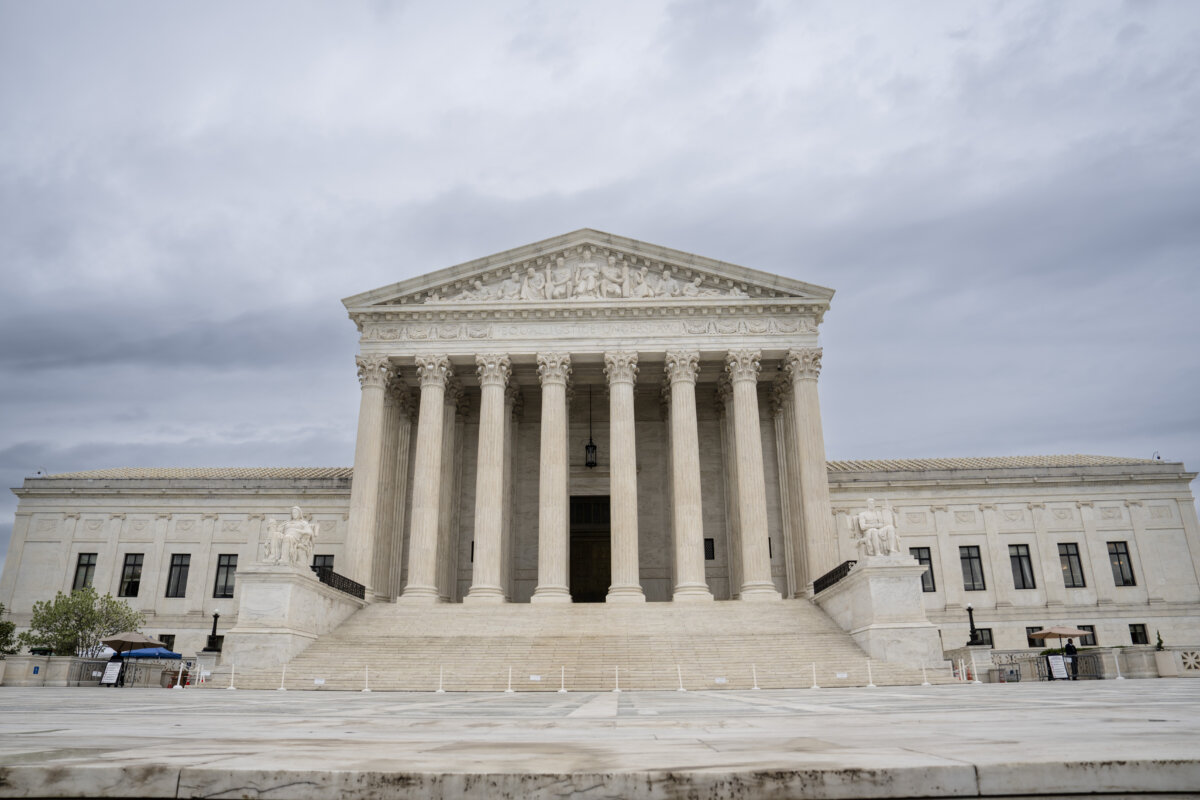

The U.S. Supreme Court on May 18 agreed to consider whether Title IX covers workplace bias claims.
The nation’s highest court is expected to consider whether Title IX creates a private right of action for employees of federally funded educational institutions to sue for sex discrimination in employment.
Title IX of the federal Education Amendments Act of 1972 is a civil rights law that forbids discrimination “on the basis of sex” at any school that receives federal funding.
The justices may also look at the interplay between Title IX and another federal statute, Title VII of the federal Civil Rights Act of 1964, which allows employees to sue over sex-based discrimination.
Until now, the Supreme Court has not allowed college employees to use Title IX for sex-bias claims. In 1979, the court held that Title IX may be privately enforced by “victims of discrimination” through an implied right of action. In 2005, it found that employees of federally funded educational institutions may use this implied private right of action to pursue claims for workplace retaliation.
The decision to hear the case took the form of an unsigned order in Crowther v. Board of Regents of the University System of Georgia. No justices dissented. The court did not explain its decision.
Petitioners Thomas Crowther and MaChelle Joseph sued the university system.
Crowther was an art professor on the faculty of Augusta University from 2006 until he was let go in 2021. He received positive peer reviews, annual evaluations, and student feedback, which led to him being promoted to senior lecturer in February 2020, according to the joint petition.
At about that time, several students filed reports accusing Crowther of inappropriate behavior in class, including sexual harassment, which led to a Title IX probe. In April 2020, he was given “a sharply negative performance evaluation—his first in nearly 15 years.” He was given the choice of resigning or of having termination proceedings initiated against him.
Although Augusta declined to identify his accusers, Crowther gathered statements from about 25 current and former students and others, which he said refuted the allegations against him. The investigation concluded without a hearing in July 2020, finding that he had violated the school’s sexual harassment policy and sentencing him to a one-semester suspension. While an internal appeal was ongoing, the school reassigned him and advised that his faculty contract not be extended into the 2021–2022 academic year, the petition states.
The appeal was eventually denied and he filed a complaint with the federal district court, arguing that his firing was illegal sex discrimination that violated Title IX. The university system moved to dismiss, arguing that Title IX employment discrimination claims were preempted, or blocked, by Title VII of the federal Civil Rights Act of 1964.
The district court sided with Crowther, finding that Title VII did not block Title IX employment claims.
Joseph was a successful basketball coach at the Georgia Institute of Technology from 2003 until she was fired in 2019 as head coach of the women’s basketball team. She had grown concerned about “what she perceived as persistent disparities in the resources provided to her and her program compared to the men’s program,” and expressed these concerns over several years, according to the petition.
After she filed an internal complaint in early 2019 claiming that the school was discriminating against her and her program, school officials began investigating her and she was placed on administrative leave. Their report states that players and staff cited positive experiences with her but that others expressed concerns over a culture of high-pressure coaching. She was given an opportunity to respond and was fired on March 26 of that year.
She sued in district court, claiming sex discrimination under Title IX, Title VII, and a Georgia whistleblower law. The court dismissed her case, finding that Title IX does not permit a private cause of action for employees claiming sex-based discrimination at work. A cause of action is a set of facts that provides a legal basis for suing someone.
The U.S. Court of Appeals for the 11th Circuit consolidated the two cases and affirmed both dismissals. The court acknowledged that regional courts of appeals are divided on whether Title VII forecloses a private remedy for employees under Title IX, but ruled that Title IX does not allow such a private remedy.
The petitioners urged the Supreme Court to take up the case, saying that the 11th Circuit’s ruling violates Supreme Court precedent and that the high court should resolve the disagreement among the courts of appeal.
The 11th Circuit’s decision usurped the policy-making function of Congress and left open “the potential for plaintiffs to be completely deprived of a remedy,” they said in the petition.
They also said they would like to be able to sue under Title IX because Title VII “erects several procedural roadblocks for plaintiffs” that are not present in Title IX, such as “an exhaustion requirement and a tighter statute of limitations.” The exhaustion doctrine holds that a plaintiff must exhaust all possible administrative remedies before seeking judicial review.
They said Title IX also allows them to sue for unlimited compensatory damages, whereas Title VII imposes “tight limits” on such damages.
The university system had asked the Supreme Court to decline the case, saying that the 11th Circuit’s decision was correct.
“There is no [circuit court] split at all on the question presented in this case—whether employees of a state school can sue under Title IX for employment discrimination claims already governed by Title VII,” it said in a brief.
The brief states that Title IX does not provide for a private right of action for employment cases. The federal laws involved in the case “have been around a long time,” and if Congress had wanted to cover employees of educational institutions, it could have done so, but it did not.
U.S. Solicitor General D. John Sauer weighed in during the briefing process.
He said in a brief that Title IX does not confer a private right of action on employees at federally funded schools and that the 11th Circuit ruled “correctly.”
However, Sauer acknowledged that that decision conflicts with those by other circuit courts, and urged the Supreme Court to take up the case to resolve that “conflict on an important question of federal law.”
The Supreme Court is expected to hold an oral argument in the case in its new term that begins in October.
 Friends Read Free
Copy
Facebook
Tweet
Friends Read Free
Copy
Facebook
Tweet