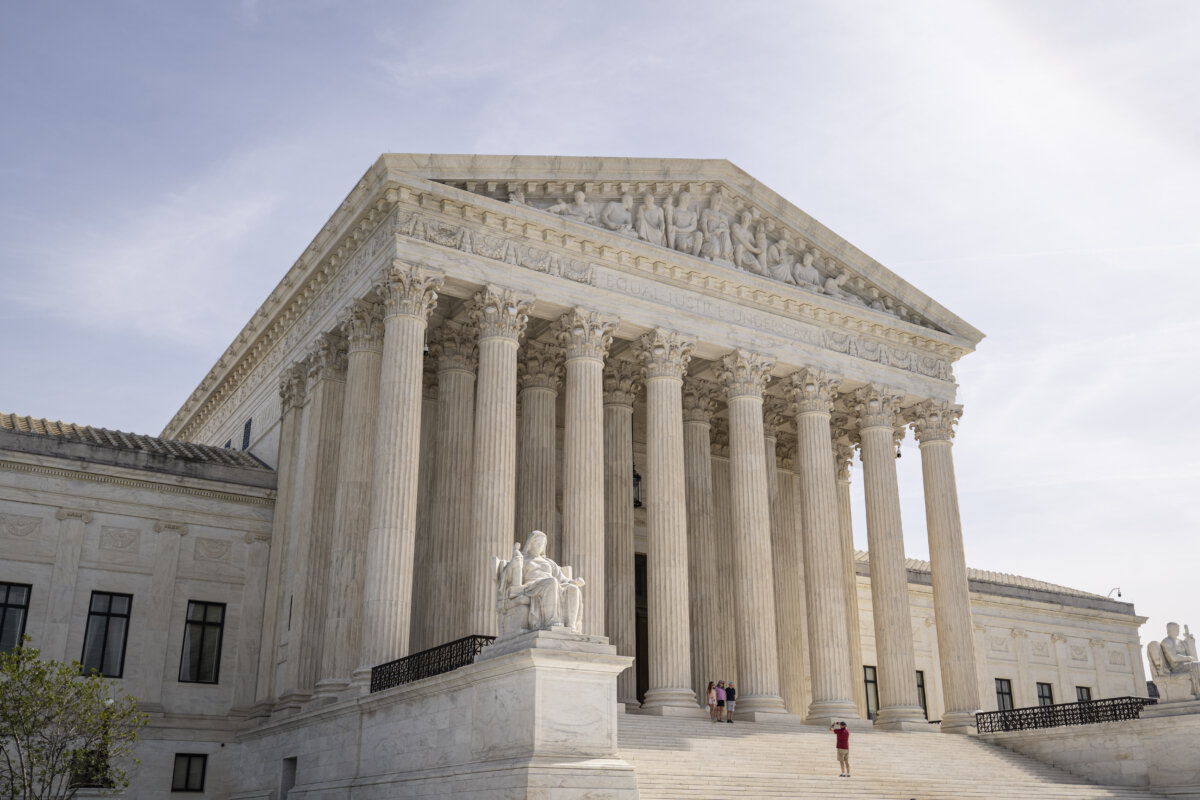

The Supreme Court on Oct. 14 heard arguments in a case testing whether a nearly 40-year-old privacy law that bars disclosure of video rental histories applies when a website shares a user’s viewing data with Facebook.
The justices considered whether Michael Salazar, a free newsletter subscriber who watched videos on Paramount-owned 247Sports.com, qualifies as a “consumer” under the 1988 Video Privacy Protection Act (VPPA). Since the law was enacted, consumer rentals of physical videotapes have all but disappeared, but courts are divided over how far the statute reaches in the digital era.
Salazar alleges the site transmitted his Facebook ID and video-viewing history to Facebook without obtaining his consent.
Several justices raised concerns about applying the law to modern data-sharing practices, while others indicated that the statutory text supports a broader reading that would cover Salazar’s claim.
The Second and Seventh Circuits have held that a person can become a “consumer” by subscribing to any goods or services from a video tape service provider, while the Sixth and D.C. Circuits have required the goods or services to be audiovisual in nature.
Salazar alleged that Paramount, which owns 247Sports.com, violated the VPPA by handing over his personally identifiable information to Facebook without his consent.
Salazar accepted a free digital subscription to 247Sports.com by registering for its online newsletter and viewing 247Sports videos while logged into Facebook. He alleges that Facebook and Paramount used his information to target him with advertising.
The law at issue has its origins in a 1987 controversy involving Supreme Court nominee Robert Bork. Congress passed the law after a newspaper leaked the video rental history of President Ronald Reagan’s then-nominee in an effort to discredit him, according to the petition.
The act forbids a “videotape service provider” from knowingly disclosing “personally identifiable information concerning any consumer of such provider.” Its definition of “consumer” includes a “subscriber of goods or services from a videotape service provider.”
Lower courts assumed that Paramount was a “videotape service provider.” Paramount asked a federal district court in Tennessee to dismiss the lawsuit, arguing that Salazar was not a consumer as defined by the act.
The district court granted the motion with prejudice, meaning that Salazar was barred from refiling the lawsuit. It held that to be a consumer under the act, Salazar would have to show that he “accessed audiovisual content through the newsletter.”
Salazar appealed, but before the U.S. Court of Appeals for the Sixth Circuit could rule, two other circuit courts held that subscribing to a newsletter from a videotape service provider makes a user a consumer under the VPPA.
After that, a divided Sixth Circuit panel reached a different conclusion, ruling against Salazar in his lawsuit against Paramount.
The panel found that even though Salazar subscribed to Paramount’s newsletter, the law concerns only “goods or services provided by a company when it is acting as a ‘videotape service provider’—[providing] ‘audiovisual materials.’”
The panel held that the statute treats someone as a consumer “only when he subscribes to ‘goods or services’ in the nature of ‘video cassette tapes or similar audio visual materials’” and that the Paramount newsletter did not meet this legal test.
During the Oct. 14 oral argument, Salazar’s attorney, Joshua Hammack, said the wording of the VPPA is clear.
Congress employed audiovisual language when it wanted to limit the application of language in the statute to video content, he said, such as when it provided a definition of “video tape service provider” and “personally identifiable information.”
Hammack said Congress did not use audiovisual language when it defined “consumer,” which the law said covers “any renter, purchaser, or subscriber of goods or services from a video tape service provider.” This omission is relevant because when Congress wanted an audiovisual restriction, it included one, but it did not do so when defining consumer, he said.
A newsletter subscriber therefore qualifies as a consumer under the VPPA, the lawyer argued. Paramount could have sought consent from Salazar, but the company chose not to do so, he said.
Paramount attorney Paul Clement said reading the VPPA broadly would change a narrow, 1980s video rental privacy law into a wide-ranging regulation of ordinary internet data sharing for targeted ads, which would jeopardize free content business models and possibly lead to liability exposure, he said.
Justice Samuel Alito focused on the age of the VPPA and the technology covered by it, questioning whether literally interpreting the phrase “video tape service provider” and “similar audiovisual materials” makes sense nowadays. He told Hammack that Congress passed a law based on 1980s technology, and asked whether Paramount is a provider “in the literal sense of the term” when it is not selling video tapes.
Alito presented a hypothetical to show whether the word “from” in the consumer definition really imposes a limit. He asked Hammack if a person who purchases gasoline from Costco could claim to have bought it “from a provider of optical services” just because the wholesale outlet also sells eyeglasses—an argument he suggested would be “playing games.”
Justice Brett Kavanaugh told Hammack he was concerned about “repurposing” a public disclosure law about what individuals view into one that governs data sharing for targeted online advertising.
“Those are very different things,” Kavanaugh said.
Justice Clarence Thomas suggested it would be “natural to think that goods and services from a video tape service provider would be video-related services.” Hammack disagreed, pointing to differences in the statutory definitions.
Justice Elena Kagan told Clement the court should follow “the definitions where they lead,” saying other definitions contain an audiovisual modifier while the consumer definition does not.
Kagan said the problem could be dealt with in the future by getting users’ consent.
“Easy enough,” she said. “People do it every day. And the other is to stop selling people’s private information.”
The Supreme Court is expected to rule on the case by June or July of 2027.
 Friends Read Free
Copy
Facebook
Tweet
Friends Read Free
Copy
Facebook
Tweet