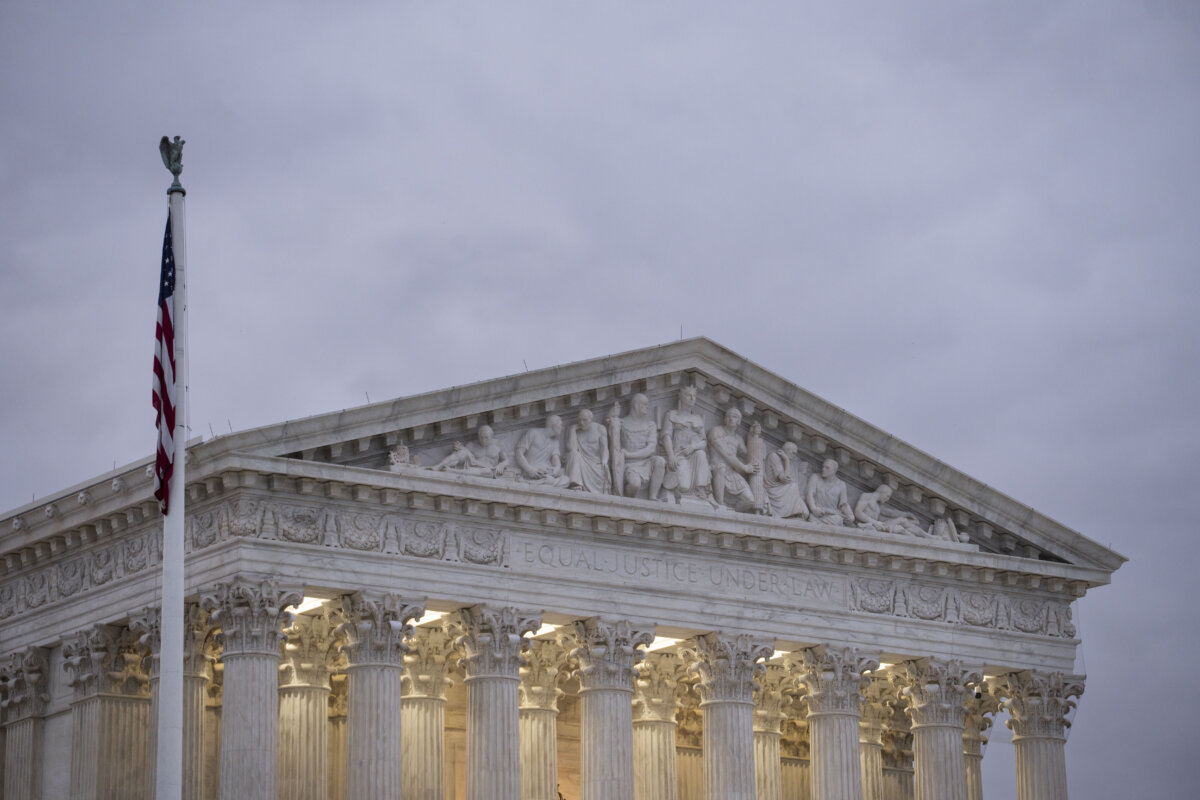

The U.S. Supreme Court on June 15 dismissed a firearms industry group’s challenge to a New York law that allows lawsuits against industry participants for alleged harms caused by their products.
The high court’s new decision took the form of an unsigned order dismissing an industry petition. No justices dissented. The court did not explain its decision.
The petition was filed by the lead petitioner, National Shooting Sports Foundation Inc., along with gun makers such as Beretta U.S.A. Corp., Glock Inc., Sig Sauer, and Smith & Wesson Inc.
The petitioners filed a legal challenge to Section 898 of the New York General Business Law, which in 2021 created a cause of action allowing the state and others to sue gun manufacturers, sellers, and distributors for harms caused by the “unlawful” marketing, sale, or misuse of firearms. This is what lawyers call a facial challenge, meaning the petitioners were arguing that the state law was invalid as written, as opposed to an as-applied challenge, which argues a law is invalid in specific situations.
The state law requires the firearms industry to take reasonable precautions to prevent gun trafficking, theft, and the use of so-called straw purchases in which guns are bought for someone else.
The petitioners argued the state statute was barred by the federal Protection of Lawful Commerce in Arms Act (PLCAA) of 2005, which was enacted to protect the gun industry from frivolous lawsuits.
The law generally protects firearms companies from lawsuits based on criminals misusing their products, but it contains an exception. Specifically, the law allows companies to face lawsuits if they knowingly violated state or federal law and if that violation was a proximate cause of a given harm.
In June 2025, the Supreme Court unanimously ruled that gun companies should not face a lawsuit in which the Mexican government was trying to hold them liable for cartel-related violence in Mexico involving firearms from the United States.
The high court said that the allegations gun companies faced weren’t the type that, if proven, would make them liable under the PLCAA.
Justice Elena Kagan, who authored the court’s 9–0 opinion, said that Mexico’s lawsuit did not make a plausible case that the gun companies “aided and abetted unlawful sales routing guns to Mexican drug cartels.”
In the case at hand, the petitioners sought a preliminary injunction, saying that the state law was preempted, or superseded by federal law, void for vagueness, and violated the U.S. Constitution’s Commerce Clause, according to the petition.
The state moved to dismiss the lawsuit, and a federal district court granted the motion.
The U.S. Court of Appeals for the Second Circuit affirmed, finding the petitioners had failed to show that the state law could not be “constitutionally applied to anyone in any situation.”
The appeals court said that Congress enacted the PLCAA to prevent state and local governments from imposing “attenuated theories of civil liability [on] the gun industry,” and that the New York law allows state and local governments to impose “precisely the type of civil liability action proscribed by PLCAA.”
The court also said the state law was an exception to the PLCAA in that it allows plaintiffs to hold the firearms industry liable for possible misconduct in sales or marketing, as opposed to crimes committed by an end user, the petition said.
The National Shooting Sports Foundation was disappointed that the Supreme Court decided not to accept its appeal.
“NSSF sincerely believes that those criminals who illegally misuse lawful products should be held responsible for the harms they cause when they commit their crimes,” foundation spokesman Mark Oliva said.
“Holding the firearm industry responsible for the criminal misuse of a firearms is akin to holding Anheuser-Bush and Ford Motor Company responsible for damages from drunk-driving crimes.”
New York Attorney General Letitia James, who defended the law in court, and New York Gov. Kathy Hochul, hailed the Supreme Court’s decision to leave the Second Circuit ruling intact as “a massive victory” in the effort to combat gun-related crimes.
“The gun lobby fought tooth and nail against this first-in-the-nation law,” the governor said. “New York will not allow gun manufacturers to profit from tragedy.”
Sam Dorman and Reuters contributed to this report.
 Friends Read Free
Copy
Facebook
Tweet
Friends Read Free
Copy
Facebook
Tweet