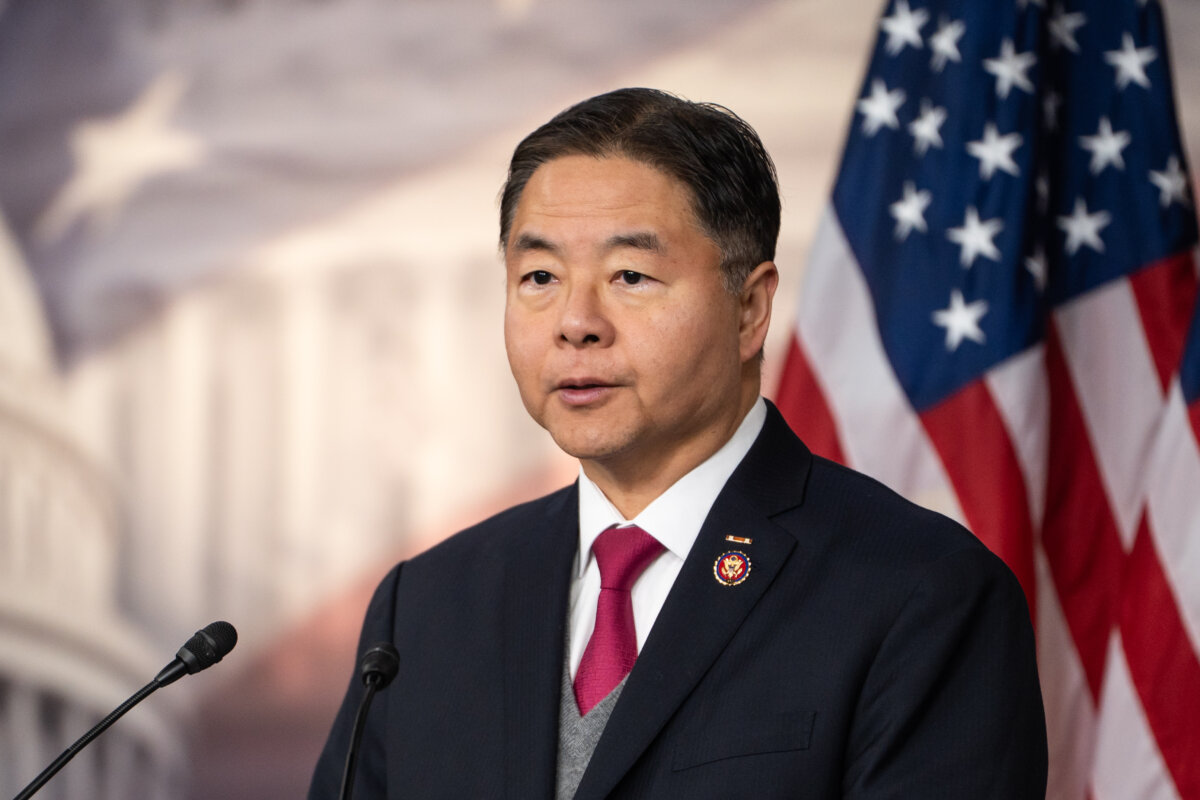

Two senior House Democratic leaders said Wednesday that the party will pursue major judicial reforms, including to the U.S. Supreme Court, if it retakes the majority in November. The two leaders linked the proposals to recent Court rulings and the mid-decade redistricting fight now underway across the country.
Rep. Ted Lieu (D-Calif.), vice chair of the House Democratic Caucus, said at a press conference Wednesday morning that recent Court rulings have made reform necessary and accused the Supreme Court of favoring the Republicans.
“It’s going to usher in massive Supreme Court reform when Democrats take control,” Lieu said. He then accused the court of being “the most partisan” in U.S. history, and said he believed it was being led by Chief Justice John Roberts, whom he criticized as an “extreme political actor.”
House Minority Leader Hakeem Jeffries (D-N.Y.) echoed the call, presenting his version more broadly around judicial reform at a separate press conference about an hour later, alongside electoral reform and campaign finance reform as priorities for Democrats if they win back the House.
“In addition to focusing on the economy, focusing on making life better for the American people and focusing on driving down the high cost of living, we need massive electoral reform, massive campaign finance reform, and massive judicial reform,” Jeffries said. “And that will also be an important part of what we’ll need to do, as Democrats in the majority, on behalf of the American people, in the next Congress.”
In his call for reform, he did not specifically mention the U.S. Supreme Court in the way that Lieu did, but said earlier in the press conference that “It’s not as if we have great faith in the fairness of the United States Supreme Court, but will let the process play itself out,” when discussing recent redistricting cases.
Neither leader specified what changes they would seek. Past Democratic proposals have ranged from expanding the number of justices to imposing term limits, creating a binding code of ethics, or stripping the Court of jurisdiction in certain cases.
In July 2024, President Joe Biden (D) formally endorsed three changes: an enforceable code of ethics for the justices, an 18-year term limit, and a constitutional amendment limiting a Court ruling that granted presidents broad immunity from criminal prosecution for official acts.
Biden had previously resisted such proposals and formed a 2021 commission that did not recommend structural changes to the Court. None of his 2024 proposals advanced in Congress.
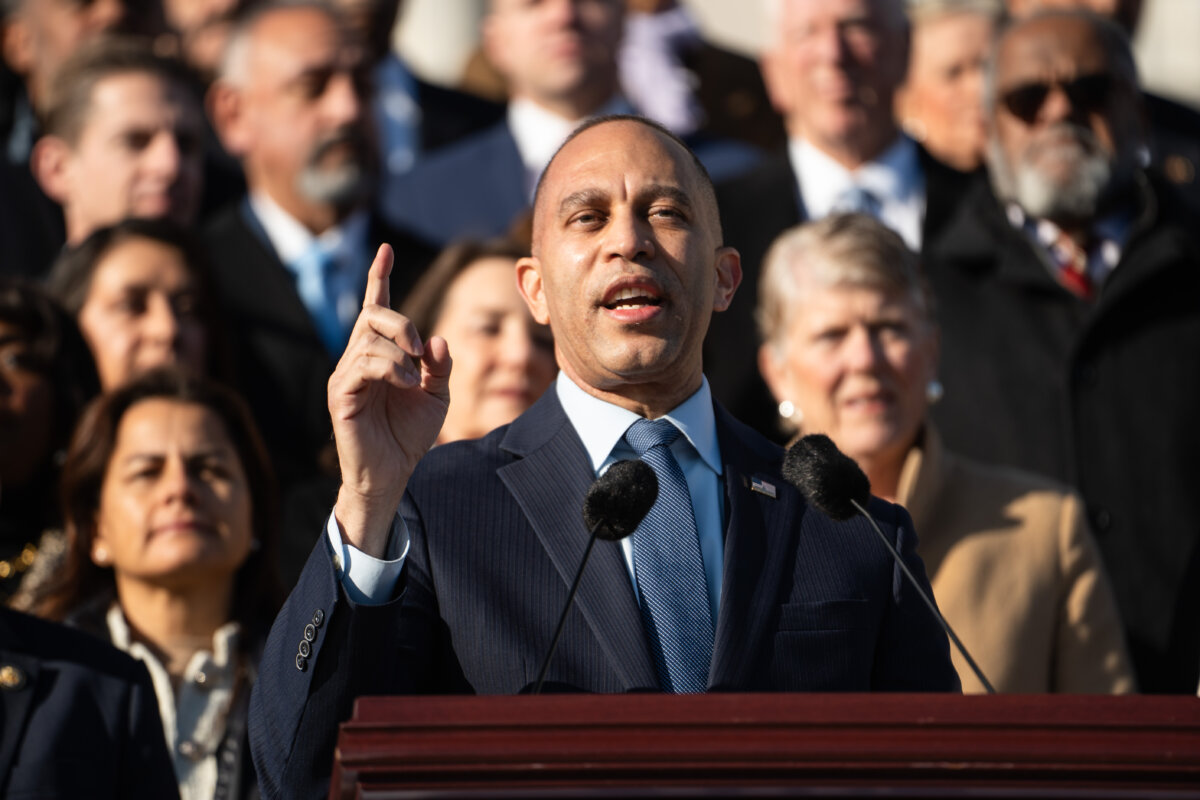 House Minority Leader Hakeem Jeffries (D-N.Y.) and other members of the House Democratic Caucus speak during a press conference outside the U.S. Capitol building in Washington on Dec. 18, 2025. (Madalina Kilroy/The Epoch Times)
Redistricting Battle
The calls on Wednesday came as Democrats lost ground in the mid-decade redistricting battle that began last year after Texas redrew its congressional maps with President Donald Trump’s backing. Other states soon followed, with the largest such Democratic gains occurring from redistricting in California.
As part of his case for reform, Lieu cited the U.S. Supreme Court’s recent ruling in Louisiana v. Callais, which limited the use of race in drawing congressional districts. Lieu argued the decision will “gut” the Voting Rights Act.
In the Callais ruling, a majority of the court said that race may not be the predominant, overriding reason for how congressional district lines are drawn. The case focused on Louisiana’s decision to add a majority-black district after a lower court said omitting the district would violate the Voting Rights Act.
That law generally prohibits race-based discrimination in voting practices. The Supreme Court ruled on April 29 that lower courts had been misapplying the non-discrimination provisions of the federal Voting Rights Act by requiring states “to engage in the very race-based discrimination that the Constitution forbids.”
The court’s decision has prompted several Southern states, including Tennessee, to redraw their congressional maps for the 2026 election.
The mid-decade redistricting battle has so far created 14 House seats that Republicans believe they could win and six that could favor Democrats. That would translate to a potential eight-seat Republican advantage in the November midterms, not counting pending map changes in Alabama, Louisiana, and South Carolina.
Republicans have hailed the Supreme Court ruling. Tennessee House Speaker Cameron Sexton said on May 6 that the court had “opined that redistricting, like the judicial system, should be color-blind.” He said the court had also indicated that “states can redistrict based off partisan politics” as the state began redrawing its districts.
Jeffries was also asked on Wednesday about a recent call he held with members of the Virginia congressional delegation after the state’s redistricting referendum was struck down by that state’s court on Friday.
A New York Times report, citing an anonymous source, claimed that he and the state lawmakers discussed a proposal to “replace the entire state Supreme Court, with a goal of reinstating their gerrymandered map.” Jeffries confirmed the call but declined to discuss what was said.
“The conversation that I had with members of the Virginia congressional delegation will remain a private conversation with members of the Virginia congressional delegation,” Jeffries said.
He added that “the consensus on the call was [Democrats are] going to win 2 or 3 seats, regardless of whether the current Virginia Supreme Court decision holds.”
Matthew Vadum contributed to this report.
 Friends Read Free
Copy
Facebook
Tweet
Friends Read Free
Copy
Facebook
Tweet