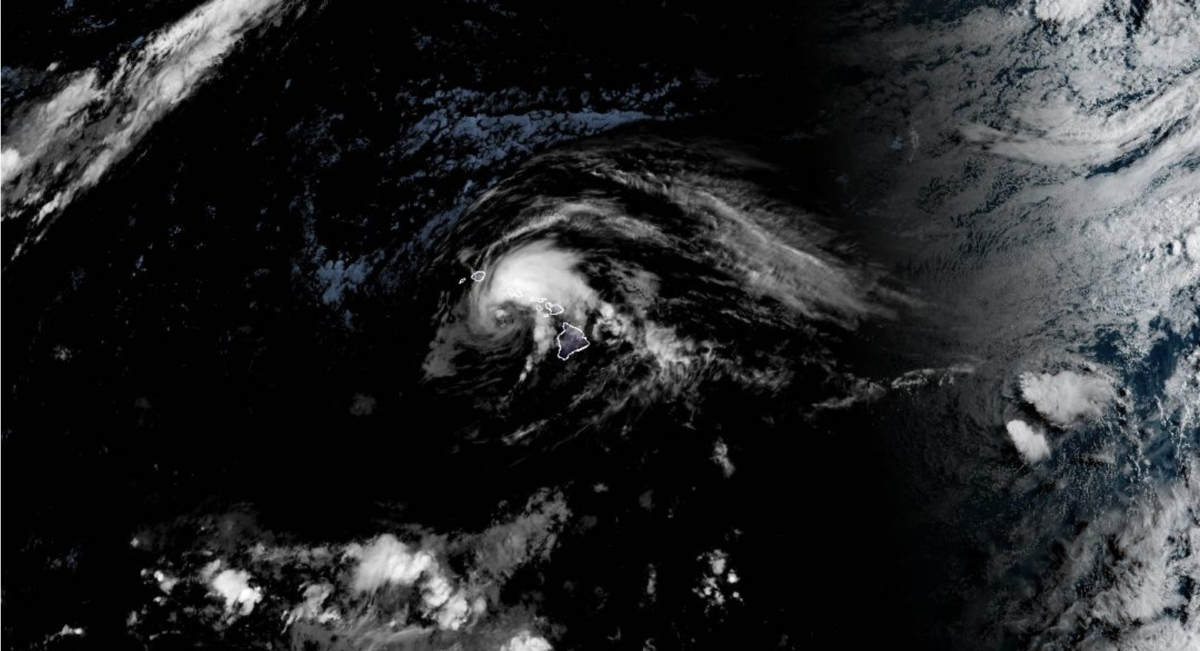

The Big Island of Hawaii and the island of Maui continue to suffer intense levels of wind and rain, raising the risk of catastrophic flooding as Tropical Storm Lala continues along the archipelago and closes in on Oahu and the state’s capital, Honolulu.
Hawaiian Electric reported that more than 57,000 customers across the Big Island have been impacted by the storm, as well as nearly 28,000 customers across Maui County.
The islands began to feel the storm’s effects at around 3 p.m. local time on Aug. 15, which became increasingly intense as Lala reached hurricane strength. Its center remained just 30 miles offshore, with the National Hurricane Center reporting that the eyewall was brushing the southern end of the Big Island around 5 p.m. Hawaii Time.
As Lala’s eye remained south of land, its storm bands covered the islands. Maximum sustained winds reached 80 mph and extended 45 miles out from the storm’s center. Areas closer to sea level, or only a few hundred feet high in elevation, recorded sustained winds mostly around or just under the hurricane marker, 73 mph, but at altitude, conditions were far worse.
“Tropical storm conditions continue across portions of the Big Island of Hawaii and Maui County, with the strongest winds occurring in areas of higher terrain,” the National Hurricane Center said. “Tropical storm conditions will spread across Oahu this morning and Kauai County later today. Wind speeds atop mountains and on the windward and leeward slopes are often up to 30 percent stronger than the near-surface winds indicated in this advisory, and in some elevated locations could be even greater.”
The Big Island’s most dominant volcano, Mauna Kea, recorded winds reaching 119 mph.
During the night, interactions with the Big Island and its big volcanoes slowed the storm down but also weakened it to a tropical storm. Still, by 5 a.m. on Aug. 16, local time, tropical storm-force winds stretched out 140 miles from the storm’s center.
Rainfall across the Big Island was forecast to be in excess of 35 inches. Meanwhile, Maui was expected to get up to a foot of rain on the eastern side and up to eight inches on the western side.
Those rains overwhelmed rivers and thundered down the mountainous terrain, triggering flash floods in the middle of the night that swept away entire homes, according to one meteorologist.
Hawaii’s Department of Emergency Management triggered flash flood warnings for the Islands of Maui, Molokai, Lanai, Oahu, Kauai, Niihau, and Kaho’olawe in the early hours of Aug. 16, local time.
As of Aug. 15, one person has been confirmed dead. According to Hawaii Gov. Josh Green, a man died in a car accident around the South Point of the Big Island. Search and rescue teams have been dispatched in response to reports of flash floods.
Looking ahead, Tropical Storm Lala is expected to remain offshore, which means Hurricane Iniki will remain the last hurricane to make landfall on Hawaii, touching down on Kauai in 1992.
 Friends Read Free
Copy
Facebook
Tweet
Friends Read Free
Copy
Facebook
Tweet