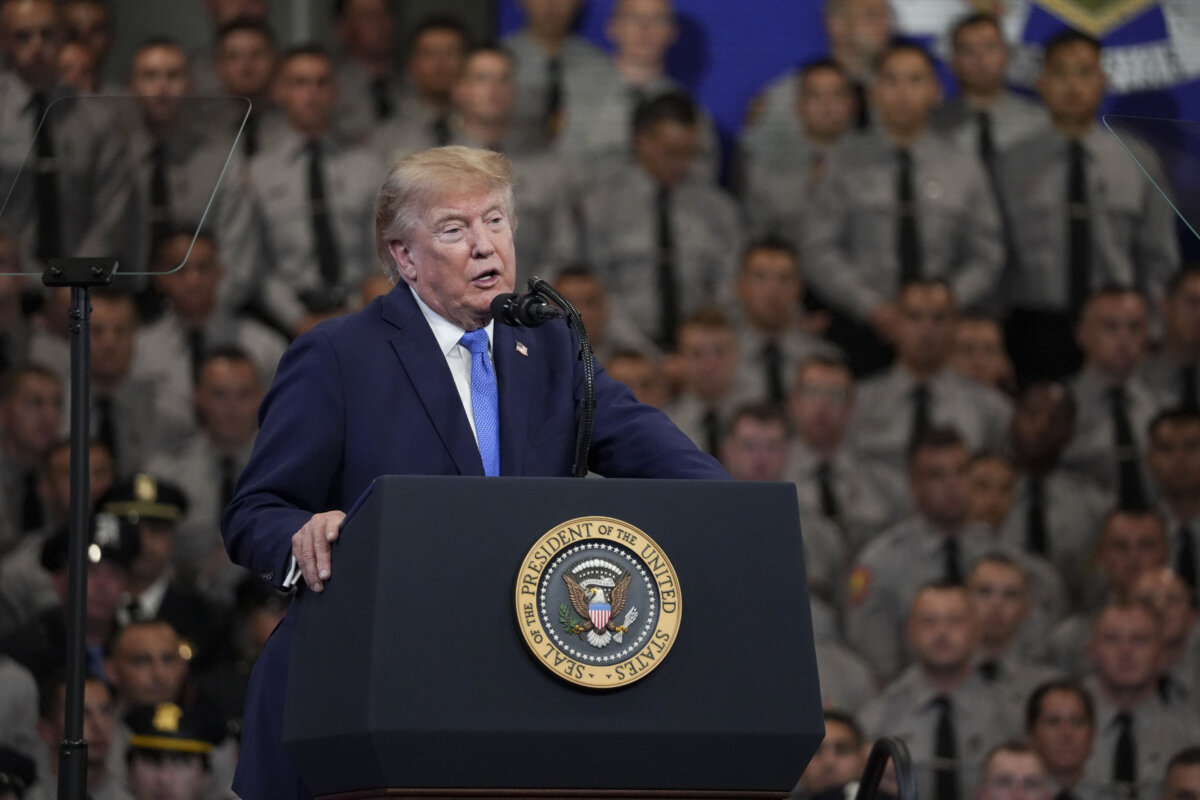

President Donald Trump announced on Friday his intention to declare the Strait of Hormuz a U.S. territory, introducing a new position regarding the strategically vital waterway at the center of the ongoing conflict with Iran.
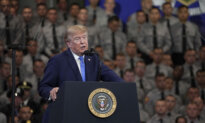
Speaking at a rally in Long Island, New York, Trump said the declaration would come after U.S. forces have defeated the Iranian regime.
“After we finish defeating Iran, which is being very badly defeated, pretty soon I’ll be declaring the Hormuz Strait a territory of the United States,” Trump said.
His remarks came two days after he said the United States has “total control” over the strait.
“I think we will keep it,” he wrote on his Truth Social platform in all capital letters.
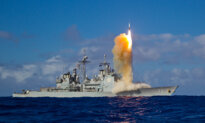
“Our Naval Blockade is being called, by everyone, ‘A WALL OF STEEL,’ and there is nothing Iran can do about it.”
At Friday’s rally, Trump also defended the U.S. military campaign against the Islamic regime, stating that Washington “cannot let Iran have a nuclear weapon.”
“It’s the number one state sponsor of terror in the world,” Trump said, noting that Americans are paying “a tiny little bit more for [their] gasoline” so that “a very evil country” doesn’t obtain a nuclear weapon.
The Strait of Hormuz remains a critical chokepoint in the conflict. Nearly 20 percent of the world’s oil and liquefied natural gas passes through the strait to reach global markets.
Since the war with Iran began in February, the strait has experienced severe disruptions. The Iranian regime has targeted commercial vessels in the waterway, creating significant uncertainty for the oil and gas markets.
The disruptions have sent pump prices higher worldwide. As of Aug. 14, the average price for a gallon of gasoline in the United States was $4.08, according to the American Automobile Association, up from $2.98 before the conflict started in late February.
Tehran considers the strait part of its territorial waters. However, under international law, the strait is an international waterway, and all ships have the right and freedom to pass through it.
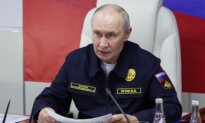
Iran has recently sought to charge tolls on ships passing through the strait. It has also threatened to keep the strait closed until the United States agreed to comply with a list of six demands, which include ending its strikes, stopping its naval blockade, and lifting sanctions.
The Trump administration signaled in recent days that it intends to increase economic pressure on Iran.
Treasury Secretary Scott Bessent told Newsmax on Aug. 13 that the United States planned to pursue “economic isolation” of the country.
“We went from Epic Fury to Economic Fury. And at the president’s orders, we have raised the level even again,” he said in the interview.
“And watch this space for more announcements coming next week because we are going to apply measures like have never been seen in the history of the economic isolation of a country.”
Bessent said the measures will combine increased economic pressure with continued naval restrictions that prevent anything from entering or leaving Iran.
Jacki Thrapp and Aldgra Fredly contributed to this report.
 Friends Read Free
Copy
Facebook
Tweet
Friends Read Free
Copy
Facebook
Tweet