
The Department of War has signed new framework agreements to expand production of critical hardware for ballistic missile interceptors, the latest step in a broader push to ramp up the nation’s munitions manufacturing capacity.
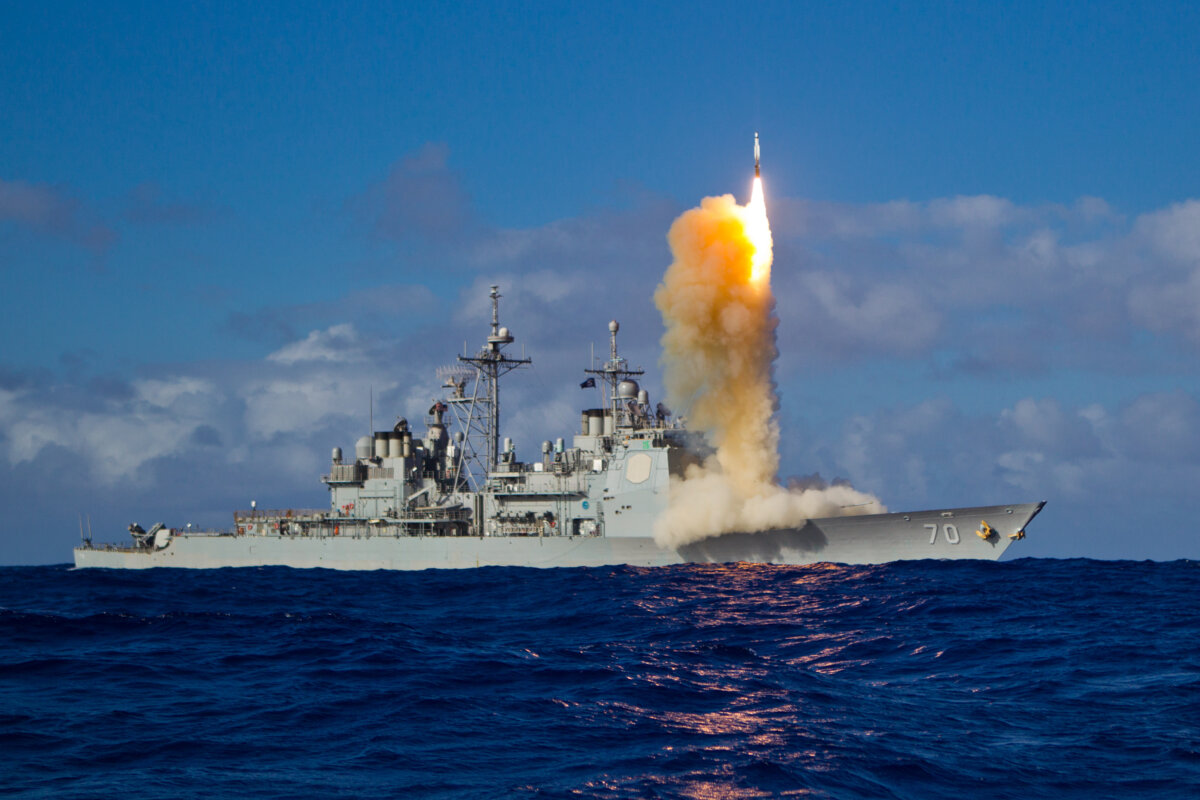
The agreements, announced on Aug. 14 with Boeing and Raytheon—now a division of RTX Corp.—call for increased production of components for the Standard Missile-3 Block IB and Block IIA interceptors.
The SM-3 Block IB is designed to intercept short- to intermediate-range ballistic missiles, while the more advanced Block IIA features larger rocket motors and an enhanced kinetic warhead, allowing it to engage threats faster and defend a wider area.
Both interceptors can be launched from Navy warships equipped with the Aegis Ballistic Missile Defense System and are a key part of the U.S. sea-based ballistic missile defense network.
“These agreements ensure our warfighters get the munitions they need to win,” Michael P. Duffey, undersecretary of war for acquisition and sustainment, said in a statement.
“We are stabilizing our supply chains, expanding munitions production and putting our entire defense industrial base on a wartime footing.”
The three parties plan to begin ramping up production while negotiating a multiyear award under the framework agreements, according to Boeing.
The company did not disclose the expected value of the eventual award or specific production targets.
The announcement came just days after Raytheon received a separate $745 million contract for production and sustainment of SM-3 Block IIA interceptors.
Broader Push to Ramp Up Missile Production
The SM-3 agreements are the latest in a series of deals aimed at expanding the U.S. defense industrial base, particularly production of air and missile defense systems.
On Aug. 3, the War Department announced framework agreements with Northrop Grumman and Lockheed Martin intended to help triple production capacity for Patriot Advanced Capability-3 (PAC-3) Missile Segment Enhancement components and quadruple production capacity for components used in Terminal High Altitude Area Defense (THAAD) interceptors.
The Pentagon has also been investing in newer forms of missile defense.
In July, it awarded two Joint Laser Weapon System agreements to nLIGHT Defense and Lockheed Martin Aculight to develop high-energy laser systems capable of countering cruise missiles and unmanned aerial systems.
The agreements have an initial value of $86 million and a total program ceiling of $847 million.
Also in July, the Space Development Agency awarded L3Harris Technologies and Sierra Space agreements totaling approximately $1.75 billion to build 36 missile-warning and tracking satellites for the Space Force as part of the Pentagon’s expanding space-based missile defense architecture.
The War Department said these agreements were enabled by its Acquisition Transformation Strategy, an initiative launched under Secretary of War Pete Hegseth to accelerate weapons procurement by cutting bureaucratic red tape, working more directly with suppliers, and giving companies longer-term demand signals needed to invest in additional production capacity.
Administration Seeks Major Defense Spending Boost
The production push comes as the Trump administration seeks a dramatic increase in military spending.
President Donald Trump’s fiscal year 2027 budget proposes $1.5 trillion in defense resources, including $1.15 trillion in discretionary funding and $350 billion in mandatory funding.
The War Department has described it as the largest defense budget request in U.S. history.
The proposal places a heavy emphasis on weapons procurement and modernization.
War Department officials said roughly 52 percent of the requested funding would go toward buying and developing munitions, aircraft, ships, and other weapons systems.
The administration is also seeking an $87.6 billion supplemental funding package for fiscal year 2026, of which $67.1 billion would go to the War Department.
In July, Hegseth told the Senate Appropriations Committee that $40 billion of the supplemental request would be used to expand production lines and accelerate deliveries of high-demand munitions, including solid rocket motors, hypersonic weapons, and counter-drone systems.
The secretary said the additional funding is necessary to replace equipment consumed during recent military campaigns and prevent readiness shortfalls.
“Rather than trying to play catch-up and make sure we’re not losing training, we should be ahead of that curve,” Hegseth told lawmakers.
 Friends Read Free
Copy
Facebook
Tweet
Friends Read Free
Copy
Facebook
Tweet