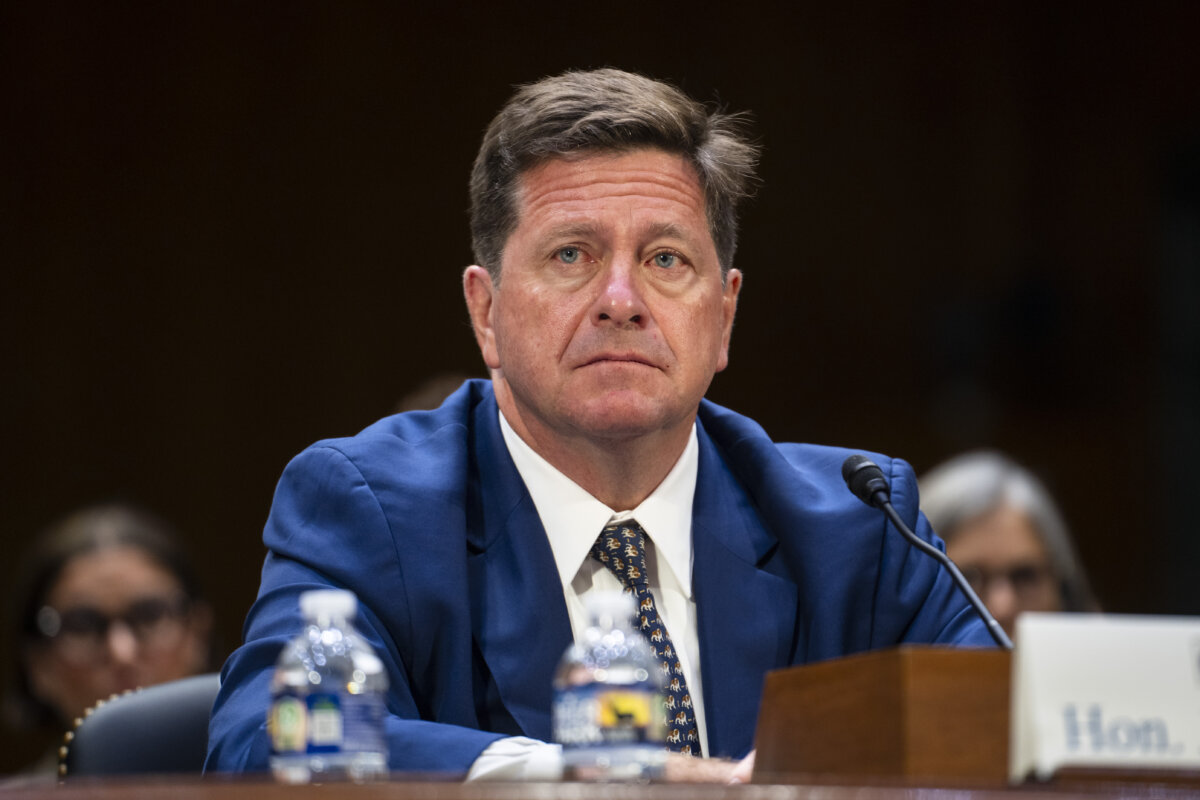

Director of National Intelligence Jay Clayton warned on Oct. 16 that both the Trump administration and American companies “need to be wary” of foreign espionage with the rise of artificial intelligence (AI), which the government now refers to as super intelligence.
Clayton, who leads the Trump administration’s Super Intelligence Force, told CNBC in a Friday interview that maintaining U.S. leadership in the AI race is critical in the face of potential foreign espionage. He noted that while AI platforms and capabilities can be used for “very good purposes,” they can also be used for “nefarious purposes.”
The intelligence chief’s comments came after President Donald Trump’s Super Intelligence Force held its first meeting at the White House on Thursday. Clayton told CNBC that the meeting was “very good” and that it built on the voluntary accord signed by Trump and multiple technology industry leaders at the White House on Sept. 29.
Asked whether Americans should be concerned about foreign espionage with AI companies, Clayton said Friday that both commercial and state-sponsored espionage are a reality facing the United States.
“It’s something that our private-sector companies need to be wary of, we as a government need to be wary of,” he said.
Clayton told CNBC that it was important for the United States to “stay on the cutting edge” of AI capabilities in order to address concerns regarding AI advances by U.S. adversaries.
“We’re not the only ones developing it. There are vectors in this technology that are coming from some of our known adversaries and competitors,” he said. “The Chinese, the Russians, the Iranians, the North Koreans all have significant technical capability. We need to stay ahead of them.”
Many of the risks posed by AI are linked to cybersecurity and digital infrastructure, Clayton told CNBC. He described the U.S. digital infrastructure as critical infrastructure, covering everything from public utilities, such as water and electricity, to national defense.
While cybersecurity risks are not new, the rise of AI “amplifies” those risks, Clayton said. To address the risks, he said the United States is “focused on hardening those systems” and is committed to staying ahead of “nefarious actors” in the AI race.
Clayton’s warning regarding foreign espionage attempts linked to AI came after prosecutors and company officials said on Oct. 13 that Abdulrahman Alfozan, a Saudi national and software engineer working for OpenAI, was arrested on allegations that he concealed a sophisticated recording device in an OpenAI office.
According to a court complaint, the office Alfozan allegedly planted a recording device in was frequently used to hold meetings involving highly confidential information, including government engagements, commercial relationships, product plans, and strategic decisions.
In a Tuesday press release, Clayton described the incident as a “serious situation [that] underscores why winning the global super intelligence race is a national security prerogative.”
During Friday’s interview on CNBC, Clayton added that the incident involving the Saudi software engineer at OpenAI “shows the lengths that people will go to try and supplant our leadership in this, or at least stay close to us, in this emerging technology.”
The intelligence chief’s warning also followed a series of AI swarm breaches, which has led some industry leaders to suggest that the pace of AI development needs to be slowed down and the technology needs additional oversight.
A report released last month by Anthropic found that the Iranian regime used the company’s AI models to track and target U.S. Navy ships in the Middle East. The report also said that a Chinese-linked operation used Claude to track and attempt to recruit Uyghurs who joined the Syrian army to become spies.
In addition, Anthropic’s report found that individuals affiliated with the Chinese regime used Claude and supporting Chinese AI systems to surveil groups targeted by the regime. Those targeted by the China-linked individuals included members of the Tibetan Buddhist civil society, practitioners of Falun Gong, Catholic cardinals, Presbyterian Church leaders, the New York-based Shen Yun Performing Arts, and NTD, The Epoch Times’ sister media outlet.
Trump announced the formation of the Super Intelligence Force earlier this month to oversee U.S. AI policies. Clayton told CNBC that the White House task force took a number of actions during its inaugural meeting on Thursday.
Those actions included outlining a plan to implement the accords signed by technology leaders, tasking the President’s Council of Advisors on Science and Technology with conducting a risk study, establishing committees covering different AI issues, and developing a system for the Department of Labor to regularly report on the impacts of AI on the U.S. workforce and economy.
 Friends Read Free
Copy
Facebook
Tweet
Friends Read Free
Copy
Facebook
Tweet