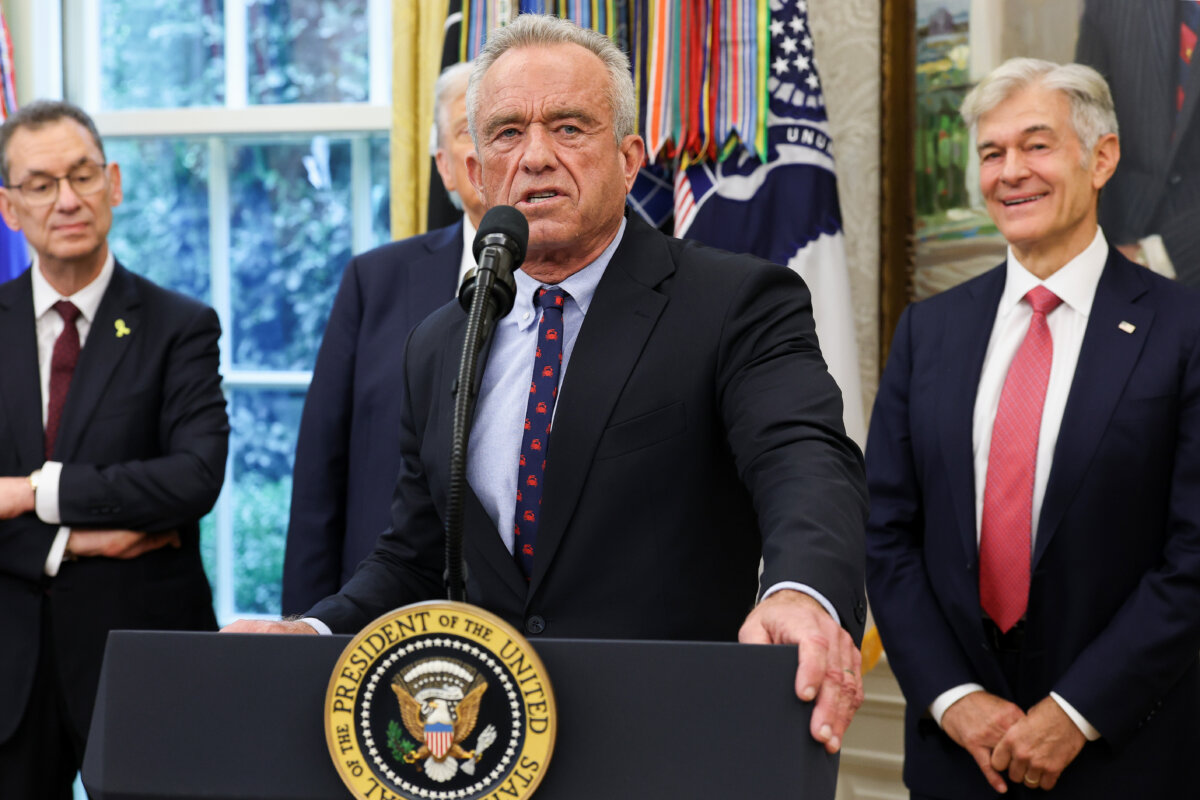

The Trump administration notified more than 500 hospitals that they must publicly post their prices as required by federal regulations or face fines that could reach $2 million per year, Health and Human Services Secretary Robert F. Kennedy announced on June 9.
The move is part of an accelerated price-transparency effort initiated by President Donald Trump through an executive order in 2025.
Hospitals say they’re working to comply with federal regulations. And some states have their own transparency laws, some stricter than the federal version.
The first Trump administration introduced a rule requiring hospitals to post prices for in-network and out-of-network patients on their websites. That rule took effect in 2021.
The Biden administration took more than 2,000 actions to enforce the rule, including warning letters and audits through 2023. Fines totaling $4 million were imposed on 14 hospitals that did not take corrective action, according to the Government Accountability Office.
Trump pledged stronger enforcement in his second term.
The administration implemented rule changes in 2025 to disallow the posting of estimated charges rather than actual prices, to require the posting of the name of the hospital CEO or other officials responsible for the accuracy of the prices, and to offer reduced fines to hospitals that agreed not to contest enforcement action.
Those changes took effect on Jan. 1, with enforcement delayed until April 1.
“The grace period has ended,” Kennedy said in a June 9 social media post announcing the stepped-up enforcement. “If your hospital is not yet in compliance, you are in violation of federal law.”
Since April 1, warning notices or corrective action plans have been sent to hospitals in every state except Alaska and in the District of Columbia.
Dr. Mehmet Oz, administrator of the Centers for Medicare and Medicaid Services, said the administration would aggressively enforce the regulation.
“Many of the [noncompliant] hospitals are owned by large, well-resourced health systems, billion-dollar networks with armies of lawyers and compliance teams and lobbyists, and are still hiding their prices from the patients that they serve. That is unacceptable,” Oz said, appearing with Kennedy in the video social media post.
Most Hospitals ‘in Compliance’
Hospitals are implementing the regulatory changes, and most are in compliance, according to Ashley Thompson, senior vice president for policy at the American Hospital Association.
Thompson noted in a statement provided to The Epoch Times that most issues flagged for action are minor and will be corrected before fines are imposed.
Yet she said more work remains to be done.
“At the same time, we also know the current system is not working as well as it could for patients, which is why we continue to work with our members, policymakers, and the administration on ways to strengthen and improve the pricing information and transparency tools that are available,” Thompson said.
Fines can range up to $5,500 per day for hospitals with more than 550 beds, according to the federal rule.
Since 2022, when enforcement of the rule began, just two hospitals with more than 550 beds have been fined, according to Becker’s Hospital Review. Of the 10 hospitals fined for noncompliance in 2025, the largest penalty imposed was nearly $310,000, according to Beckers.
Patient advocates hailed the announcement.
“Today’s action by Secretary Kennedy and Administrator Oz is a huge win for America’s patients and a strong warning to hospitals and insurers who have put profits over patients for far too long,” Cynthia Fisher, founder and chairman of Patient Rights Advocate, said in a statement provided to The Epoch Times.
Twelve states have their own hospital price transparency laws.
For example, Virginia passed a price transparency law in 2016 and another to combat surprise medical bills in 2020. Arizona requires its state department of health to verify compliance with price transparency regulations annually.
 Friends Read Free
Copy
Facebook
Tweet
Friends Read Free
Copy
Facebook
Tweet