



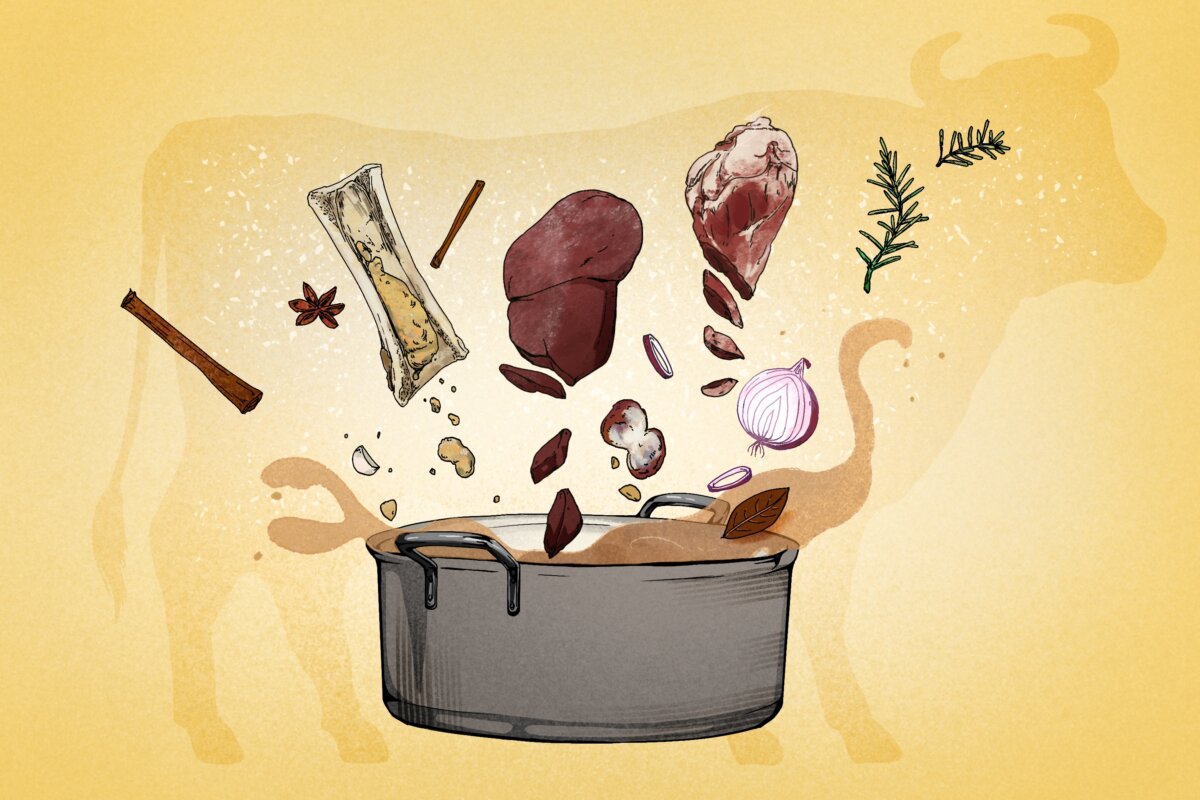
At a Hudson Valley butcher counter, chicken livers cost $1.70 per pound. The ribeye featured next to them costs $20 per pound. Nutritionally, the liver wins—more iron, more B12, more vitamin A than the steak will ever deliver. Yet the liver sits unwanted while the ribeye sells quickly.
That gap raises a bigger question: If protein is only part of the nutrition story, are we overlooking the most nutrient-dense cuts the animal has to offer?
As a clinical nutritionist, I’ve been helping patients learn how to build meals that are protein‑rich, affordable, and realistic to cook. Nose‑to‑tail eating—once a basic necessity—offers a more complete alternative to muscle‑meat-only diets.
How We Lost the Whole Animal
For most of human history, the whole animal—bones, skin, organs, fat, and connective tissue—was utilized as part of everyday meals. That changed with industrial meat production and urban life—when meat became more standardized, more processed, and easier to recognize in boneless, skinless, neatly packaged form.
“Even one or two generations ago, people were eating much more of the whole animal,” professor Frédéric Leroy, a food science and biotechnology expert, told The Epoch Times.
Nutrition, taste, habit, convenience, and familiarity all shape what ends up on the plate.
Nutrient-dense foods can feel out of reach if we were taught to view them as strange or lack the skills to cook them. As reliance on ultra-processed convenience foods has grown, our traditional repertoire has faded, leaving cuts such as liver, kidney, tripe, and tongue stigmatized in the West despite their popularity elsewhere. Leroy said that this stigma is as much about skill as it is about taste.
“People aren’t necessarily cooking less; they’re less creative with traditional resources and more dependent on pre-prepared meals,” he said. “Frying a chicken breast is easy. But preparing liver in a decent manner requires a certain skill. You cannot just take the fifth quarter and start cooking.”
The “fifth quarter” is the offal—organs and other trimmings.
What Muscle Meat Misses
Nutritionally, muscle meat has its value.
Chicken breast and beef steak provide complete protein for muscle repair, satiety, and metabolism. However, they fall short on the micronutrients that bones, skin, and organ meats provide in abundance. Steak offers modest amounts of iron and B vitamins, while liver is a nutrient powerhouse containing vitamin A, iron, B12, folate, and copper.
“Even a small portion of liver can significantly boost micronutrient intake,” Leroy said. “You get high value for reasonable amounts of money.”
Organ meats—such as the overlooked heart—provide iron, B vitamins, taurine, and coenzyme Q10 (CoQ10) in concentrations that muscle meats don’t match. CoQ10 plays a key role in human bodies’ cellular energy production, particularly in high-energy tissues such as the heart and muscles.
And there’s beef kidney. After liver, it is one of the highest sources of vitamin B12 and riboflavin (vitamin B2), and it contains exceptionally high levels of selenium, a powerful antioxidant.
Organ meats are also rich sources of fat-soluble vitamins—A, D, E, and K—and other nutrients essential for neurological development.
The problem is not too little meat but too little of the right parts of the animal, according to Sally Fallon Morell, a nutrition researcher, the founder of the Weston A. Price Foundation, and the author of “Nourishing Traditions.”
“We’ve been brought up on muscle meat alone—and we’re eating it all wrong,” she told The Epoch Times. “Traditional diets had 10 times more of certain key nutrients than modern ones.”
She said that bone broth is also a key part of the traditional diet.
Bill Schindler, a chef and archaeologist who studies how traditional cultures have used every part of the animal, told The Epoch Times that “bones are not just structure; they’re nutrient stores.” When you make bone broth, he said, “you’re not just cooking bones—you’re extracting the minerals and fat.”
Researchers have also raised questions about amino acid balance. Muscle meat is rich in methionine, an essential amino acid involved in growth and repair, but contains relatively little glycine, which is more abundant in connective tissue, skin, and bone broth.
Some research suggests that diets very high in methionine, without enough glycine to balance them, may be linked to more cellular stress and faster aging processes. Whole‑animal eating naturally includes both.
Simmering bones, cartilage, and skin converts collagen into gelatin, which is rich in arginine and glycine, both of which are amino acids important for cellular maintenance. Collagen makes up 25 percent to 35 percent of our body’s protein and builds the body’s structure.
More Than Nutritious
Taste is one of the most overlooked aspects of the organ-meat conversation. People often assume that food chosen for ethical or health reasons has to be tolerated rather than enjoyed. However, the opposite tends to be true when the whole animal is raised and prepared well.
Farmer and founder of Polyface Farm Joel Salatin sees nose-to-tail eating as more than a nutrition strategy.
“Nose-to-tail eating honors the animal and respects the whole creation, instead of treating the animal as a factory product to be disassembled into profitable parts,” he said.
He said that eating this way is both a practical and moral choice—one that connects flavor and respect for the animal, because the way an animal lives shows up directly in the meat it produces.
“If we say you are what you eat—you also are what [what] you eat ate,” he said.
Nose-to-tail eating is also economical. Americans now spend a smaller share of their income on food than in earlier generations, while healthcare spending has risen sharply. Salatin said that shift is no coincidence.
“Whenever I hear people say clean food is expensive, I tell them it’s actually the cheapest food you can buy,” he said.
The pricing gap is hard to ignore; some of the most nutritious parts of the animal—the bones, the organs, and the offcuts—are also the least expensive.
Bringing skin and bones back into the kitchen can help children reconnect with foods and understand that chicken nuggets come from a real chicken, Schindler said.
“We need to put a face back on our plate,” he said.
How to Prepare the Edible Parts
When people ask me how to start, I usually suggest beginning with the simplest foods first. The goal is not to jump straight into the most unfamiliar cut, but to build comfort.
A good first step is bone broth.
“Just throw meat bones, feet, and skin into a pot, and let them simmer,” Schindler said.
Moving beyond broth, slow‑cooked cuts such as oxtail, cheeks, and shanks, braised over low heat, turn tougher pieces into tender, rich meals.
Chicken gizzards are another mild-tasting starting point. The gizzard is a small, muscular part of the stomach that becomes tender and flavorful when simmered slowly. They can be braised, fried, or stirred into gravy with onions.
Liver is often easiest to introduce as pâté, blended in a small amount into ground meat for adding to burgers or meatballs. That was also how I got my son to enjoy it, and it’s a simple way to serve it at home while keeping the flavor familiar.
For meats such as heart or liver, Schindler suggests soaking them in milk overnight to soften stronger flavors and aromas.
“You can portion and freeze them for later use,” he said, “which takes the pressure off having to cook them all at once.”
Fallon suggested eating liver, in pâté or meatballs, once a week and broth “almost every day.”
For anyone not quite ready for offal, Fallon points to other accessible animal foods that deliver many of the same nutrients, including egg yolks, butter, and tallow.
“Stop throwing away the parts that are richest in nutrients,” Schindler said. “At least throw them in your bone broth. That’s where the story of the whole animal can start again.”
2 Easy Family Friendly Recipes
Chicken Liver Pâté
This creamy chicken liver pâté has a rich, savory flavor, and it is typically chilled and served as an appetizer with toast, crackers, or vegetable sticks (download the recipe card here).
Prep Time: 5 minutes
Cook Time: 10 to 15 minutes
Serves: 4 to 6 as an appetizer or side dish
Instructions
- Melt 1.5 tablespoons butter or duck fat in a heavy skillet over medium heat. Sauté shallots until translucent, about 3 minutes; add garlic and herbs and cook for another 3 minutes.
- Add the livers, stirring until lightly browned. Add the wine or bone broth and reduce. Remove the livers from heat, let the mixture cool, discard the bay leaf.
- Once cool, process in a food processor and add the remaining 1.5 tablespoons of butter or duck fat and salt.
- Place in a crock or mold and chill well.
Serve with crackers, bread, or vegetable sticks.
Beef Bone Broth
Deeply nourishing and flavorful, this broth can be warmed and sipped as is, used as a soup base, or used as a cooking liquid for grains (download the recipe card here).
Prep Time: 15 minutes
Cook Time: 12 to 24 hours
Makes 8 cups
Instructions
Preheat oven to 375 degrees F.
Brush marrow or knuckle bones with tomato paste and roast for about 10 minutes. Transfer bones to a large pot with onion, carrots, apple cider vinegar, bay leaf, and salt.
Cover with water and simmer on low for 12 to 24 hours, skimming foam during the first hour. Strain, cool, and skim fat. Store refrigerated for up to five days or freeze.