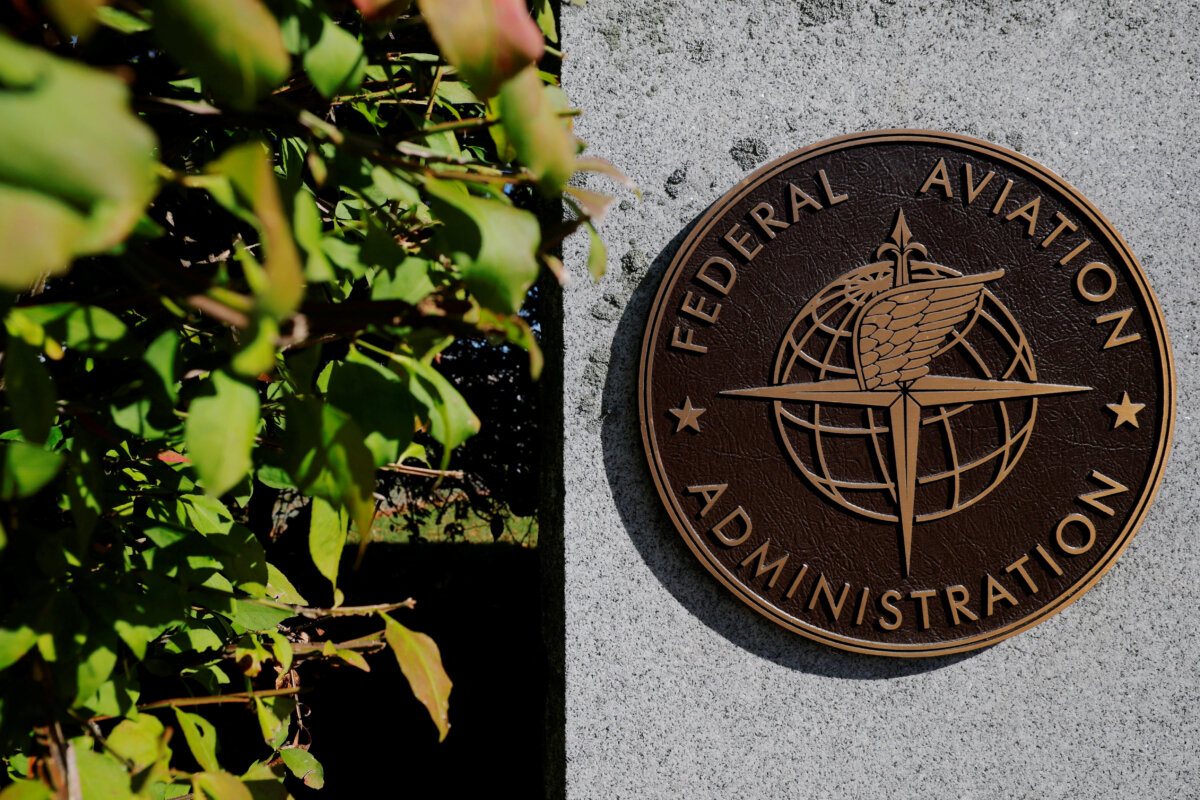

The Federal Aviation Administration (FAA) has issued a proposed rule that would allow certain critical infrastructure facilities in the United States to seek restrictions against third-party drones flying around their sites.
“Restrictions—which would be submitted and approved via a new FAA web portal—will be approved based on safety or security criteria,” the Department of Transportation (DOT), under which FAA operates, said in a May 6 statement. “The restricted area would have clearly defined horizontal and vertical boundaries, and violators could face civil or criminal penalties.”
“The rule would also allow site operator to contact law enforcement if a drone flew in a restricted area, after which authorities can use Remote ID to locate the control station or operator. Pilots could face license suspensions, revocations, fines, and criminal charges for entering these no fly zones.” Remote ID enables a drone to provide identification and location information while in flight.
Two types of restrictions have been proposed by the FAA—Standard Unmanned Aircraft Flight Restriction (UAFR) and Special UAFR.
Standard UAFR is a general restriction that bans drones from operating within a specific boundary. Only drone operators who have met stringent security and safety standards can fly in these areas.
Special UAFR is a more severe ban, applied to all operators. The only exemption is if an operator has already received prior approval from the FAA as well as an agency, such as the Department of Homeland Security.
In a Fact Sheet, the FAA said it was seeking to balance “security needs with economic growth and public interest,” with the rule being proposed to address the rapid increase in drones flying across the country and the threats they pose to sensitive locations.
Facilities seeking drone restrictions must show that such a restriction is necessary for protecting people and property on the ground, national security, aviation safety, or homeland security.
When a site is approved for UAFR, it will remain active for five years, after which the facility has to renew its application for drone restrictions.
In its recent statement, DOT said that facilities from sixteen sectors will be eligible to seek drone restrictions at their sites, including defense industrial complexes, water treatment plants, transportation systems, chemical facilities, energy production sites, dams, and the communications industry.
“Restoring airspace sovereignty in America means protecting sensitive locations from aerial threats while providing clear guidance to drone pilots so they can operate with confidence. This rule does just that,” Transportation Secretary Sean P. Duffy said, according to the DOT statement.
“Under President Trump’s leadership, we will continue to fight to ensure our skies are secure and unleash the next wave of transportation innovation.”
The public can submit comments on the proposed rule until July 5.
According to the DOT, the drone restrictions are in line with President Donald Trump’s June 2025 executive order—Restoring American Airspace Sovereignty.
In the order, Trump wrote that unmanned aircraft systems (UAS) were being weaponized by criminals, hostile foreign actors, and terrorists, which pose serious threats to the United States.
“Critical infrastructure, including military bases, is subject to frequent—and often unidentified—UAS incursions. Immediate action is needed to ensure American sovereignty over its skies and that its airspace remains safe and secure,” the order said.
Commercial Drone Operations
In a May 6 public comment submitted to the FAA, commercial drone operator Avios Media raised “significant concerns” regarding the proposed drone restrictions in close proximity to critical sites.
Implementing the rule in heavily populated, highly developed places such as the New York and New Jersey metropolitan areas will have “devastating effects” for commercial operations, the company said.
“New Jersey is the most densely populated state in the nation. Because of this density, our region is heavily saturated with the exact types of ‘critical infrastructure’ outlined in the proposed rule’s sector-specific requirements—including chemical plants, transportation systems, water and wastewater facilities, energy sector sites, and communications infrastructure,” the comment said.
“If broad Unmanned Aircraft Flight Restrictions (UAFRs) are granted to these facilities, it will inadvertently create a massive, overlapping patchwork of restricted airspace. In the NY/NJ area, it is nearly impossible to conduct routine commercial business—such as mapping a construction site, performing a roof inspection, or collecting survey data for a local municipality—without being in ‘close proximity’ to one or more of these fixed-site facilities.”
Meanwhile, the Commercial Drone Alliance (CDA) welcomed the proposed rule in a May 5 statement.
The regulation is an important step in creating a secure low-altitude airspace ecosystem that allows authorized drones to operate while ensuring that critical national security assets are protected from the threats of dangerous drone use, the alliance said.
“This proposal represents a significant step forward in modernizing how our low altitude ecosystem works,” Liz Forro, policy director of the CDA, said.
“Everyone who flies drones legally, or who is experiencing rogue unauthorized drone overflight, should participate in this comment period to provide concrete advice to regulators on how to further refine the proposal.”
 Friends Read Free
Copy
Facebook
Tweet
Friends Read Free
Copy
Facebook
Tweet