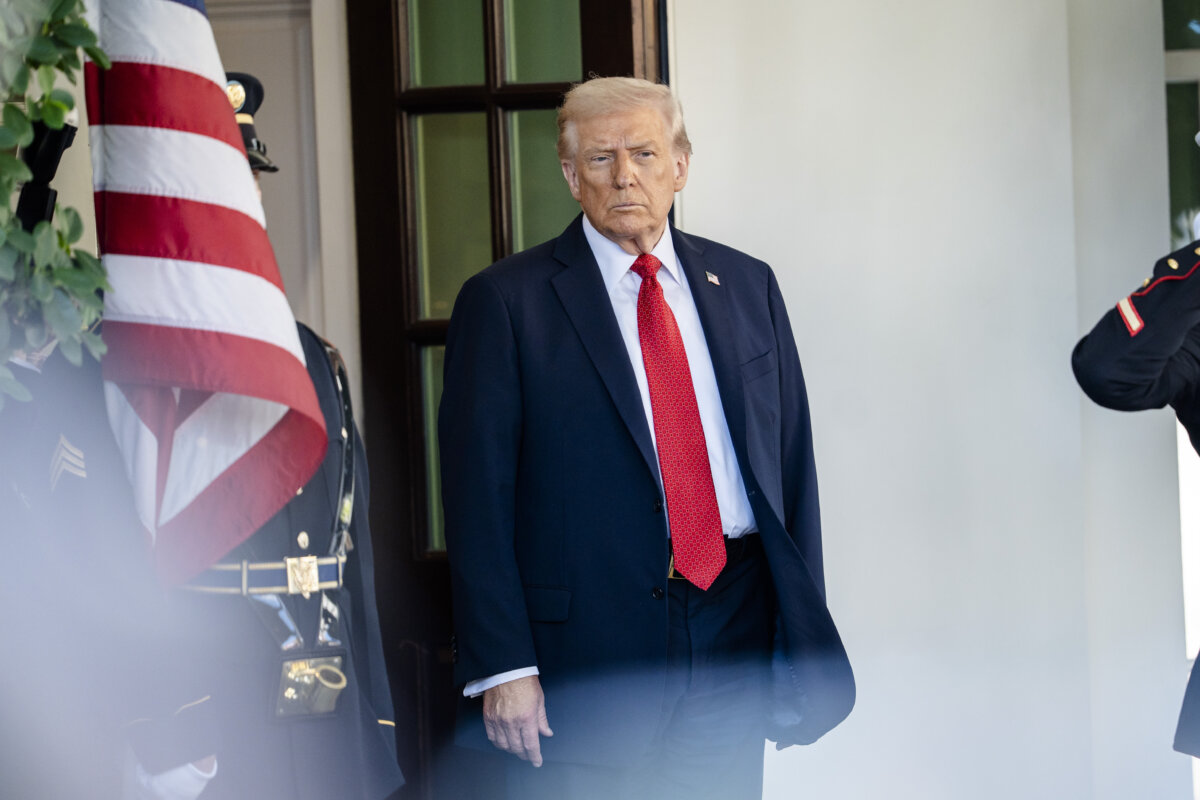

President Donald Trump is calling for a federal standard on artificial intelligence (AI) to prevent U.S. states from regulating the technology themselves, even as Republican lawmakers voted to remove similar language from the president’s flagship funding bill earlier this year.
On Nov. 18, Trump wrote on social media that AI investments are “helping to make the U.S. Economy the ‘HOTTEST’ in the World,” but that “overregulation” from states is threatening to undermine that growth.
“We MUST have one Federal Standard instead of a patchwork of 50 State Regulatory Regimes. We can do this in a way that protects children AND prevents censorship!” Trump said.
He alleged that some states are trying to embed diversity, equity, and inclusion ideology into AI models, but did not specify which states or how.
Multiple media outlets, including CNBC, The Financial Times, and The Information, reported on Nov. 20 that Trump is considering signing an executive order that would withhold federal funding from any states that seek to establish their own laws on AI. A draft of the order appeared on CNBC shortly after Trump’s social media post.
A White House official told The Epoch Times that until an official announcement comes from the White House, talk regarding potential executive orders is speculation.
Lawmakers have introduced similar proposals as part of recent legislative packages.
After a provision to give AI companies 10 years of amnesty from any statewide regulations on the industry was removed from the One Big Beautiful Bill Act, AI regulation advocates pointed out that there is another 10-year AI amnesty provision buried deep in the upcoming National Defense Authorization Act.
Florida Gov. Ron DeSantis, a Republican, called it “an insult to voters” to sneak the provision into the defense bill.
Arkansas Gov. Sarah Huckabee Sanders, a Republican who served as White House press secretary during the first Trump administration, also criticized the move to reintroduce the AI amnesty provision into the National Defense Authorization Act.
“This summer I led 20 GOP governors to pressure Congress to vote down its 10 year prohibition on state-level AI regulations—protecting Arkansas’ AI child-exploitation ban and other commonsense safeguards,” she wrote on social media. “Now isn’t the time to backtrack. Drop the preemption plan now and protect our kids and communities.”
Sen. Josh Hawley (R-Mo.), who pushed to remove the 10-year AI regulation moratorium from the One Big Beautiful Bill Act, said it “Shows what money can do” in response to the lawmakers who introduced it into the National Defense Authorization Act.
While Hawley did not directly comment on the president’s Tuesday social media post calling for a “Federal Standard” of AI regulation to supplant state efforts, a day later, the senator introduced a bill that would require employers to report “AI-related layoffs,” ramping up his efforts to put pressure on the AI industry.
When asked if the president supports a 10-year moratorium on states regulating AI companies, the White House official repeated the statement made in response to the speculated executive order.
A YouGov survey conducted in June for the Institute of Family Studies found that most Americans oppose a 10-year moratorium on state AI regulation by a 3-to-1 margin.
The poll also found that the sentiment varies by party affiliation, with 44 percent of 2024 Trump voters opposing the provision and 65 percent of people who voted for Vice President Kamala Harris also against it.
Multiple U.S. states have moved to establish regulations on AI companies so far this year.
North Dakota enacted a law that prohibits people from using an AI-powered robot to stalk and harass others, in an expansion of its current harassment and stalking laws.
Arkansas created a law that clarifies who owns AI-generated content, including the person who provides the data or input used to train a generative AI model or an employer in cases where content is generated as part of employment duties. The regulation specifies that generated content cannot infringe on existing intellectual property rights or copyright.
Early this year, California state Sen. Steve Padilla, a Democrat, introduced legislation to protect children from “predatory [AI] chatbot practices.”
 Friends Read Free
Copy
Facebook
Tweet
Friends Read Free
Copy
Facebook
Tweet