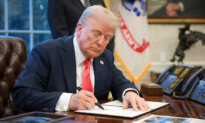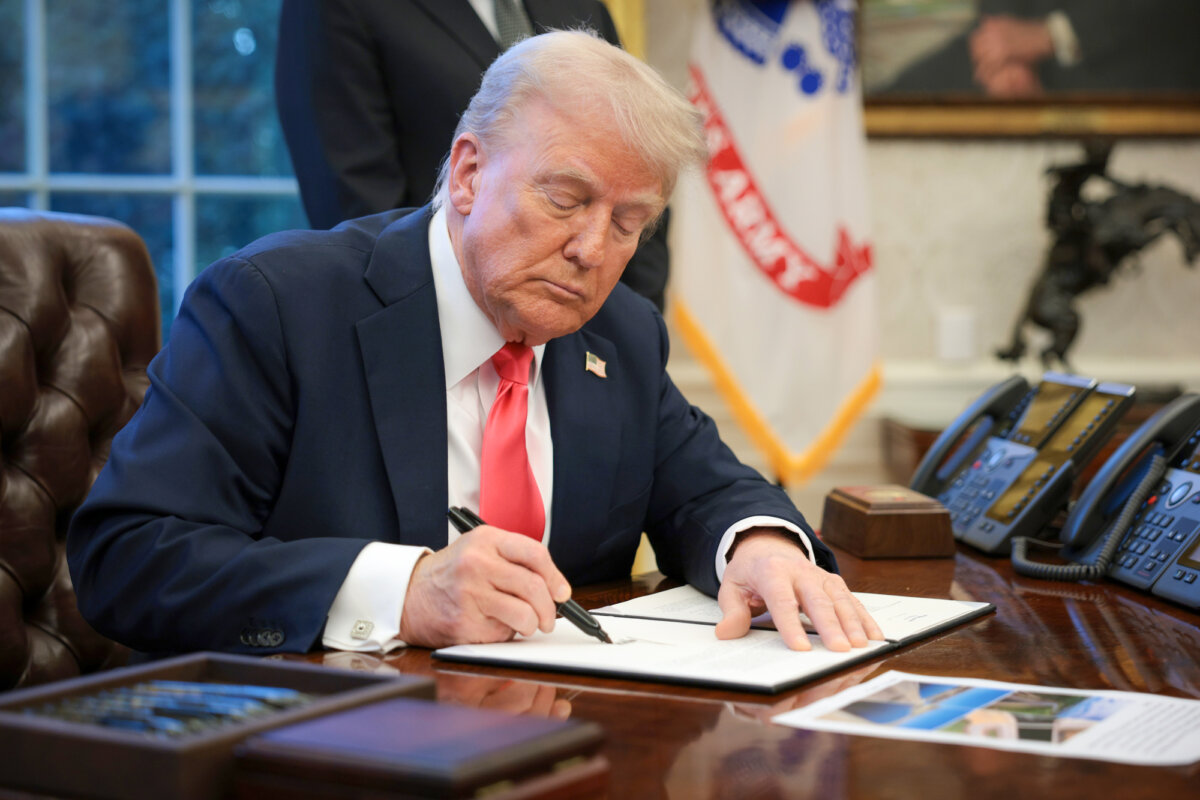

President Donald Trump issued an executive order on Feb. 6 directing the establishment of an America First Arms Transfer Strategy, focusing on the use of arms sales to advance U.S. foreign policy objectives and increase domestic production capacity.
The order creates a framework to further U.S. interests, using foreign purchases to bolster production and develop a resilient national security manufacturing base to support the military and allies, who are expected to be more responsible for their own national defense, as in the case of NATO.
“American-manufactured military equipment is the best in the world, resulting in American dominance across international defense exports,” the directive states. “It is critical that the United States fully use this comparative advantage in arms transfers as both a tool of foreign policy and a tool to expand domestic production and transfer.”
The order is designed to enhance the United States’ defense industrial base.
“This strategy will advance a technologically superior, ready, and resilient national security industrial enterprise,” the order states.
The policy includes designing a clear strategy with guidance for stakeholders and streamlining processes across departments. It outlines increasing production for key weapons as chosen by the secretary of war. It also states as an objective making use of foreign capital for domestic reindustrialization and supply chain resilience, and it encourages new and nontraditional defense firms.
The new directive, like executive order 14268 from April 9, 2025, favors allies contributing to U.S. economic security.
The secretary of war must, within 120 days, along with state and commerce secretaries, submit a sales catalog of prioritized platforms to the president through the national security adviser.
Trump signed orders in April 2025 to increase arms procurement and streamline sales, ordering the Pentagon to grow shipbuilding investments. The United States approved more than $15 billion in arms to Israel and Saudi Arabia amid tensions with Iran. The State Department stated that these “wouldn’t affect the military balance in the region but would enhance Israel’s ability to protect itself.”
U.S. envoy to Taiwan Raymond Greene said the country could become a “powerhouse in trusted global defense supply chains,” and the Trump administration recently announced an $11 billion arms sale package to the island nation.
In Ukraine, Trump shifted U.S. policy from aid to negotiated arms sales, securing NATO deals for weapons supply.
“We’re sending weapons to NATO, and NATO is paying for those weapons, 100 percent,” Trump told NBC News in July 2025. “So what we’re doing is, the weapons that are going out are going to NATO, and then NATO is going to be giving those weapons (to Ukraine), and NATO is paying for those weapons.”
Trump has issued more than 225 executive actions to reorganize U.S. policy to prioritize America, including expanded defense spending and military strikes.
 Friends Read Free
Copy
Facebook
Tweet
Friends Read Free
Copy
Facebook
Tweet