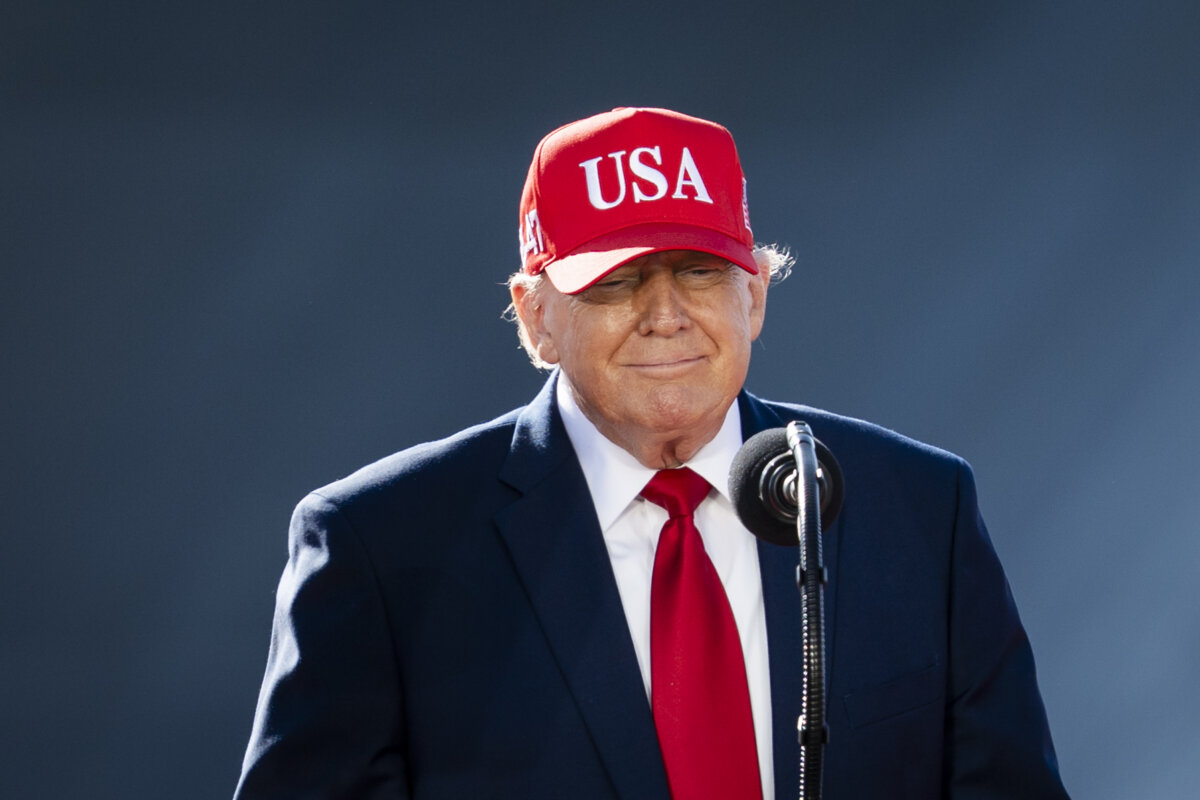

President Donald Trump said he was thinking about suspending the federal gas tax as he spoke to reporters on Tuesday.
“We’re thinking about that,” Trump said when asked if the federal gas tax should be suspended. He didn’t provide any more details.
The federal gasoline tax is 18.4 cents per gallon, according to the U.S. Energy Information Administration. The average price for a gallon of regular unleaded in the United States was $4.36 on Tuesday, up from $3.13 a year ago.
Trump also said at the press conference that the Strait of Hormuz was open and oil flows exceeded prewar levels.
“The Hormuz Strait, tremendous amounts, millions of barrels of oil has been delivered just over the last couple of days. We’re getting it through at levels that were now even and sometimes exceeding prior to the war, and we’ve done very well,” Trump said Oct. 6.
“What’s driving up Gasoline is no longer the Strait of Hormuz, because Record Numbers of Barrels are coming out now on an almost daily basis, but the word, ‘Refineries,’ where Russia’s are being blown up by Ukraine, and where ours are being closed up, in Blue States, like California,” Trump said in an Oct. 5 post on Truth Social.
His comments contrasted with those of Iranian parliament speaker Mohammad Bagher Ghalibaf, who said Oct. 4 that the waterway would not reopen until Washington met conditions under an agreement made previously during the summer.
Trump signed an executive order Oct. 5 aimed at lowering diesel costs for farmers and truckers by expanding access to red-dyed diesel, normally reserved for off-road use.
The action directs federal penalty relief for highway use and a review of whether certain diesel tax payments can be deferred through Dec. 31. Trump said the relief could save truckers approximately $100 per fill-up.
The cost of gas has been a hot topic among politicians.
“There’s no ifs, ands or buts about it. The war in Iran, the senseless, reckless war that Donald Trump brought us into with no plan, is the primary cause of skyrocketing gas prices and inflation,” said U.S. Sen. Cory Booker (D-N.J.) in an Oct. 6 post on X. “The Constitution is clear. The power to declare war rests with Congress. But Congressional Republicans are too afraid of Trump to stand up to him.”
The U.S. Energy Information Administration said in an Oct. 5 analysis that renewed military strikes in the Middle East and disruptions to oil shipments contributed to rising crude prices during the third quarter.
The agency cited U.S. and Iranian attacks on crude oil tankers, the U.S. blockade on Iranian oil exports, attacks on pumping stations along Saudi Arabia’s East-West pipeline, attacks on Saudi Arabian oil tankers around the Bab el-Mandeb Strait and Ukraine’s drone attacks on Novorossiysk, one of Russia’s major oil terminals on the Black Sea, as reasons for a September increase in the price of oil.
The daily volatility of the price of oil from July 8 to Sept. 8 was due to market responses to public statements by U.S., Iranian, and other regional leaders on military plans and the likelihood of a peace deal as well as disruptions to flows through the Strait of Hormuz and attacks on oil infrastructure in Russia.
 Friends Read Free
Copy
Facebook
Tweet
Friends Read Free
Copy
Facebook
Tweet