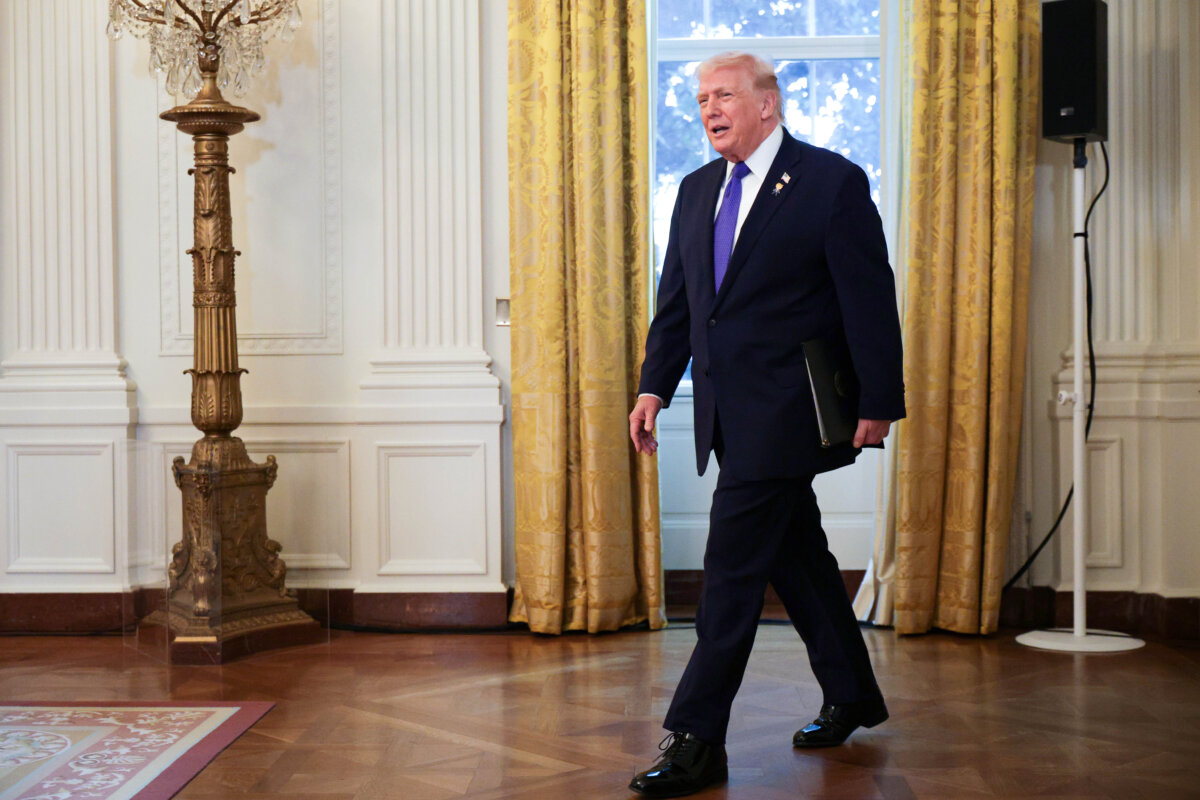

President Donald Trump said on Jan. 11 that he “might” veto a bill extending Affordable Care Act (ACA) subsidies, if it reaches his desk.
The comment came days after the House advanced the legislation over the objections of Speaker Mike Johnson (R-La.), who had blocked any debate on renewing the tax credit subsidies for ACA, also known as Obamacare.
On Jan. 7, the House voted 221–205 to move forward with a Democrat-led discharge petition forcing consideration of the bill, with nine Republicans joining all Democrats to cast a “yes” vote. The next day, the House approved the measure in a final 230–196 vote, this time with the support of 17 Republicans.
The bill would restore ACA enhanced tax credits, which were created during the Biden administration under the American Rescue Plan Act of 2021 and later extended by the Inflation Reduction Act of 2022. Those subsidies expired at the end of 2025.
Extension of the tax credits was at the center of the most recent federal government shutdown, which stretched through October and into November 2025 and was the longest in the nation’s history. After a handful of Senate Democrats broke with their party to reopen the government without securing an extension, House Democrats moved ahead with their own push to revive the subsidies.
The issue has caused divisions inside the Republican Party. Most Republican lawmakers have argued that the subsidies should end, and a smaller group has backed a temporary extension.
“Obamacare has been a failure that’s enriched insurance providers at the expense of patients,” Sen. Ted Cruz (R-Texas) wrote on X on Jan. 11. “There are many reforms we can and should make to our healthcare system. Extending the ACA’s subsidies isn’t one of them, and doing so only further perpetuates Obamacare’s damage to American consumers.”
Rep. Mike Carey (R-Ohio), who voted for the House bill, countered that the subsidies remain necessary at least for now so that many Americans don’t immediately lose coverage.
“The cost of health care is still too high because of the failed Obamacare policies that removed choice and raised premiums with punishing government mandates on our working families,” Carey said in a statement after the vote. “Close to 45,000 Ohioans in our district currently have these plans, and I want to make sure that they do not lose access to a plan that they have relied on as Congress continues addressing the high cost of health care.”
The Senate has yet to vote on the measure. Although it may prove difficult for Democrats to find enough Republican support to pass the bill in its current form in the upper chamber, a bipartisan Senate group is discussing a possible compromise.
That proposal, backed by lawmakers including Sens. Bernie Moreno (R-Ohio) and Susan Collins (R-Maine), would reestablish the enhanced tax credits for two years with new limitations.
Under the Senate group’s framework, the extension would add a series of guardrails: a minimum premium of $5 per month, an income cap at 700 percent of the federal poverty level in the first year, and a second-year option allowing enrollees to receive their subsidy in the form of pre-funded health savings accounts (HSAs). The premium tax credits would end once household income reaches $200,000 and would then require a premium contribution of $25 per month.
Trump has pushed for shifting away from the ACA toward expanded use of HSAs, which he envisions would give Americans more direct control over their medical care. His sweeping tax and spending package, the One Big Beautiful Bill Act, broadened access to HSAs, making 7.3 million more Americans eligible to use them.
HSAs function as tax-advantaged accounts for medical expenses, allowing individuals and employers to deposit money tax-free as long as they are covered by a high-deductible health plan. Funds can be withdrawn for qualified medical costs at any time and, after age 65, for non-medical expenses subject to ordinary income tax.
 Friends Read Free
Copy
Facebook
Tweet
Friends Read Free
Copy
Facebook
Tweet