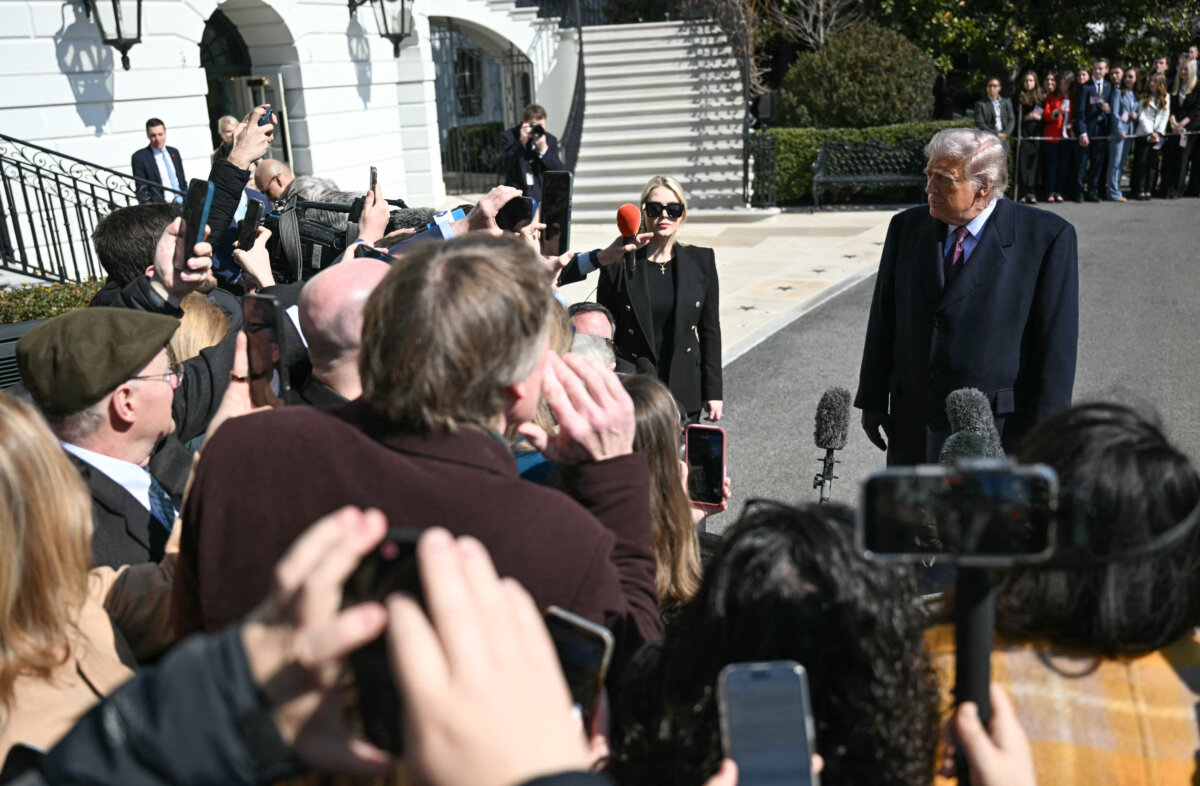

President Donald Trump on Friday expressed displeasure with the progress in talks with Iran over the country’s nuclear program, coming as tensions continue to remain escalated with U.S. military assets deployed to the Middle East.
While speaking to reporters before he left the White House, the president said that he hasn’t yet made a decision on whether to strike Iran or not, but he said he isn’t happy with the negotiations.
“I’m not happy with the fact that they’re not willing to give us what we have to have,” Trump told members of the press before he’s set to leave for Texas. “I’m not thrilled with that. We’ll see what happens. We’re talking later.”
He again said that Iran cannot obtain a nuclear weapon and suggested the administration would prefer a diplomatic path.
“It’d be nice if we could do it without [the military], but sometimes you have to do it with,” Trump told reporters. “We have the greatest military anywhere in the world. There’s nothing close. I’d love not to use it, but sometimes you have to.”
When asked about strikes on Iran turning into a long, drawn-out conflict in the Middle East, Trump noted that “there’s always a risk” but said he’s had “tremendous luck” with military action in the region. He then cited his first administration’s targeted airstrike that killed Iranian commander Qassem Soleimani in early 2020 and the operation that led to the death of then-ISIS leader Abu Bakr al-Baghdadi.
On Thursday, U.S. special envoy to the Middle East Steve Witkoff and Trump’s son-in-law Jared Kushner met with Iranian officials in Switzerland for talks aimed at diffusing potential U.S. military strikes against the country, as some Middle Eastern nations have warned strikes could lead to a major regional conflict. At least two U.S. aircraft carrier groups are currently deployed to the region.
Israel and the United States launched airstrikes targeting Iran’s nuclear facilities last summer, with U.S. officials saying that it was severely compromised or destroyed. Iran also fired barrages of missiles at Israeli and U.S. assets in the region, including at a Qatari airbase that is frequently used by the American military.
During his State of the Union speech to Congress on Tuesday night, Trump warned Iran may be close to producing long-range missiles that could reach the United States, but stressed that negotiations are ongoing. Days earlier, on Feb. 19, Trump said he would give Iran 10 to 15 days to make a deal.
Iranian Foreign Minister Abbas Araghchi said in a statement Friday that there has been further progress in the talks in Switzerland and that technical teams would meet in the coming days.
“This round of negotiations was the most intensive stage so far,” he said in a statement through state-run Tasnim News Agency. “These discussions concluded with this mutual understanding that regarding fundamental issues for any agreement, including the lifting of sanctions and steps related to the nuclear field.”
The U.S. Embassy in Israel, meanwhile, said earlier on Friday it is authorizing non-emergency personnel and family members to leave the country due to security concerns. The alert did not elaborate on the reason but only stated that it’s being sent “in response to security incidents and without advance notice.”
Also on Friday, the State Department confirmed in a statement that Secretary of State Marco Rubio would visit Israel on Monday and Tuesday next week, with the focus on Iran, Lebanon, and Gaza.
 Friends Read Free
Copy
Facebook
Tweet
Friends Read Free
Copy
Facebook
Tweet