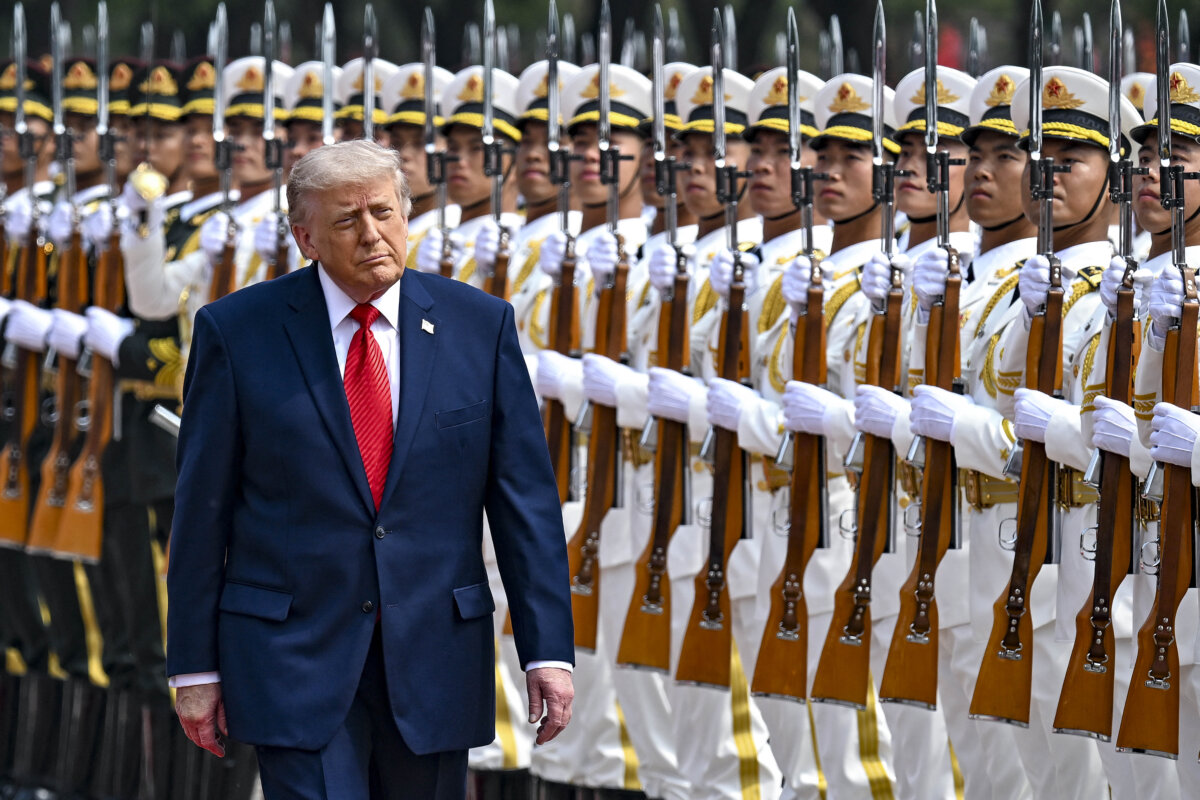

President Donald Trump said on May 15 that Taiwan was a major topic of discussion during his summit with Chinese leader Xi Jinping and said he has not yet decided whether to proceed with a major U.S. arms package for the island, while expressing confidence that tensions over the self-governing island would not lead to war.
Speaking to reporters aboard Air Force One while traveling to Alaska on Friday, Trump said he and Xi spoke “a lot” about Taiwan during their meeting in Beijing, where the Chinese leader said that the issue of Taiwan could trigger clashes between the world’s two largest economies.
“On Taiwan, he does not want to see a fight for independence because that would be a very strong confrontation,” Trump said.
When asked whether a confrontation with China over Taiwan was possible, Trump expressed confidence that it’s unlikely that the situation will deteriorate into an outbreak of hostilities.
“I think we’ll be fine,” Trump said, adding that the Chinese leader “doesn’t want to see a war.”
Trump also confirmed that the two sides discussed U.S. arms sales to Taiwan “in great detail,” but indicated that he had made no final decision on an $11.1 billion weapons package approved by Washington in December 2025, the largest ever proposed for the island democracy.
“We discussed the Taiwan … whole thing with the arm sales in great detail, actually,” Trump said. “I’ll be making decisions.”
At another point during the gaggle, Trump told reporters on the issue of Taiwan arms sales, “I will make a determination over the next fairly short period.”
Trump said he would first need to speak with the person “that’s running Taiwan,” referring to Taiwan’s President Lai Ching-te, without elaborating further.
Prospective Taiwan Arms Sales
The package includes high-mobility artillery rocket systems, self-propelled howitzers, drones, Javelin anti-tank missiles, anti-armor systems, helicopter spare parts, and refurbishment kits for Harpoon missiles.
Trump declined to say whether the United States would defend Taiwan militarily in the event of a Chinese attack.
“I don’t want to say that,” Trump said. “There’s only one person that knows that … me.”
According to a statement released by the Chinese foreign ministry, Xi warned Trump that Washington “must exercise extra caution” in handling Taiwan.
“If it is handled properly, the bilateral relationship will enjoy overall stability,” the statement said. “Otherwise, the two countries will have clashes and even conflicts, putting the entire relationship in great jeopardy.”
The White House released a brief summary of the summit that did not mention Taiwan, instead highlighting discussions on Iran, trade, and maintaining shipping through the Strait of Hormuz.
Secretary of State Marco Rubio, who participated in the Beijing meetings, said Xi’s comments were expected and stressed that U.S. policy toward Taiwan had not changed.
“They always raise it on their side. We always make clear our position, and we move on to the other topics,” Rubio told NBC News.
Rubio also warned that it would be “a terrible mistake” for China to attempt to take Taiwan by force.
“There would be repercussions for that globally, not just from the United States,” Rubio said, adding that this “sort of ambiguity” is how the United States characterizes the issue of Taiwan in talks with China.
The United States has maintained a policy of strategic ambiguity toward Taiwan while remaining the island’s most important security partner and largest supplier of defensive weapons.
“We don’t want to see conflict,” Rubio said. “We don’t want to see something disruptive happen, because I think it would be very disruptive for the world and for both countries.”
Taiwan’s government responded cautiously to the summit while accusing Beijing of being the main source of instability in the Taiwan Strait.
Mainland Affairs Council deputy minister and spokesman Liang Wen-chieh told reporters in Taipei that Taiwan has long been among the most sensitive topics in U.S.–China diplomacy.
“So at this point, all we can say is that there has been no surprising information so far, and we will continue to maintain close communication with the American side,” Liang said.
Liang said China’s military activities near Taiwan—rather than Taiwan’s desire to preserve its democratic system—posed the real threat to regional stability.
“If maintaining peace and stability in the Taiwan Strait is truly the greatest common ground between China and the United States, then the Chinese Communist Party should restrain its own behavior of military intimidation,” he said.
Taiwan’s foreign ministry similarly described Beijing as “the sole risk to regional peace and stability,” citing China’s military operations in the Taiwan Strait, East China Sea, and South China Sea.
Taiwan, a self-governing democracy of about 23 million people, rejects Beijing’s sovereignty claims and says only its people can determine the island’s future. The Chinese Communist Party has never ruled Taiwan but claims it as China’s territory and has not ruled out using force to seize control.
Emel Akan and James Xu contributed to this report.
 Friends Read Free
Copy
Facebook
Tweet
Friends Read Free
Copy
Facebook
Tweet