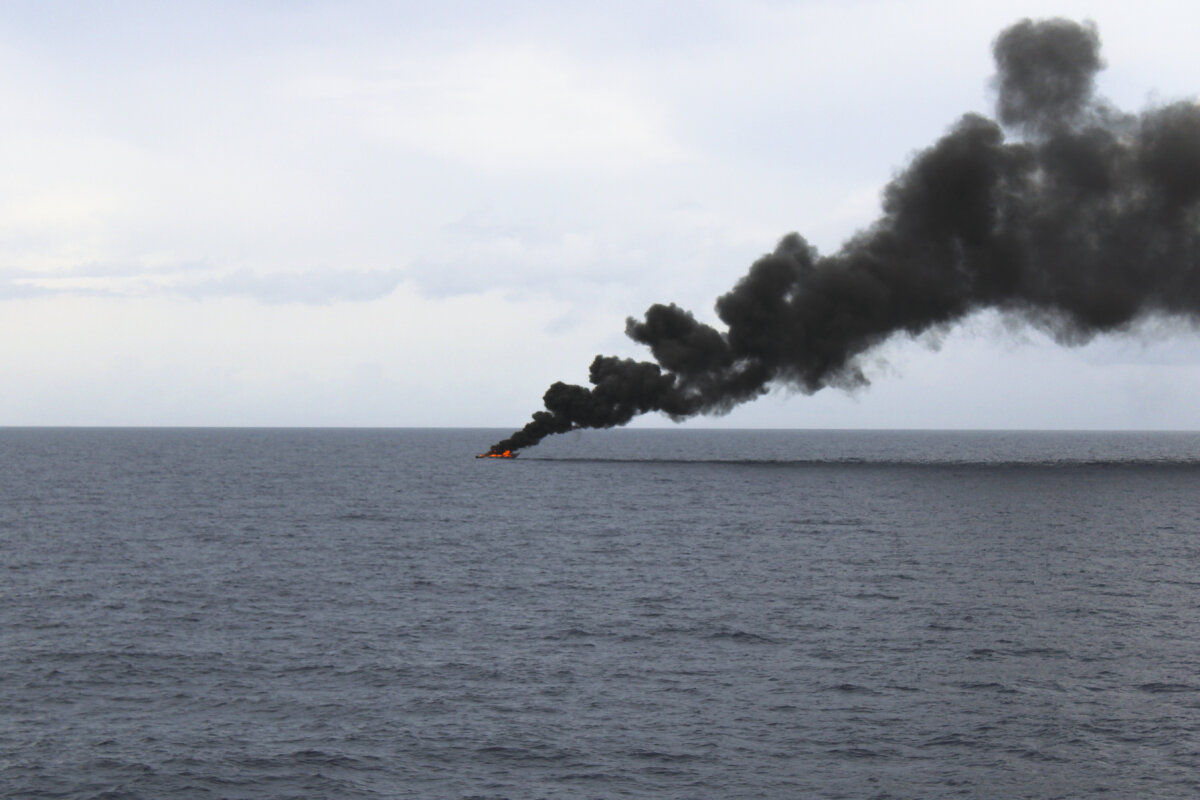

U.S. forces recently targeted a submersible vessel suspected of trafficking narcotics, President Donald Trump said during an Oct. 17 White House press conference, while hosting Ukrainian President Volodymyr Zelenskyy.
Trump described the strike on the submersible vessel after facing questions about reports that U.S. forces had recovered the survivors of a recent strike on a vessel operating in the Caribbean Sea. Reuters was the first to report that two individuals had survived the Oct. 16 U.S. strike on the suspected drug vessel.
Trump initially referred questions about the Oct. 16 strike to Secretary of State Marco Rubio.
“It’s well known there’s an ongoing narco-terrorist operation the United States has been conducting. As far as details of any recent strikes, we’re not prepared here to announce all those details, but you’ll get that information here very shortly,” Rubio began his response.
Following Rubio’s initial comments, Trump described the targeted vessel as a submarine.
“That was a submarine, right? It was. We attacked a submarine, and that was a drug-carrying submarine built specifically for the transportation of massive amounts of drugs,” Trump said. “Just so you understand, this was not an innocent group of people. I don’t know too many people that have submarines, and that was an attack on a drug-carrying loaded-up submarine.”
The Epoch Times initially reached out to the Pentagon regarding reports that individuals had survived an Oct. 16 U.S. strike. The Pentagon referred questions about the reported strike to the White House, which did not respond before Trump’s comments during the Oct. 17 press conference.
This strike on the alleged narcotics-trafficking submarine would mark at least the sixth time that U.S. forces have struck at a vessel operating in the Caribbean Sea since September.
On Sept. 2, Trump announced U.S. forces had killed 11 suspected narcotics traffickers in the Caribbean Sea. Since then, he and Secretary of War Pete Hegseth have shared footage of additional lethal U.S. strikes in the region.
These strikes come amid a heightened U.S. naval build-up in the Caribbean Sea and a growing pressure campaign targeting Venezuelan President Nicolás Maduro, whom the Trump administration has accused of backing cartels in his country. Maduro has denied the accusations.
In a social media post announcing the Sept. 2 strike, Trump said the 11 deceased suspects aboard the targeted vessel were members of Tren de Aragua, a transnational criminal organization that originated in Venezuela and which the State Department designated as a foreign terrorist organization earlier this year. In the same social media post, Trump said that Tren de Aragua is a group “operating under the control of Nicolas Maduro.”
Some U.S. lawmakers have raised questions about the legal justifications and intelligence assessments guiding recent U.S. strikes on vessels in the Caribbean Sea.
“We still don’t know if the strikes are legal, and why the U.S. is not instead interdicting to get intelligence to disrupt narcotrafficking routes,” said Sen. Tim Kaine (D-Va.) in an X post.
Earlier this month, the Trump administration formally notified Congress that the United States is in a “non-international armed conflict“ with drug cartels, which the administration referred to as “unlawful combatants.”
Last week, the U.S. Senate voted 48–51 to reject a war powers resolution attempting to restrain the Trump administration’s military operations in the Caribbean Sea.
 Friends Read Free
Copy
Facebook
Tweet
Friends Read Free
Copy
Facebook
Tweet