
President Donald Trump has said there’s “a possibility” the United States will join European powers in offering security guarantees to Ukraine—a longstanding demand from Kyiv, which fears that without such assurances, any peace deal with Russia could prove short-lived.
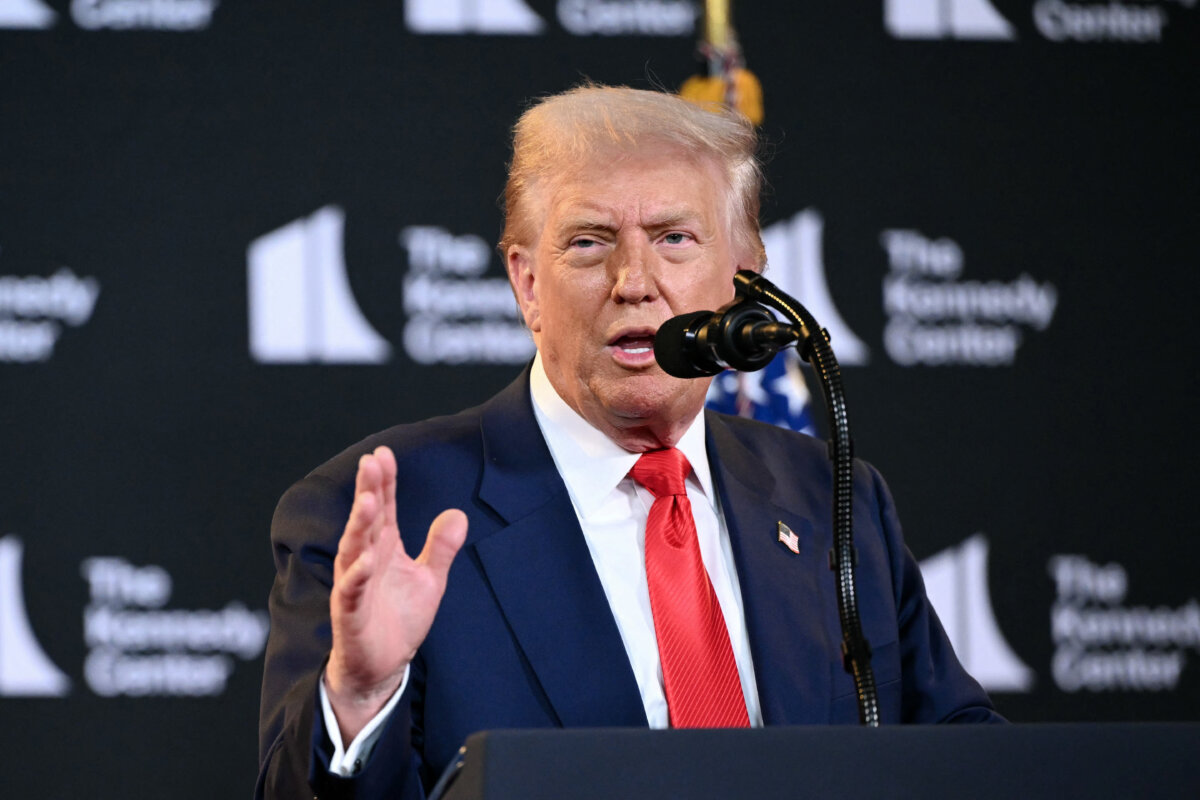
Trump made the comment to reporters aboard Air Force One on Aug. 15 as he traveled to Alaska for a summit with Russian President Vladimir Putin.
“Maybe,” Trump said when asked by reporters whether the United States would be willing to provide security guarantees to Kyiv, though he made clear this would not involve admitting Ukraine as a member of NATO.
“Not in the form of NATO,” he said. “There are certain things that aren’t going to happen.”
Ukraine has insisted that safeguards against future Russian aggression, backed by its Western allies, must be part of any durable settlement. Many Western governments, however, have hesitated to commit troops.
In an Aug. 13 statement, countries in the “coalition of the willing”—those prepared to help police a future peace agreement—stressed that “robust and credible security guarantees” are essential for Ukraine to protect its sovereignty and territorial integrity.
“The Coalition of the Willing is ready to play an active role, including through plans by those willing to deploy a reassurance force once hostilities have ceased,” the group said.
“No limitations should be placed on Ukraine’s armed forces or on its cooperation with third countries. Russia could not have a veto against Ukraine‘s pathway to EU and NATO.”
Trump held virtual meetings on Wednesday with European leaders in the coalition and, according to French President Emmanuel Macron and European Council President Antonio Costa, offered American military backup for the European reassurance force, though he has not provided details.
Afterward, Costa welcomed the readiness of “the United States to share with Europe the efforts to reinforce security conditions once we obtain a durable and just peace for Ukraine,” according to a statement from the council.
While Trump did not publicly reference U.S. security commitments after the meetings, his remarks on Air Force One two days later appeared to signal a willingness for some form of American role in enforcing a future peace.
Some European capitals have been reluctant to commit to a peacekeeping mission in Ukraine in part because of uncertainty over whether Trump would provide U.S. support, especially with air power. Senior Russian officials have repeatedly rejected the idea of European peacekeepers in Ukraine.
British Prime Minister Keir Starmer said after Wednesday’s meeting that the coalition—which includes the UK—would avoid front-line deployments, focusing instead on providing logistics, weapons, and training in western Ukraine, where the risk of direct attack is lower.
Meanwhile, Trump told reporters aboard Air Force One that he was not traveling to Alaska to negotiate on Ukraine’s behalf but to bring the warring sides together.
“I’m not here to negotiate for Ukraine,” the president said. “I’m here to get them at a table.”
He said it would be up to the Ukrainians to decide whether to concede territory to Putin as part of a settlement to end the more than three-year war, adding: “I think they’ll make a proper decision.”
Since announcing his meeting with Putin, Trump has suggested a deal could involve exchanges of captured land. Ukrainian President Volodymyr Zelenskyy has rejected that notion, noting that Ukraine’s constitution prohibits ceding territory.
Trump and Putin are scheduled to meet at Joint Base Elmendorf-Richardson at 11:30 a.m. local time. Zelenskyy will not be present.
The Associated Press contributed to this report.
 Friends Read Free
Copy
Facebook
Tweet
Friends Read Free
Copy
Facebook
Tweet