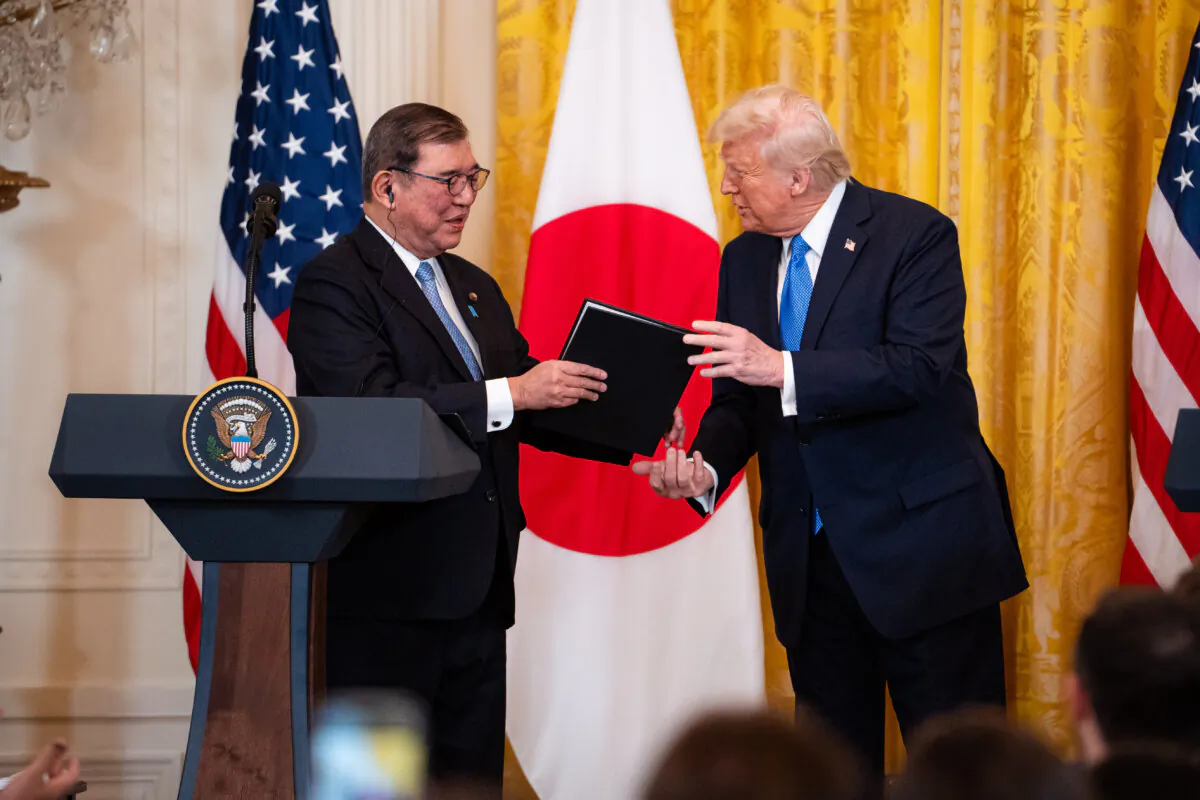

WASHINGTON—President Donald Trump signed an executive order on Sept. 4 to impose new 15 percent tariffs on Japanese goods and enact other provisions of a previous trade agreement with Tokyo, which includes $550 billion in investment commitments in the United States.
The U.S.-Japan trade deal, agreed on July 22, sets a baseline 15 percent tariff on nearly all Japanese imports. The tariffs will be applied retroactively to shipments from Aug. 7.
The agreement includes separate sector-specific tariffs for key industries such as automobiles, aerospace products, pharmaceuticals, and certain natural resources, as outlined in the executive order.
The deal represents a significant win for Japan, lowering tariffs on Japanese automobiles—including models from Toyota, Honda, and Nissan—from 27.5 percent to 15 percent. Tariffs previously imposed on Japanese civil aircraft, excluding unmanned aircraft, will be removed. Additionally, certain Japanese products, including natural resources not available in the United States, generic pharmaceuticals, and essential pharmaceutical ingredients, may face no tariffs.
According to the Office of the United States Trade Representative, the U.S. goods trade deficit with Japan totaled $69.4 billion in 2024.
The U.S.-Japan trade agreement will help reduce this deficit and create a more balanced economic relationship between the two countries, according to the order.
Japan has agreed to open its markets to American producers across many sectors, including manufacturing, aerospace, agriculture, food, energy, automobile, and industrial goods. As part of this expanded access, Tokyo has committed to increasing U.S. rice imports by 75 percent and purchasing $8 billion annually in American agricultural and other products, including corn, soybeans, fertilizer, and bioethanol.
Japan will also work on accepting U.S.-certified passenger vehicles without requiring additional testing, while committing to buy U.S.-made commercial aircraft and defense equipment, according to the agreement.
Japan has also agreed to invest $550 billion in the United States. These investments will be selected by the U.S. government and will help generate new jobs and boost domestic manufacturing, the executive order stated.
On Sept. 3, Trump warned that his administration might need to “unwind” trade agreements with other countries, including Japan, if it loses a Supreme Court case on tariffs, warning that such a loss could cause the United States “to suffer so greatly.”
The Trump administration asked the Supreme Court on Sept. 3 to review a lower court order that struck down most of his global tariffs.
In the appeal, Treasury Secretary Scott Bessent wrote that letting the decision to take effect “would lead to dangerous diplomatic embarrassment,” “expose the United States to the risk of retaliation,” and “interrupt ongoing negotiations midstream, undermining [the administration’s] ability to protect the national security and economic welfare of the American people.”
 Friends Read Free
Copy
Facebook
Tweet
Friends Read Free
Copy
Facebook
Tweet