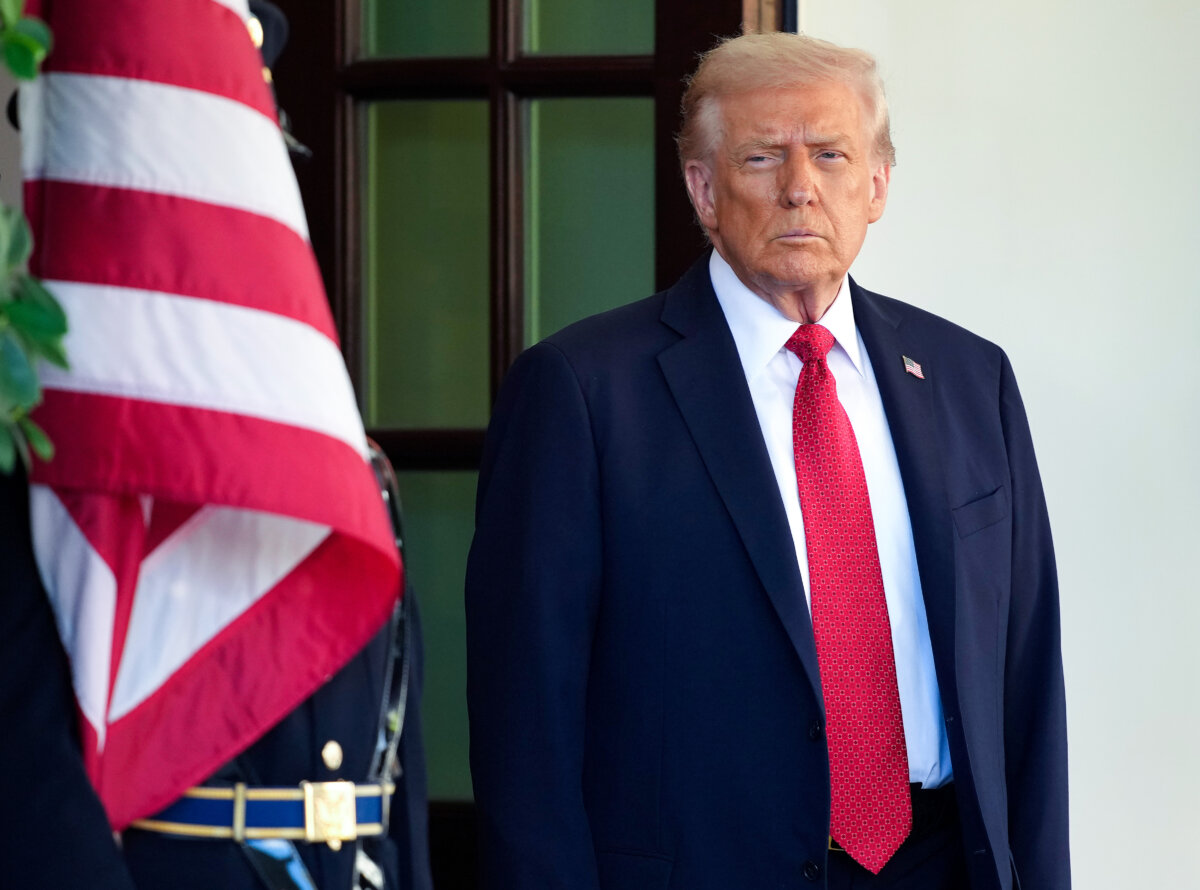

The White House has unveiled a new national security strategy built around President Donald Trump’s “America First” doctrine, prioritizing the halting of destabilizing mass illegal immigration, a sweeping revival of U.S. industrial power, and the elevation of U.S. dominance in the Western Hemisphere as a central foreign policy objective rather than acting as a global police force.
Released on Dec. 5, the document calls for a far-reaching realignment of U.S. military posture, urging the redirection of American resources toward emerging threats in the Western Hemisphere and a pullback from regions viewed as less vital to U.S. security. It marks a sharp departure from decades of post-Cold War doctrine that sought to shore up Washington’s role as a global hegemon.
“The United States rejects the ill-fated concept of global domination for itself,” it states.
While the United States must still work to prevent other nations from achieving global or regional dominance, the strategy argues, it rejects entangling the country in “forever wars” or assuming what it calls “forever global burdens” disconnected from core national interests.
“This does not mean wasting blood and treasure to curtail the influence of all the world’s great and middle powers,” the strategy states. “The outsized influence of larger, richer, and stronger nations is a timeless truth of international relations. This reality sometimes entails working with partners to thwart ambitions that threaten our joint interests.”
In place of open-ended military commitments, the strategy calls for allies to assume primary responsibility for their own defense. Washington, it says, will increasingly rely on economic tools—such as favorable commercial terms, defense procurement cooperation, or technology sharing—acting as a “convener and supporter” that manages a network of burden-sharing partnerships rather than serving as the first responder in every crisis.
“The days of the United States propping up the entire world order like Atlas are over,” it states. “This strategic clarity will allow the United States to counter hostile and subversive influences efficiently while avoiding the overextension and diffuse focus that undermined past efforts.”
Reviving the Monroe Doctrine
The strategy speaks explicitly about deepening U.S. influence in Latin America, where the administration has stepped up maritime interdictions, pressured leftist governments, and pressed for stronger control over critical infrastructure, such as the Panama Canal.
“The United States must be preeminent in the Western Hemisphere as a condition of our security and prosperity—a condition that allows us to assert ourselves confidently where and when we need to in the region,” it states.
Central to that vision is a “Trump Corollary” to the Monroe Doctrine, under which the United States will block foreign rivals—implicitly China—from acquiring or controlling critical ports, telecommunications networks, or other infrastructure in the Americas. The strategy calls for enhanced Coast Guard and naval deployments; targeted operations against drug cartels, including potential lethal force; and stepped-up commercial diplomacy to counter foreign investment.
“Non-Hemispheric competitors have made major inroads into our Hemisphere, both to disadvantage us economically in the present, and in ways that may harm us strategically in the future,” it states. “Allowing these incursions without serious pushback is another great American strategic mistake of recent decades.”
Mass Migration, Economic Security
Immigration is presented as a core national security challenge. The strategy argues that uncontrolled mass migration threatens U.S. cohesion, wages, and sovereignty, identifying border control as essential to national defense.
It links border vulnerabilities to foreign espionage, drug trafficking, and cartel violence, calling for firm federal control over all entries into the country.
“A border controlled by the will of the American people as implemented by their government is fundamental to the survival of the United States as a sovereign republic,” it notes. “The era of mass migration must end.”
The strategy also portrays Europe as facing “civilizational erasure” due to migration, demographic decline, and political censorship, urging Europe to “regain its civilizational self-confidence.” Ending the war in Ukraine through a negotiated settlement is described as a “core interest” necessary to stabilize Europe and restore strategic equilibrium with Russia.
Economic nationalism forms another foundation of the strategy. It commits the United States to tariffs, reshoring incentives, and expanded industrial capacity to secure supply chains and underpin wartime readiness, alongside efforts to rebuild the defense industrial base and expand fossil fuel and nuclear energy while rejecting net-zero mandates.
“The United States must never be dependent on any outside power for core components,” it states. “We must re-secure our own independent and reliable access to the goods we need to defend ourselves and preserve our way of life.”
China as Main Competitor, Middle East and Africa Recast
The strategy identifies China as the United States’ chief long-term competitor and focuses on rebalancing the relationship through fairer trade, resilient supply chains, and strict protections for sensitive technology.
“In the long term, maintaining American economic and technological preeminence is the surest way to deter and prevent a large-scale military conflict,” it states, while also emphasizing continued deterrence in the Indo-Pacific.
The United States will maintain a strong presence in the Western Pacific but insists allies must assume far greater responsibility for regional stability.
“We will build a military capable of denying aggression anywhere in the First Island Chain,” it states. “But the American military cannot, and should not have to, do this alone.”
The Middle East is de-emphasized as a primary focus, with the document citing domestic energy abundance and Trump’s regional peace efforts. It reaffirms commitments to Israel and securing vital waterways such as the Strait of Hormuz, while rejecting prolonged “nation-building” campaigns.
In Africa, policy shifts toward energy, trade, and critical minerals rather than aid and what it calls the export of “liberal ideology.”
In an introductory letter, Trump wrote that the strategy is about “putting America First.”
“This document is a roadmap to ensure that America remains the greatest and most successful nation in human history, and the home of freedom on earth,” the president wrote.
“In the years ahead, we will continue to develop every dimension of our national strength—and we will make America safer, richer, freer, greater, and more powerful than ever before.”
 Friends Read Free
Copy
Facebook
Tweet
Friends Read Free
Copy
Facebook
Tweet