
The United States has reached trade deals with four Southeast Asian countries addressing critical rare earth minerals and broader trade imbalances.
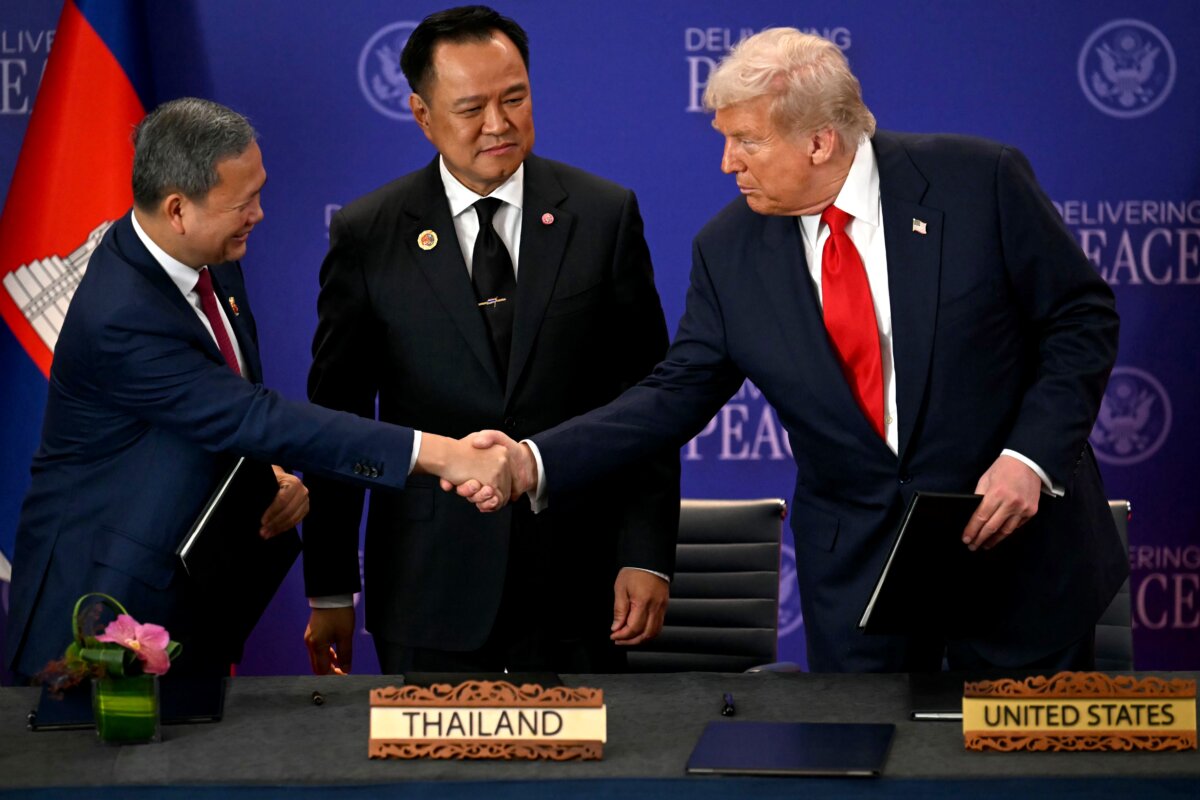
President Donald Trump, while in Kuala Lumpur, Malaysia, for a trade summit with the Association of Southeast Asian Nations, signed agreements with Malaysia and Cambodia, as well as a framework agreement with Thailand that commits both to working on trade issues.
Under the deals, all three countries would be subject to a continued U.S. tariff rate of 19 percent, although some goods are exempted.
The White House previously announced a similar deal with Vietnam, which will see a 20 percent tariff levied on its exports to the United States.
Vietnam also promised to substantially increase its purchases from the United States to help close a $123 billion trade deficit with the superpower.
All four countries promised to remove trade barriers and provide preferential market access to various U.S. goods, as well as commitments related to digital trade, services, and investments.
The four countries also promised to protect labor rights and strengthen environmental protections under the deal.
Thailand, Malaysia, and Vietnam have also agreed to accept vehicles built to U.S. motor vehicle safety and emissions standards.
Thailand said it would eliminate tariff barriers on approximately 99 percent of U.S. goods and relax foreign ownership restrictions for U.S. investment in its telecommunications sector.
Thailand also agreed to purchase 80 U.S. aircraft, worth a total of $18.8 billion, and U.S. energy products such as natural gas and oil, totaling about $5.4 billion annually.
Rare Earths
As part of the deal, Malaysia agreed not to ban exports of rare earth materials to the United States.
The global market for rare earths—which are critical components in modern computer technology and in other sectors—is cornered by China, which dominates the refining of these materials and has among the largest deposits of them in the world. The U.S. adversary has increasingly sought to crack down on exports of these critical materials, sending global manufacturers scrambling to find alternative sources.
In a nonbinding agreement on the issue, the United States said it would assist Malaysia in developing the sector.
The two nations agreed to “share relevant information, knowledge, and technical expertise on international best practices to increase the competitiveness of Malaysia’s critical minerals sector.”
This could include meetings between the two nations’ governments; joint geoscience work; information exchanges, workshops, and seminars with the private sector, universities, and other stakeholders; and capacity-building activities.
Malaysian trade minister Tengku Zafrul Aziz told reporters that Malaysia had also secured tariff exemptions for aerospace equipment and pharmaceutical products, as well as commodities such as palm oil, cacao, and rubber.
Reuters contributed to this report.
 Friends Read Free
Copy
Facebook
Tweet
Friends Read Free
Copy
Facebook
Tweet