
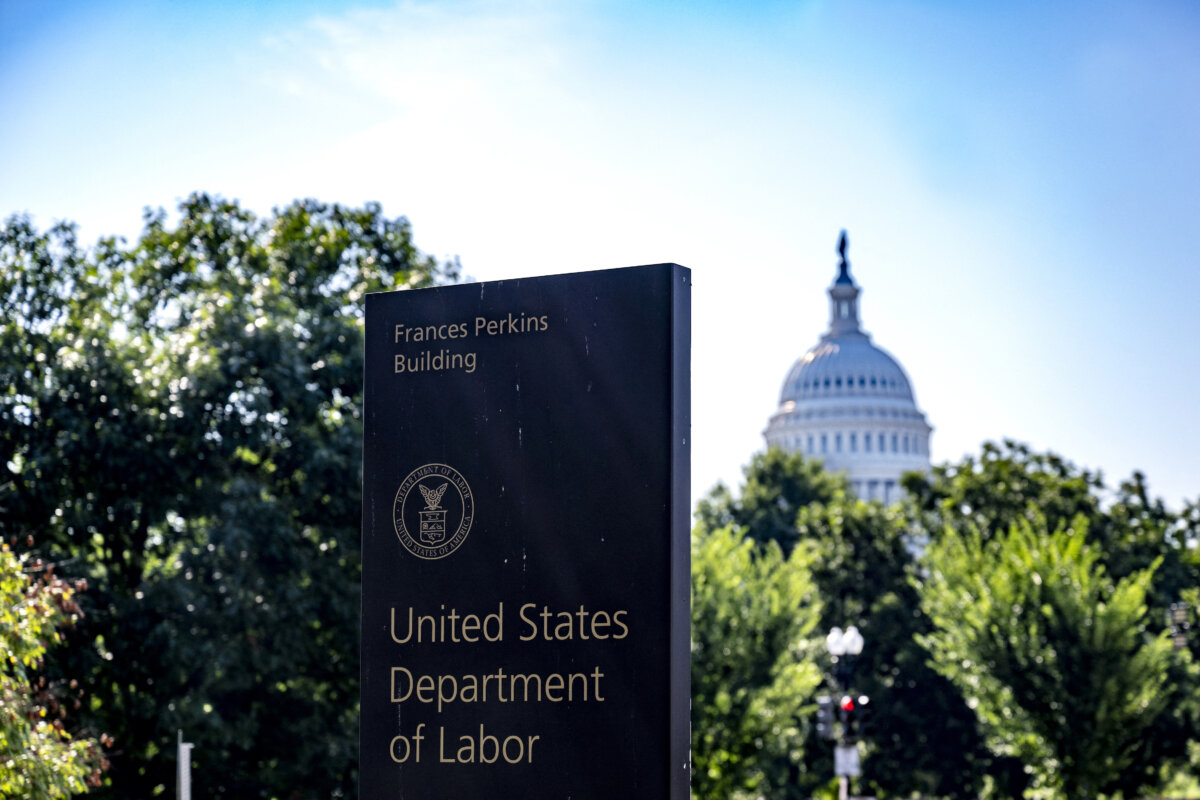
The Department of Labor’s Bureau of Labor Statistics (BLS) will not release a full October jobs report after the 43-day federal government shutdown prevented officials from collecting critical data used to calculate the unemployment rate and other key labor market measures, the agency said in a Nov. 19 notice.
Instead of releasing an October edition of the bureau’s signature “Employment Situation” report, the agency will fold select October data, primarily payroll job creation figures, into the delayed November report, now rescheduled for release on Dec. 16.
The October household survey, which produces the unemployment rate, could not be conducted during the government shutdown, and the missed data collection cannot be made up, the BLS said.
“The household survey data is not able to be retroactively collected,” the agency said, adding that collection for both November surveys will be extended and require additional processing time.
The lapse in appropriations also disrupted the Job Openings and Labor Turnover Survey (JOLTS), a monthly report that tracks job vacancies, hiring, and quits and is closely watched as a broader gauge of labor-market tightness and worker demand. The agency said it will skip the September JOLTS release entirely and instead publish the September and October data together at a later date.
White House Data Collection Warning
The cancellation of the October jobs report had been anticipated. On Nov. 12, the White House said the October figures might never be released because the prolonged shutdown had halted BLS field operations and delayed statistical processing.
“The Democrats may have permanently damaged the federal statistical system with October [consumer price index] and jobs reports likely never being released,” White House press secretary Karoline Leavitt said during a Nov. 12 briefing. “All of that economic data released will be permanently impaired, leaving our policymakers at the Fed flying blind at a critical period.”
National Economic Council Director Kevin Hassett said the administration expected to recover only the payroll data for October.
“We’ll get the jobs part, but we won’t get the unemployment rate. And that’ll just be for one month,” he said in a Nov. 13 Fox News interview.
Former BLS commissioner Erika McEntarfer—fired by President Donald Trump earlier this year after a dispute over July’s weaker-than-expected jobs numbers—said the situation was straightforward.
“No conspiracy here, folks,” she wrote in a Nov. 19 post on Bluesky. “Payroll data from firms can be retroactively collected for October. The household survey cannot.”
Fed Loses Key Data Ahead of December Meeting
The missing October job data also means the Nov. 20 release of the September employment report—originally due Oct. 3—will draw unusually sharp scrutiny. It is the last full reading of hiring and unemployment that Federal Reserve officials will receive before their Dec. 9–10 policy meeting.
Divisions at the Fed have widened over whether to deliver a third straight rate cut next month. At the October meeting, officials lowered the benchmark rate to a range of 3.75 percent to 4 percent and were split over whether further reductions are warranted amid mixed signals on inflation and a softening labor market.
Fed Governor Christopher Waller said this week that weakening employment conditions justify another cut.
“I worry that restrictive monetary policy is weighing on the economy, especially about how it is affecting lower-and middle-income consumers,” he said in a Nov. 17 speech, adding that a December cut would “provide additional insurance” against further cooling.

Others, including Boston Fed President Susan Collins, have urged caution.
“It will likely be appropriate to keep policy rates at the current level for some time to balance the inflation and employment risks in this highly uncertain environment,” Collins said on Nov. 12.
Additional private-sector data points to a slowdown. Payrolls processor ADP said this week that private employers shed an average of 2,500 jobs per week over the four weeks ending Nov. 1, extending a months-long “low fire, low hire” trend.
The BLS said revised release dates for all delayed reports will be posted as updates become available.
Andrew Moran contributed to this report.
 Friends Read Free
Copy
Facebook
Tweet
Friends Read Free
Copy
Facebook
Tweet