

U.S. firms are apprehensive about passing higher tariff-related costs on to their customers, according to the latest Federal Reserve report, released on Oct. 15.
The October Beige Book—a periodic summary of economic conditions across the central bank’s 12 districts—found that businesses have been facing higher input costs at a faster pace due to rising import costs. Firms are also experiencing increasing input pressures from services, including health care, insurance, and technology solutions.
But many companies have refrained from putting pressure on consumers’ wallets.
“Some firms facing tariff-induced cost pressures kept their selling prices largely unchanged to preserve market share and in response to pushback from price-sensitive clients,” the report reads.
The report found, however, that manufacturing and retail firms did pass tariff-driven costs entirely onto their customers.
Economic observers have been attempting to gauge the effect President Donald Trump’s global tariffs may have on business and consumer prices since he unveiled the contours of his trade agenda in April.
A new Goldman Sachs analysis projects that U.S. consumers will pay 55 percent of the tariff-related costs. American businesses and foreign exporters will take on 22 percent and 18 percent, respectively.
“At the moment, however, U.S. businesses are likely bearing a larger share of the costs because some tariffs have just gone into effect and it takes time to raise prices on consumers and negotiate lower import prices with foreign suppliers,” the report reads.
Due to the U.S. government shutdown, market watchers have faced challenges in determining producer and consumer inflation levels.
The Bureau of Labor Statistics did not release the September Consumer Price Index (CPI) and Producer Price Index (PPI) this week. The federal agency plans to publish the CPI data on Oct. 24 to ensure the Social Security Administration can calculate cost-of-living adjustments, or COLAs.
Prior to the now two-week-old shutdown, the Federal Reserve Bank of Cleveland’s Inflation Nowcasting model pointed to the annual inflation rate reaching 3 percent for the first time since January.
Because it covered the period of late August through the end of September, the Beige Book did not provide businesses’ insights into the U.S. government shutdown.
Private-sector alternatives, however, highlight little impact from higher import costs.
The Truflation U.S. Inflation Index, for example, which relies on a treasure trove of metrics, is hovering at around 2.2 percent—slightly above the Fed’s inflation target.
Still, Federal Reserve Chair Jerome Powell noted that the inflation outlook has not changed.
Appearing at a National Association of Business Economists event on Oct. 14, Powell said there is a risk that the slow pass-through of tariffs to consumer prices could resemble persistent inflation rather than a one-time adjustment. However, this result is unlikely, he said, adding that the institution is walking a tightrope when responding to threats to the Fed’s dual mandate.
“If we move too quickly, then we may leave the inflation job unfinished and have to come back later and finish it,” Powell said. “If we move too slowly, there may be unnecessary losses, painful losses, in the employment market.”
In recent months, the figures have spotlighted deteriorating employment conditions.
National Labor Snapshot
According to the Beige Book, employment levels have been stable, although demand for labor has been “generally muted” across the country and business sectors.
“In most Districts, more employers reported lowering head counts through layoffs and attrition, with contacts citing weaker demand, elevated economic uncertainty, and, in some cases, increased investment in artificial intelligence technologies,” the report reads.
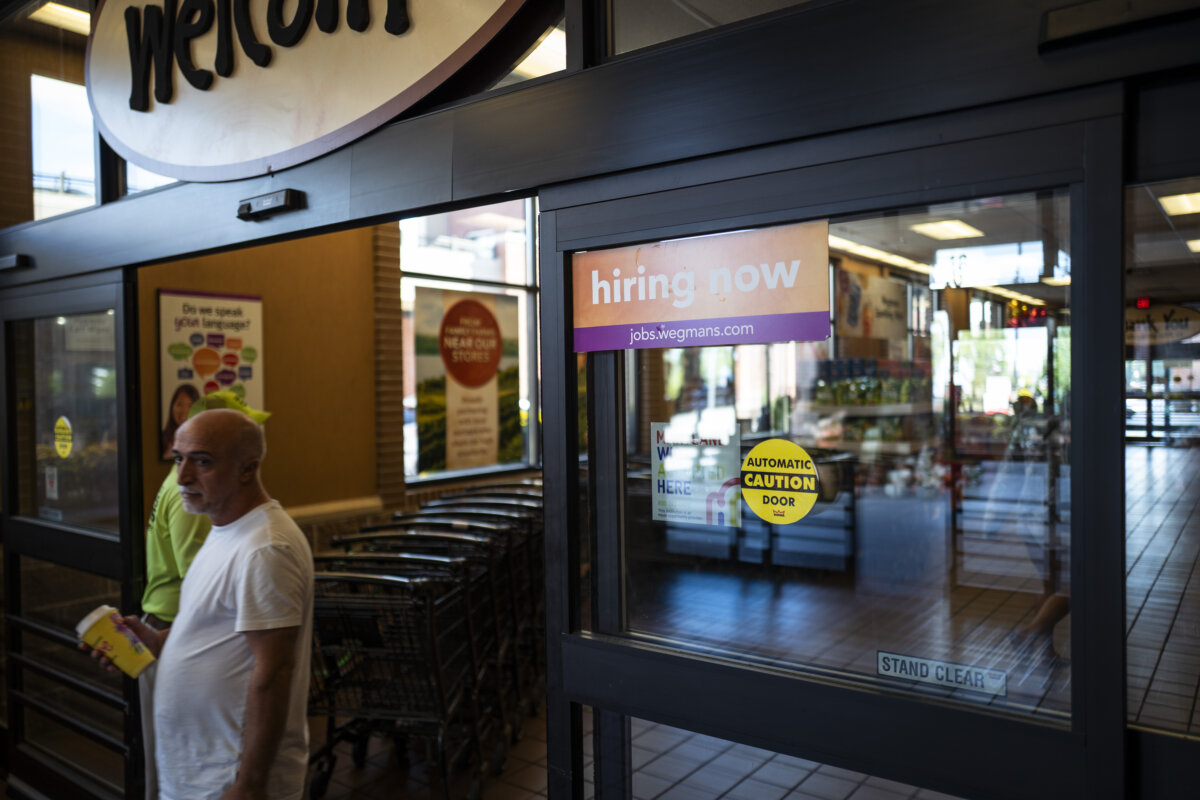
Employers who were hiring generally observed greater labor availability, with some firms opting for temporary or part-time roles instead of full-time positions. However, labor shortages persisted in multiple industries, including hospitality, agriculture, construction, and manufacturing, in several districts. This, the report said, was largely due to recent immigration policy changes.
Meanwhile, wages rose across the country at a “modest to moderate pace,” while labor cost pressures ballooned “due to outsized increases in employer-sponsored health insurance expenses.”
As with inflation, investors and policymakers have been closely examining employment metrics to gauge the health of the labor market.
Real-time data from the Indeed Job Posting Index—a running estimate of hiring demand based on millions of job postings—have been flat this month after a 2.5-percent decline in September.
The Chicago Fed’s biweekly Labor Market Indicators report reaffirmed the months-long trend of an economy facing a low-fire, low-hire climate. The unemployment rate was flat at 4.3 percent, mirroring what the Bureau of Labor Statistics reported last month.
Despite weakness showing up across the labor market, consumers still enjoy “some runway,” said Mark Malek, chief investment officer at Siebert Financial.
“Yes, the labor market is showing softness. Yes, interest rates are elevated. Yes, inflation and geopolitical risks continue to loom, but consumer credit strength, at least as validated through the banks’ own performance, suggests that the average American still has some runway,” Malek said in a note emailed to The Epoch Times.
“They are still spending, still borrowing carefully, and still supporting consumption.”
This week, the big banks released their earnings reports for the third quarter. Financial institutions, from the Bank of America to Wells Fargo, highlighted a resilient consumer.
“While some economic uncertainty remains, the U.S. economy has been resilient and the financial health of our clients and customers remains strong,” Wells Fargo CEO Charlie Scharf said in an Oct. 14 conference call.
Data from the Bank of America Institute show that total credit and debit card spending per household rose 2 percent year over year in September, up from 1.7 percent in the previous month.
 Friends Read Free
Copy
Facebook
Tweet
Friends Read Free
Copy
Facebook
Tweet