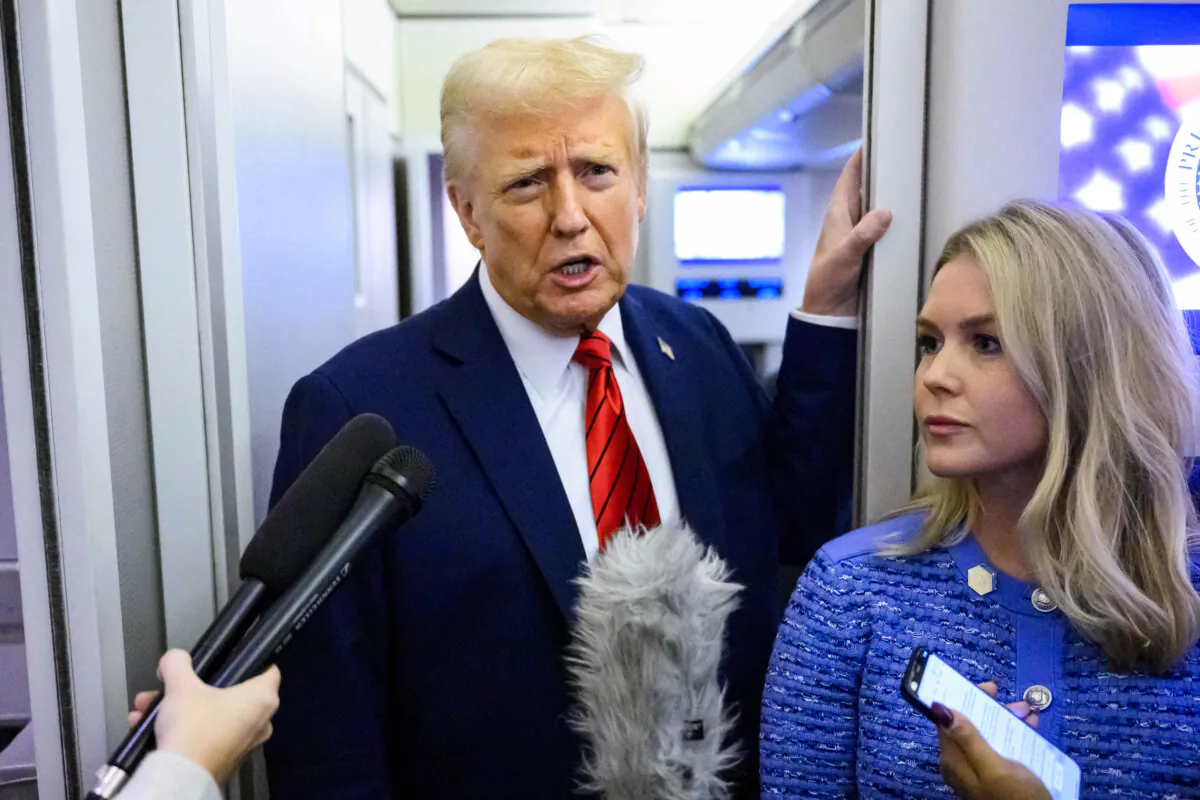

President Donald Trump and White House officials signaled that the administration is open to regime change, after the United States bombed the country’s nuclear facilities over the weekend.
In a statement on Truth Social, Trump suggested that Iran’s government, which has ruled the country as an Islamic theocratic autocracy since 1979, could be toppled in the midst of more than a week of airstrikes between Iran and Israel. The United States bombed multiple nuclear sites in an attempt to prevent Iran from producing a nuclear weapon.
“It’s not politically correct to use the term, ‘Regime Change,'” Trump wrote on Sunday afternoon, “but if the current Iranian Regime is unable to MAKE IRAN GREAT AGAIN, why wouldn’t there be a Regime change??? MIGA!!!”
On Monday morning, White House press secretary Karoline Leavitt told ABC News that “if the Iranian regime refuses to come to a peaceful, diplomatic solution—which the president is still interested in engaging in … why shouldn’t the Iranian people take away the power of this incredibly violent regime?”
“Our posture has not changed,” she said.
In reference to the president’s comment on Truth Social, Leavitt said that Trump “was just simply raising a question” and stressed that “as far as our military posture, it has not been changed.”
Neither Trump nor Leavitt suggested an ouster of the Islamic regime, led by Ali Khamenei, and nor did he say that the United States should play a role in overthrowing it.
Vice President JD Vance, Secretary of State Marco Rubio, and Defense Secretary Pete Hegseth signaled Sunday that the Trump administration isn’t interested in removing the current regime, but is interested in dismantling its nuclear facilities to prevent the regime from acquiring nuclear weapons.
“We don’t want to achieve regime change. We want to achieve the end of the Iranian nuclear program,” Vance told ABC News in an interview Sunday. “That’s what the president set us out to do.”
Rubio, speaking to CBS News on Sunday, said that the airstrikes were not “an attack on Iran” and “not an attack on the Iranian people,” adding that “this wasn’t a regime change move.”
Suggestions of regime change from the White House could draw the ire of some Republicans allied with Trump. In a post on social media platform X, Rep. Marjorie Taylor Greene (R-Ga.) has often said that the United States shouldn’t get involved in the Israel–Iran conflict.
In a post on Sunday, hours after the U.S. airstrikes on Iran, Greene wrote that she doesn’t want any more American participation in foreign conflicts.
“Americans now fear Iranian terrorists attacks on our own soil and being dragged into another war,” she said.
“American troops have been killed and forever torn apart physically and mentally for regime change, foreign wars, and for military industrial base profits.”
On Sunday and Monday, several top Iranian officials threatened retaliation after the airstrikes, but did not indicate how. Following airstrikes in 2020 that killed Iranian commander Qassem Soleimani, Iran launched barrages of missiles at U.S. bases in the Middle East, while state media reported that Iran’s Parliament voted to close down the Strait of Hormuz, a key global shipping chokepoint.
Iranian Army Maj. Gen. Amir Hatami said through state-run Iranian media that the United States would face Iranian repercussions, while Iran’s foreign minister said a day earlier that “all options” are on the table.
Vance reiterated Sunday that there will be “no boots on the ground” in Iran, meaning no U.S. troops will be deployed there. He also said that Trump has been clear that the United States also doesn’t want a lengthy conflict with Iran.
“I think that we have really pushed their program back by a very long time,” he added. “I think that it’s going to be many many years before the Iranians are able to develop a nuclear weapon.”
 Friends Read Free
Copy
Facebook
Tweet
Friends Read Free
Copy
Facebook
Tweet