
President Donald Trump announced Tuesday that the United States has reached a trade agreement with the Philippines that includes a 19 percent tariff on goods imported from the Southeast Asian country.
The agreement will eliminate tariffs on U.S. exports to the Philippines, according to Trump, who praised Philippines President Ferdinand Marcos Jr. for “going open market with the United States.”
“In addition, we will work together Militarily,” the president said in a Truth Social post announcing the deal, which came shortly after Marcos departed the White House.
“It was a beautiful visit, and we concluded our Trade Deal,” Trump wrote. He did not provide further details about the agreement.
The 19 percent tariff is slightly lower than the 20 percent figure Trump announced earlier in July, and above the 17 percent reciprocal tariff rate he unveiled in April. It matches the 19 percent rate recently announced for Indonesia and undercuts Vietnam’s 20 percent rate.
The Philippines maintains a close trade relationship with the United States, exporting $14.2 billion worth of goods last year while posting a $4.9 billion trade surplus.
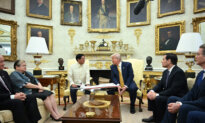
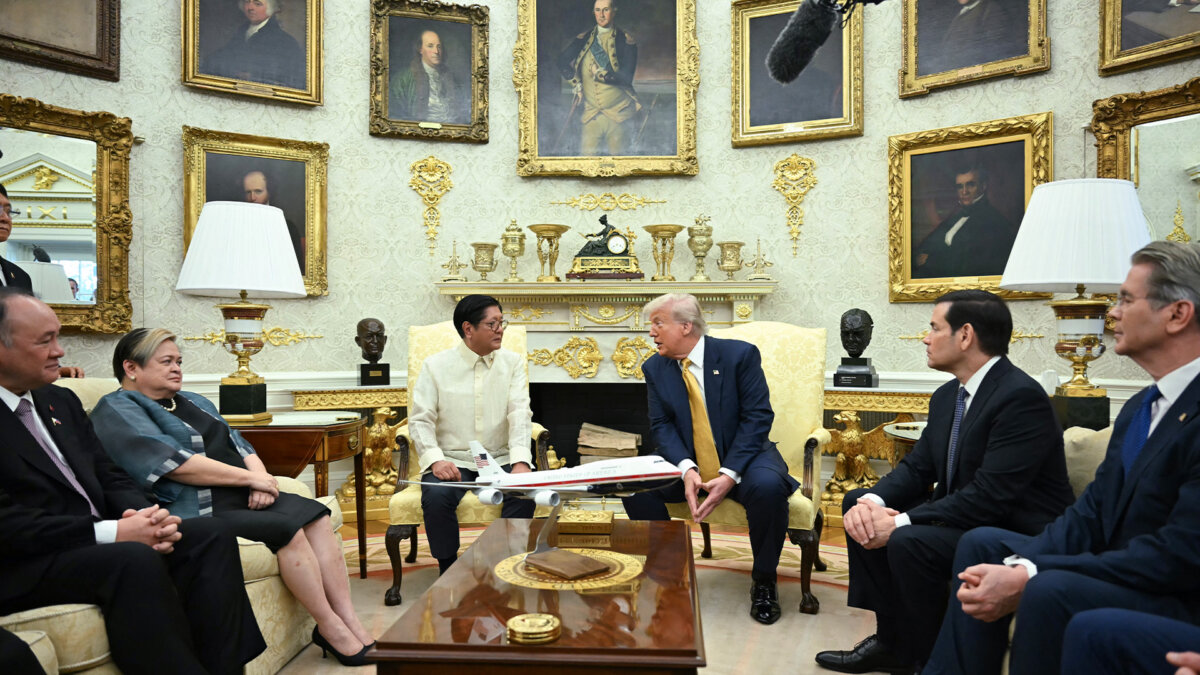
During the Oval Office event earlier Tuesday, the topic of China, including the recent deployment of U.S. missile systems in response to the China threat, came up repeatedly as Trump and Marcos fielded questions from reporters.
Under former President Rodrigo Duterte, the Philippines pursued a China-friendly policy, halting joint maritime patrols with the United States and even threatening to scrap an accord that was key to maintaining a U.S. military presence in his country.
Duterte sought to leverage Chinese investments and infrastructure financing under Beijing’s Belt and Road Initiative and proposed joint resource exploration in contested waters, but those efforts did not yield the economic or diplomatic gains he had hoped for.
In 2021, a year before his retirement, Duterte dramatically reversed course and restored defense ties with Washington. Marcos has continued that trajectory, expanding cooperation with the United States and pushing back against China’s territorial claims.
Sitting next to Trump in the Oval Office, Marcos said the Philippines had been “forced to modernize” its military in response to Chinese aggression in the South China Sea, site of long-running territorial disputes between China and its maritime neighbors.
According to Marcos, the United States is “assisting the Philippines in what we call our self-reliance defense program, which is to allow us to be self-reliant and to be able to stand on our own two feet, whatever the circumstances that occur in the future.”
Trump, in turn, emphasized the importance of the two countries’ military cooperation and welcomed the renewed direction of U.S.–Philippines relations.
“The country was maybe tilting toward China, but we un-tilted it very, very quickly,” Trump said. “You had a country that was tilting toward China for a period of time, and I just don’t think that would have been good for you.”
Still, Trump signaled he would not oppose continued diplomatic engagement between Manila and Beijing.
“I don’t mind if he gets along with China, because we’re getting along with China very well,” Trump reassured Marcos. “We have a very good relationship.”
“In fact, the magnets … are coming out, you know very well,” he continued, referring to recent talks held in London and Geneva that led China to resume rare-earth exports to the United States in exchange for the lifting of corresponding U.S. countermeasures. “They’re sending them in record numbers.”
“We’re getting along with China very well. And I don’t mind if [President Marcos] dealt with China, because I think he has to do what’s right for his country.”
 Friends Read Free
Copy
Facebook
Tweet
Friends Read Free
Copy
Facebook
Tweet