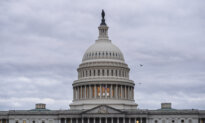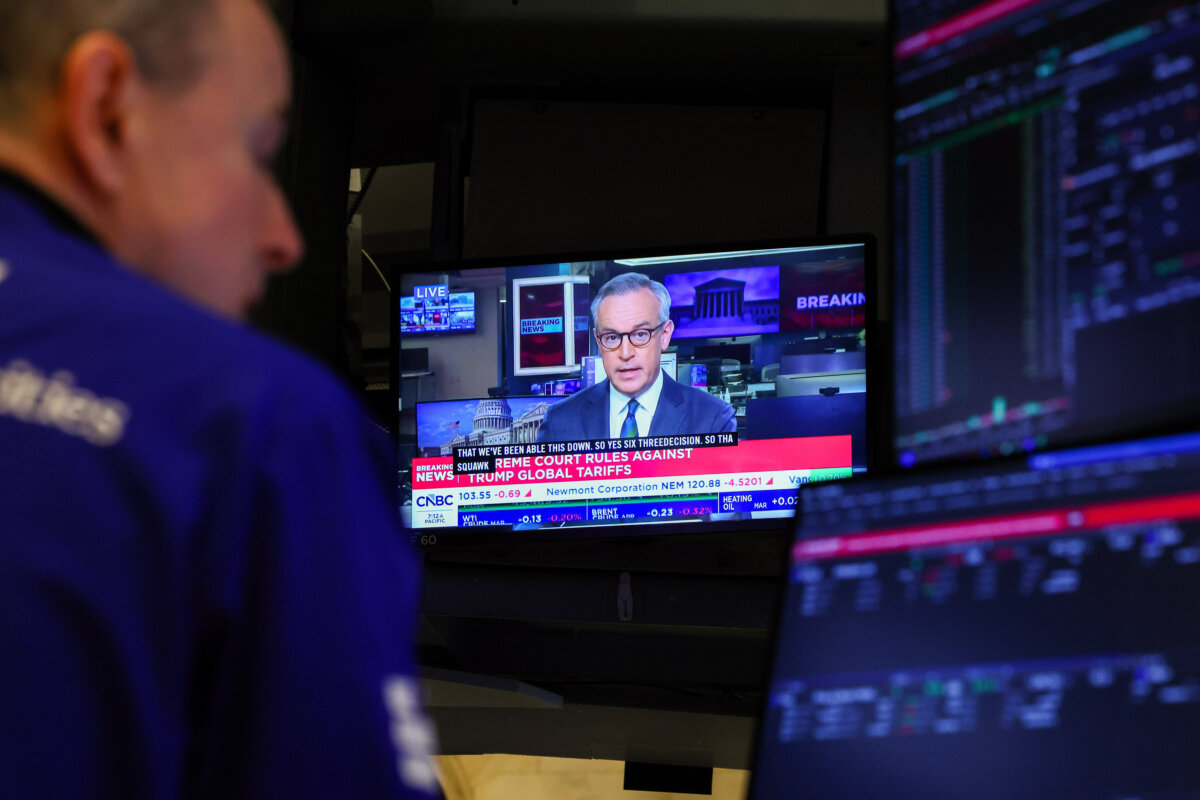

The Dow Jones Industrial Average, the S&P 500 Index, and the Nasdaq Composite all rose slightly following the U.S. Supreme Court’s 6–3 ruling that struck down a large portion of President Donald Trump’s tariffs.
As of noon trading on Friday, the Dow Jones was up around 140 points, or 0.28 percent, while the Nasdaq increased by 1.12 percent, or 253 points, in that same time period. The S&P 500 increased 0.66 percent, or 45 points.
On Friday morning, a decision released by the Supreme Court’s majority found that the U.S. Constitution “very clearly” gives Congress the power to impose taxes, which include tariffs.
“The Framers did not vest any part of the taxing power in the Executive Branch,” Chief Justice John Roberts wrote in the opinion, adding that the president “enjoys no inherent authority to impose tariffs during peacetime.”
Roberts added that the government “does not defend the challenged tariffs as an exercise of the President’s warmaking powers. The United States, after all, is not at war with every nation in the world.”
In dissent, Associate Justice Brett Kavanaugh disagreed with the majority, saying the “tariffs at issue here may or may not be wise policy … but as a matter of text, history, and precedent, they are clearly lawful.”
As of December, federal data show that the Treasury Department had collected more than $133 billion from the tariffs through U.S. Customs and Border Protection. The tariffs, meanwhile, were estimated to have an economic impact of some $3 trillion over the next decade, according to the Congressional Budget Office.
On behalf of the Trump administration, the Department of Justice argued before the Supreme Court that a 1977 law allowing the president to regulate imports during emergencies also includes setting tariffs. But the challengers argued that the law doesn’t even mention tariffs and that Trump’s use of it fails several legal tests, including one that doomed then-President Joe Biden’s $500 billion student loan-forgiveness program.
As the Supreme Court was considering the case, Trump, Treasury Secretary Scott Bessent, and other administration officials signaled they could pivot to imposing their tariffs using other authorities. And in January, Bessent said that the Treasury Department has enough funds to potentially cover any refunds to companies.
Trump has said that the tariffs, in part, were used as leverage to reach peace deals, diffusing multiple armed conflicts around the world. The tariffs, he said in early January, are similarly used for national security-related purposes, and a ruling against the policies would be a “terrible blow” against the United States.
In November, Trump also floated the idea of sending out $2,000 payments to American families derived from the tariffs, although few details about the plan have been released to the public since then.
Democrats have been critical of Trump’s tariffs, saying they are harming Americans’ pocketbooks. After the ruling on Friday, a number of prominent Democrats hailed the ruling.
“Your tariffs were nothing more than an illegal cash grab that drove up prices, hurt working families, and wrecked longstanding global alliances,” California Gov. Gavin Newsom, a Democrat, said in a post on X, directed at Trump. “Every dollar your administration unlawfully took needs to be immediately refunded—with interest.”
The Epoch Times has contacted the administration for comment.
The Associated Press contributed to this report.
 Friends Read Free
Copy
Facebook
Tweet
Friends Read Free
Copy
Facebook
Tweet