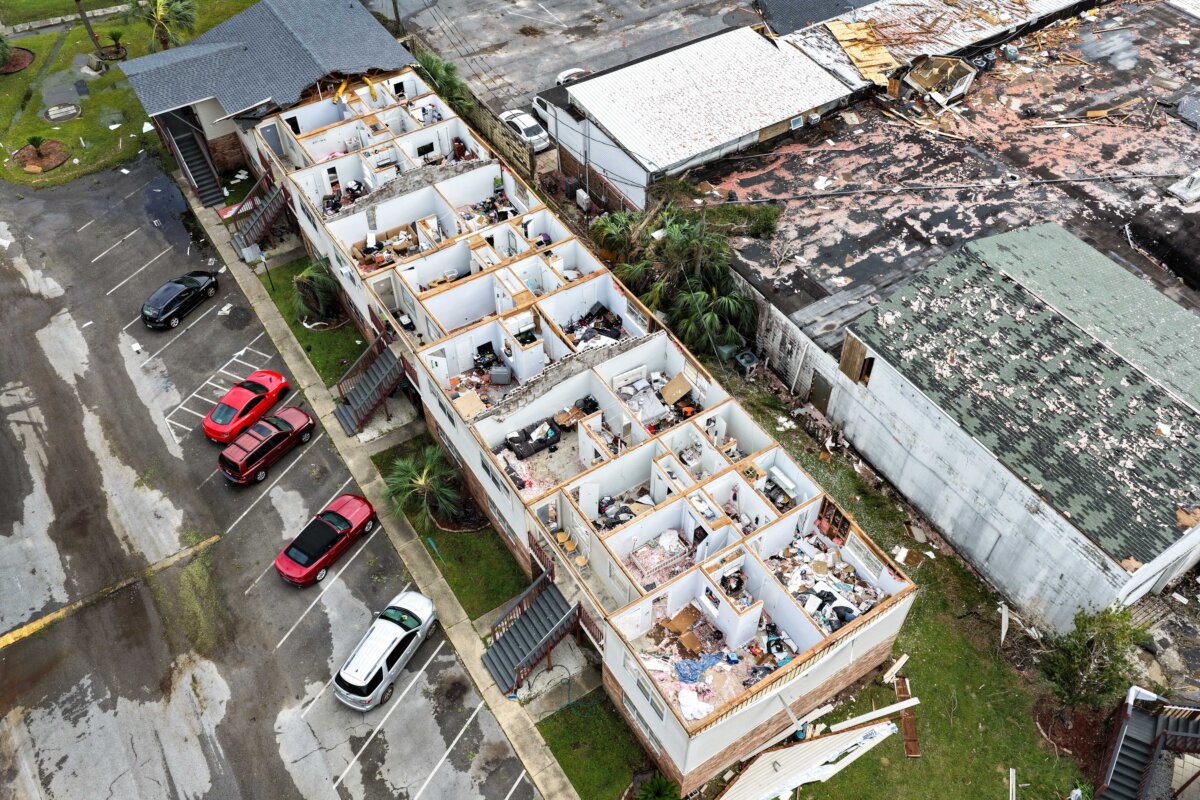


MILTON, Fla.—It’s called a “sting jet.” A catastrophic cluster of tornado-like winds emerged on the edge of Hurricane Isaias and swept across hundreds of miles of Florida and Alabama like an atmospheric landslide.
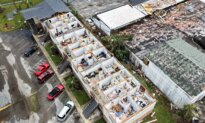
While coastal, more densely populated areas such as Florida’s Pensacola Beach and Destin faced their own destructive suite of storm surge and roof-ripping winds, this extremely rare wind event left the sparsely populated rural areas farther north bombarded by falling trees that crushed homes, downed power lines, and completely cut off entire communities.
Now, volunteers armed with chainsaws, winches, and emergency supplies are pushing into that Flora-Bama pine-and-oak forest to rescue people and reconnect them to civilization.
Charitable Chainsaw Work
They assembled in the parking lot of Jubilee Church in Pensacola on the morning of Oct. 11. They circled up in prayer, had a safety briefing, and set off in SUV caravans.
They wore matching blue shirts bearing the United Cajun Navy emblem, and with it came the expectation that people in need would get the help they needed for free from kind, helpful, competent volunteers.
The first stop for a team led by former Marines Keisha Boyd and Mason Adcock—alongside volunteers Greg and Alex—was the home of an elderly man named John Robbins and his neighborhood in Bagdad, Florida.
Chainsaws in hand, they worked to clear Robbins’s fallen trunks and branches so the elderly man could enter and exit his home.
They were just one of several volunteer teams out across the Panhandle on Oct. 11, answering the call to clear paths so people could access and leave their homes and get the help they need.
Those calls come directly to United Cajun Navy and are distributed to the teams in the field.
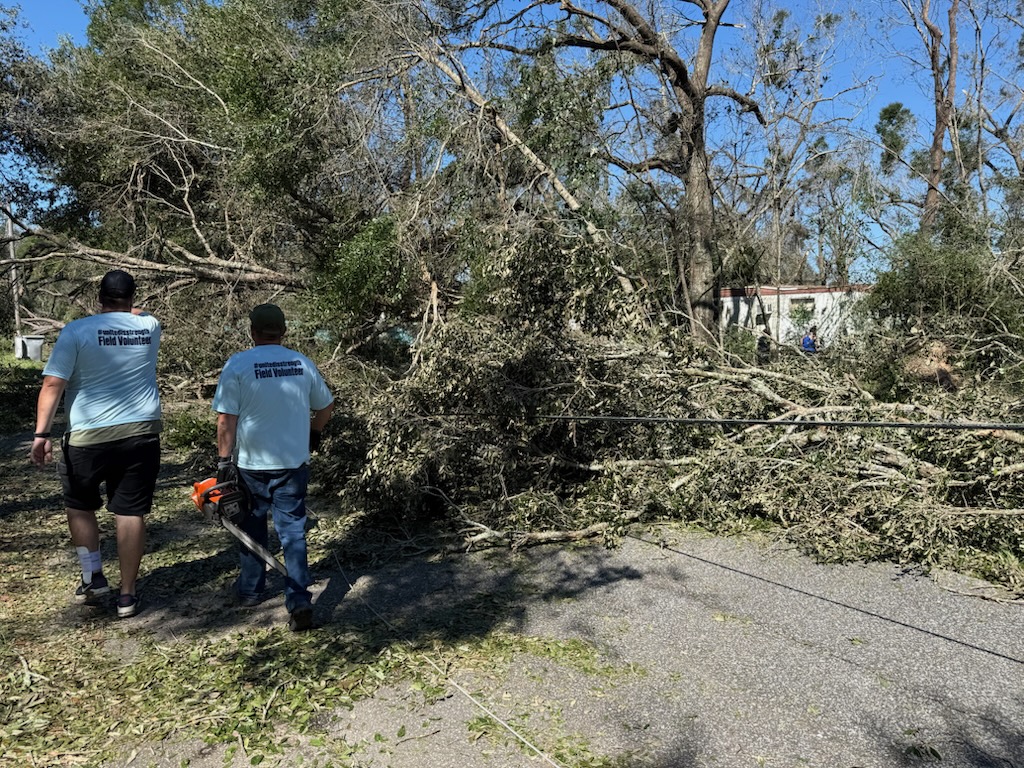 United Cajun Navy volunteers assess a downed tree that needs to be cleared in the aftermath of Hurricane Isaias in Bagdad, Fla., on Oct. 11, 2026. (T.J. Muscaro/The Epoch Times)
Sometimes, their volunteers work directly with emergency medical services, law enforcement officers, or even the National Guard and Coast Guard.
Escambia County Sheriff’s Office deputies were dispatched to help direct traffic at Jubilee Church in Pensacola, as United Cajun Navy volunteers set up a distribution center to give out needed food and supplies.
The Santa Rosa County Sheriff’s Office has been on standby to coordinate a food drop on Oct. 12.
But other times, like that morning just south of Milton, they set off on their own and do what they can themselves.
Chainsaws were put to work in Robbins’s neighborhood, slicing through thick trunks and limbs of cedar and oak from yards and streets, and there was debate over whether dangers such as downed power lines pushed the work beyond safe limits.
Meanwhile, crates of water bottles and other basic supplies that they could carry were distributed to neighbors who needed them.
United Cajun Navy volunteers received hundreds of requests for help throughout Oct. 11. Ultimately, they had to decide which requests to answer.
Boyd explained her team’s priorities.
“If a tree’s on a house, we won’t touch it. … We’re not going to put our safety in jeopardy for that. But we also have to make sure there’s an exit and entrance at every home,” Boyd said. “So we will make sure that’s clear and then their driveways so they can get in and out safely.”
People without power and the elderly with medical or other needs are also a top priority, Boyd and Adcock said.
Sting Jet Conditions
David Eversole has been with the National Weather Service since 1992 and had never heard of a sting jet until Oct. 10.
It is an event whose rarity almost equals that of its mother cyclone’s record-late arrival in hurricane season.
“I have never seen it, and I’ve been with the [National] Weather Service since 1992,” he told The Epoch Times.
What happened was a mass of dry air collided with the outer storm wall of Hurricane Isaias. That dry pocket began to rapidly suck up the storm’s moisture, making the air immediately much heavier.
That sudden shift in air density created a downburst effect that produced intense tornado-like winds on the ground.
But these weren’t necessarily tornadoes—although residents on the ground reported tornado sightings.
“That’s what happens during a thunderstorm,” Eversole said. “It ingests that drier air and the precipitation, and the thunderstorm starts to evaporate, and that starts making a lot of cold air, which is heavy, and so that starts sinking down.
“Now the sting jet, that is like that phenomenon but on steroids.”
This was a single cluster of catastrophic winds that sliced through the Florida and Alabama landscape. Radar screenshots show a bright line of intensity streaking from the coastline, through Milton, Florida, across the state line to Frisco City and Monroeville, Alabama. Gusts of 117 miles per hour were reported on Santa Rosa Island, and winds of 114 miles per hour were reported at Whiting Field near Milton.
Just before noon on Oct. 11, hundreds of thousands of customers across the Panhandle were still without power, including nearly 114,000 in Escambia County, which includes Pensacola; nearly 83,000 in Santa Rosa County; and nearly 39,000 in Okaloosa County.
Firsts and Worsts
Diane Darby has been in and out of Bagdad since the 1980s and said that the damage dealt by Hurricane Isaias was the worst damage she’d seen.
“Worse than Ivan,” she told The Epoch Times emphatically, citing a devastating category 3 hurricane that hit the area in 2004.
She said she mainly remembers hearing the wind battering the tin roof of her home during the storm.
“I looked out the door, and I saw the power line playing down, and that was about as good as I could see, except for looking at the backyard with the flashlight and seeing the trees down,” Darby said. “It was rough, but the sounds were the worst part.”
Nevertheless, she praised how fast the immediate response efforts had been, from getting water back up and running to seeing efforts to clear roadways from United Cajun Navy and her own neighbors.
Adcock said Isaias was his first hurricane.
“I have been working with these guys for the total of two days. I’m from Oklahoma,” he said.
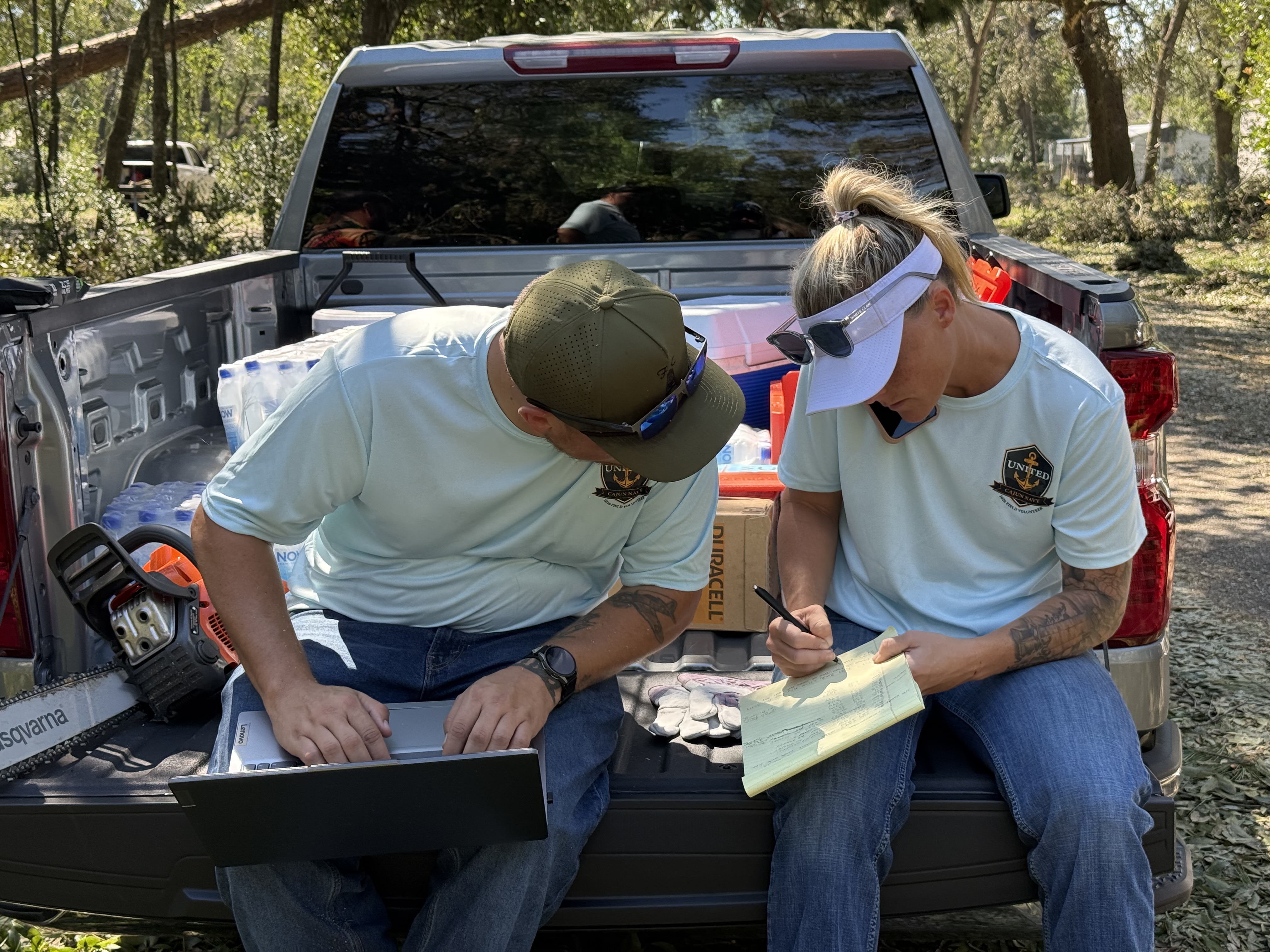 United Cajun Navy volunteers Mason Adcock (L) and Keisha Boyd (R) receive and log requests for aid on site in Bagdad, Fla., on Oct. 11, 2026. (T.J. Muscaro/The Epoch Times)
“We weren’t in the worst of it in Niceville, and all the wind and everything—that’s all it reminded me of,” he said. “Heavy winds, trees not getting knocked down, and everything—that’s how tornadoes act.”
His flight home to Oklahoma was canceled, and Boyd recruited him to stay and help with recovery efforts.
He and Boyd have known each other since 2010, when they met in the Marine Corps.
After Adcock said that he found the hurricane underwhelming, Boyd—also from Tornado Alley—joked that he hadn’t seen what a hurricane could do at its worst.
The United Cajun Navy has indicated that it’s just getting started and is urgently seeking new volunteers.
“You’ve seen our volunteers clearing roads, checking on families, and distributing supplies,” the group wrote in an Instagram post. “The requests for help are pouring in, and we urgently need reinforcements.
“We have crews ready to work and communities still waiting for help. But we can’t do it alone.”
 Friends Read Free
Copy
Facebook
Tweet
Friends Read Free
Copy
Facebook
Tweet