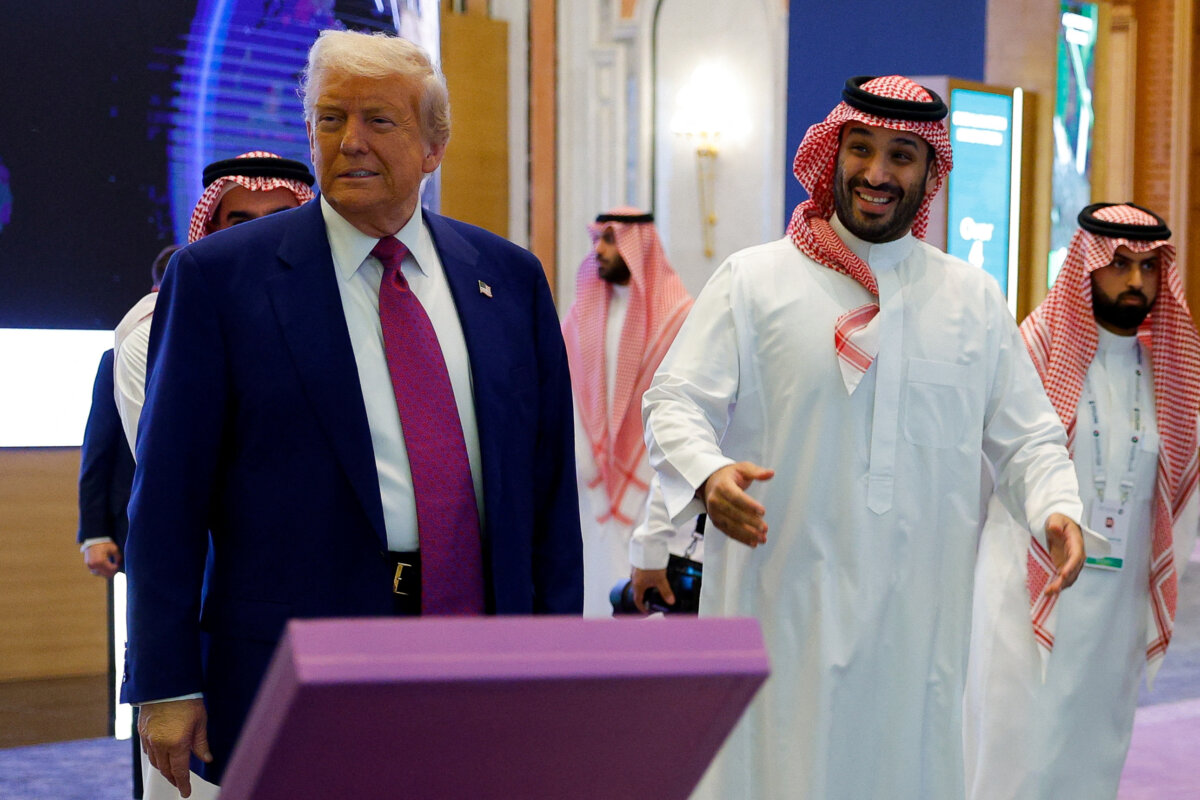

WASHINGTON—Saudi Crown Prince Mohammed bin Salman’s visit to the White House on Nov. 18 will be his first in more than seven years. The United States and Saudi Arabia have had a rocky relationship during that time, but U.S. President Donald Trump’s invitation has raised hopes for a fresh start between the two countries.
Although this is not an official state visit, Trump will greet the crown prince with an arrival ceremony. The leaders will hold bilateral meetings followed by a formal evening dinner.
Here is what to expect from the meetings.
Defense Pact and Arms Sales
The Saudi crown prince is expected to focus on U.S.–Saudi defense cooperation.
“We reviewed the Saudi-US relations and explored ways to bolster our strategic cooperation,” Saudi Defense Minister Khalid bin Salman Al Saud said in a post on X last week after meeting with U.S. Secretary of State Marco Rubio and other U.S. officials.
During his visit to Saudi Arabia in May, Trump signed a $142 billion arms deal with the Gulf state as part of a larger $600 billion agreement to expand economic ties with the country.
On Nov. 17, ahead of the White House meeting, Trump announced that he will approve the sale of advanced F-35 Lightning II stealth fighter jets to Saudi Arabia.
Trump’s discussions with the Saudi crown prince on security cooperation are also expected to go beyond arms sales.
In September, Trump issued an executive order vowing that the United States would guarantee Qatar’s security if it were to come under attack. The Saudi monarch may be looking for a similar commitment for his kingdom.
During a panel discussion with the Carnegie Endowment for International Peace on Nov. 17, former U.S. Ambassador to Saudi Arabia Michael Ratney said buying F-35s may conflict with Riyadh’s long-term goal to develop a domestic defense industry.
Ratney said Saudi Arabia may be more interested in a long-term security partnership with the United States. He said Trump may offer a security pact via executive order, as he did with Qatar, but warned that such a pact—which falls short of a Senate-ratified treaty—could falter after Trump leaves office.
“I think at heart, what they want is something long-term and predictable,” Ratney said.
Saudi–Israeli Normalization
Ahead of the Gulf monarch’s visit, Trump expressed his desire for Saudi Arabia to normalize diplomatic relations with Israel under the Abraham Accords framework.
“I hope that Saudi Arabia will be going into the Abraham Accords fairly shortly,” Trump told reporters on board Air Force One on Nov. 14.
Although several Arab states have joined the accords since Trump’s first term, Saudi Arabia’s participation has continued to elude Washington.
In a speech before the United Nations in September 2023, Israeli Prime Minister Benjamin Netanyahu suggested that he was on the verge of a diplomatic breakthrough with Riyadh. Those efforts stagnated following the Hamas terrorist group’s Oct. 7, 2023, attack on Israel and the subsequent Israeli military campaign in the Gaza Strip.
Saudi Arabia has repeatedly maintained that it will not resume efforts to normalize relations with Israel without a clear path to concrete steps toward the establishment of a Palestinian state, a proposition Netanyahu opposes.
Gregg Roman, executive director of the Middle East Forum, said the president will likely use arms sales as leverage to bring Saudi Arabia into a rapprochement with Israel.
“I think that the president’s willingness to advance these arms is contingent on the Saudis at least making commitments to him privately that they’ll go on the Abraham Accords path,” he told The Epoch Times.
AI Partnership
As in his first term, Trump chose Saudi Arabia for his first state visit, signaling the strategic importance of ties with the oil-rich nation.
The $600 billion economic partnership announced during Trump’s visit to Riyadh in May includes investments in both countries across various sectors such as artificial intelligence (AI) data centers, energy infrastructure, and health care.
During the meeting, the two leaders could make further announcements about how this economic partnership will begin to take shape.
For years, Riyadh has been trying to diversify its economy away from oil. Attracting foreign investment in AI and advanced technology is now central to this goal, according to Ratney.
During an interview on Nov. 6 with the Center for Strategic and International Studies, a U.S. think tank, Ratney said the Saudis have been frustrated that Washington has not developed a reliable export regime for its most advanced chip technologies.
“The Saudis have huge ambitions and are awaiting investment from big U.S. companies to develop data centers,” he said. “They want to develop their own artificial intelligence industry, including the intellectual capital that goes into developing it.”
Military Cooperation With China
Saudi Arabia’s deepening ties with Beijing create a problem for Washington.
In October, China and Saudi Arabia conducted a joint naval exercise called Blue Sword 2025. It was the third joint exercise the two countries have conducted.
In a statement, both countries pledged to strengthen military cooperation.
Some in Washington have raised concerns about the Chinese Communist Party acquiring the technology of F-35 jets if the Trump administration agrees to sell the warplanes to Riyadh.
“That is not exactly a good look for a country arguing they should be able to procure America’s most advanced fighter jet,” Bradley Bowman, senior director of the Center on Military and Political Power at the Foundation for Defense of Democracies, said during a recent media call previewing the meeting.
He noted that the Saudis should end military cooperation with Beijing if they want to acquire the F-35 jets.
 Friends Read Free
Copy
Facebook
Tweet
Friends Read Free
Copy
Facebook
Tweet