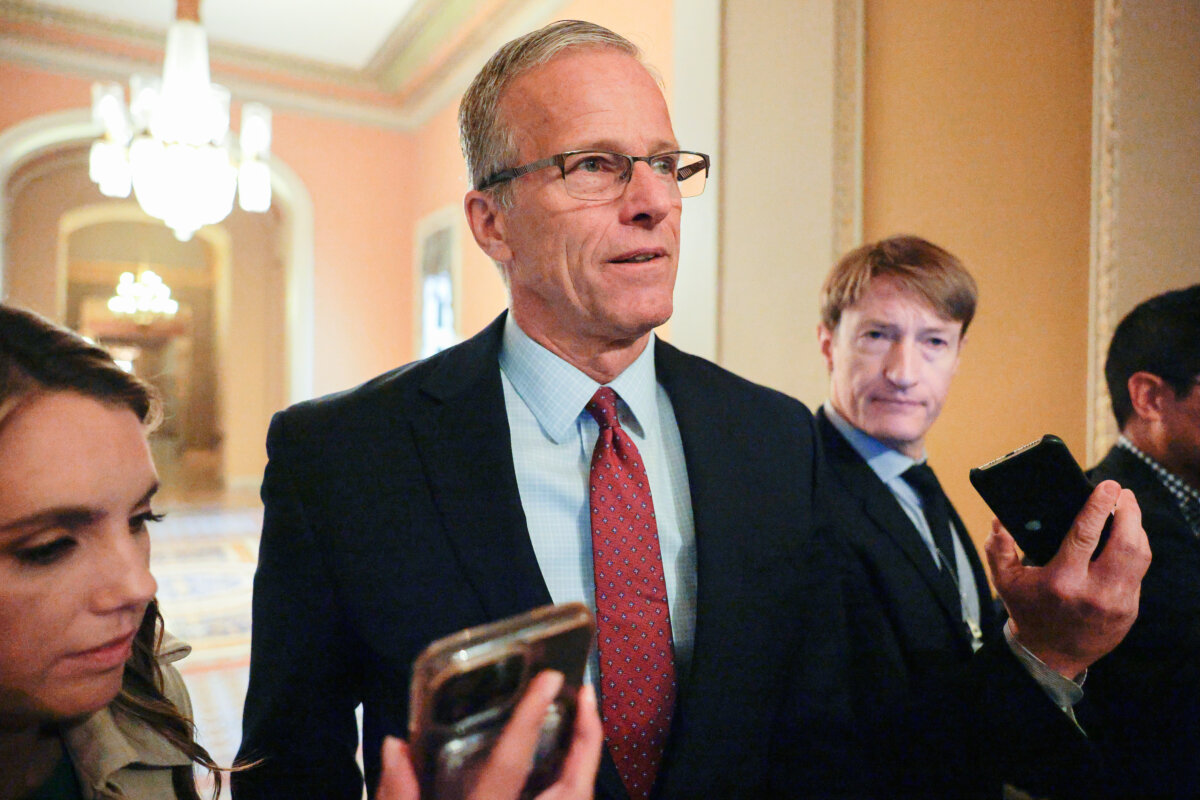

The Senate on Aug. 2 adjourned to begin its monthlong summer recess, after senators and the White House failed to reach an agreement on confirming President Donald Trump’s nominees.
Senate Majority Leader John Thune (R-S.D.) and Trump have been in negotiations with Senate Minority Leader Chuck Schumer (D-N.Y.) over how to move forward on more than 150 pending nominations that have been slow-walked through the Senate by Democrats.
Trump said Democrats demanded the release of about 1 billion dollars, and promises not to rescind additional federal funds, in exchange for allowing the quick consideration of the president’s nominees.
In a post on Truth Social on Aug. 3, Trump gave his blessing to lawmakers leaving, writing, “Have a great RECESS and, MAKE AMERICA GREAT AGAIN!!!”
Republicans confirmed a handful of the nominees over the weekend ahead of the start of the recess, including Judge Jeanine Pirro‘s confirmation to serve as U.S. attorney for the District of Columbia.
When lawmakers return, Republicans could change the Senate rules to overcome the blockade.
Here’s what to know.
How Democrats Are Slowing Nominees
With Democrats out of the White House and in the minority of both chambers of Congress, the party has few official means to oppose Trump’s agenda.
In the Senate, things work a little differently, as the collegial upper chamber gives the minority significant power. That includes rules related to speaking and debate.
Under the rules of the Senate, two hours of discussion and consideration are allowed between the cloture vote on a nomination and the final confirmation vote.
Democrats have been taking advantage of this rule to slow confirmations by taking up the maximum permitted time on any vote, time that adds up when it applies to lower-level nominations as well as high-profile ones.
Low-level posts that are usually approved through a unanimous consent vote provide another opportunity to slow consideration of nominees, as Democrats can demand roll call votes on each candidate.
Negotiations Fall Through
Schumer has suggested that Democrats are open to ending their use of these tactics in exchange for concessions related to federal spending.
In line with his 2024 campaign promises, Trump has moved to rapidly cut federal spending from various agencies. Democrats have opposed these efforts.
While negotiations were being handled outside the public eye, the broad outlines of Democrats’ demands were widely reported.
Namely, Democrats wanted Trump to unfreeze about $1 billion in funding for the National Institutes of Health and foreign aid.
Trump called this demand “egregious and unprecedented,” saying that accepting it “would be embarrassing to the Republican Party.”
“It is political extortion, by any other name,” Trump wrote, telling lawmakers to “go home.”
In a post on Truth Social, Trump suggested this demand was for $2 billion at first.
“They wanted us to pay, originally, two billion dollars for approvals,” he wrote. “The Dems are CRAZED LUNATICS!!!”
Earlier, Trump raised the prospect of canceling the August recess—a near-sacred break for Washington lawmakers—to move forward on the nominees. While Thune signaled openness to such a move, many Republicans in the conference weren’t enthusiastic about it.
Democrats Claim Victory
Schumer and the Democrats are claiming a win in the showdown.
“Donald Trump tried to pressure, threaten, cajole, [and] name call Democrats,” Schumer said in a video posted to X. “But he took his ball home and got nothing. Donald Trump caved, and brought home nothing.”
In a news conference on Aug. 2, Schumer said Trump “threw in the towel, sent Republicans home, and was unable to do the basic art of negotiating.”
Expressing a similar sentiment, Sen. Chris Murphy (D-Conn.) wrote in a post on X, “Senate Republicans tried to bully Democrats into expediting nominations to fill out positions in their increasingly authoritarian state. They failed.”
Nuclear Option
With a truce temporarily declared, lawmakers won’t take the issue up again until they return from the recess. Until then, senators will remain in their districts, meeting with constituents and spending time with their families.
When they return, Republicans could move forward with a different approach to overcoming the blockade: the so-called nuclear option.
In Senate parlance, the “nuclear option” describes any change to the chamber’s rules in the middle of a session of Congress.
In this case, Republicans could change the Senate rules around confirming nominees, potentially reducing the amount of time lawmakers can speak before a cloture vote.
In an appearance on Fox News, Sen. Markwayne Mullin (R-Okla.) suggested that this option should be on the table, saying, “We can do this the easy way or the hard way.”
He said that historically, most nominees of either party have been confirmed by a unanimous voice vote and that this sort of dispute is unprecedented.
The Senate’s next session will begin on Sept. 2, with confirmation of nominees likely to be a top priority alongside the pending Sept. 30 government funding deadline.
 Friends Read Free
Copy
Facebook
Tweet
Friends Read Free
Copy
Facebook
Tweet