
Rising global energy prices triggered by the Iran conflict have led President Donald Trump to waive a century-old U.S. maritime law governing the movement of goods between American ports.
The Jones Act includes several provisions, but its core requirement is that all goods transported by water between U.S. ports must travel on vessels built in the United States, flagged in the United States, owned by American companies, and crewed by U.S. citizens or permanent residents.
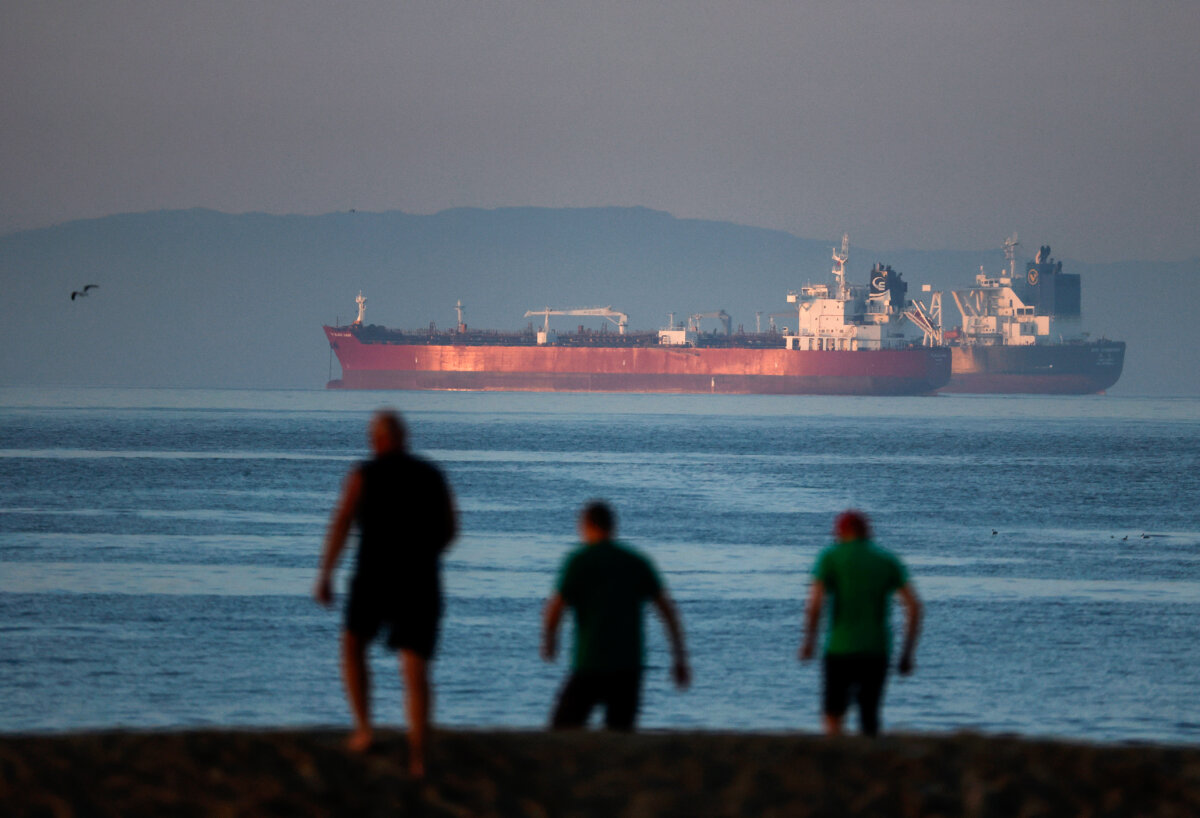
Oil and gas prices have soared this month amid a standstill in traffic through the Strait of Hormuz. While a small number of oil and gas vessels have traversed the narrow waterway located between Iran and Oman, the global chokepoint has yet to return to pre-war levels.
Until the situation in the Middle East is resolved, the Trump administration continues to deploy various measures to stabilize oil and gas markets.
Here are the details on the Jones Act and the president’s waiver.
Understanding the Jones Act
Following World War I, the United States determined it lacked sufficient American-controlled ships to support military logistics.
To address this, Sen. Wesley Jones (R‑Wash.) introduced the Jones Act—officially the Merchant Marine Act of 1920—to regulate maritime trade in U.S. waters and between U.S. ports.
Wesley and the bill’s supporters believed Section 27 of the legislation would establish a dependable local fleet that the United States could rely on during wartime.
The bill was signed into law by President Woodrow Wilson.
What Trump’s Waiver Achieves
The waiver allows foreign‑flagged vessels to move goods between U.S. ports. It applies to a range of commodities, including coal, crude oil, fertilizer, natural gas, and refined fuels.
The suspension would enable foreign tankers to help transport U.S. crude to domestic refineries, easing energy‑price pressures stemming from disruptions in the Strait of Hormuz.
“President Trump’s decision to issue a 60-day Jones Act waiver is just another step to mitigate the short-term disruptions to the oil market as the U.S. military continues meeting the objectives of Operation Epic Fury,” White House press secretary Karoline Leavitt said.
“This action will allow vital resources like oil, natural gas, fertilizer, and coal to flow freely to U.S. ports for sixty days, and the Administration remains committed to continuing to strengthen our critical supply chains.”
The bill contains a measure that allows it to be waived in the “interest of national defense.”
Reaction
Over the past century, labor unions have largely supported the Jones Act, mainly because it supported U.S. maritime jobs and shielded domestic industry jobs from foreign competition.
Following the president’s decision to suspend the Jones Act, several labor unions opposed the waiver, citing national security concerns.
“America’s maritime labor unions are deeply concerned about the Administration’s broad Jones Act waiver, which undermines our national security, weakens military readiness, and hands critical maritime work to foreign vessel operators,” a coalition of U.S. maritime labor organizations said in a March 18 statement.
They argued that, with American sailors facing threats in the Persian Gulf and nearby waters, issuing a broad Jones Act waiver that opens U.S. shipping lanes to foreign rivals would further endanger U.S. security.

“Maritime labor calls on the Administration to reverse course and work with stakeholders on real solutions that address energy costs without sacrificing American jobs, national security, or the long-term strength of the U.S. maritime industrial base,” the statement adds.
Critics of the Jones Act contend that the law raises domestic shipping costs by restricting competition and limiting the number of commercial vessels for domestic transportation.
These costs can adversely affect shipping-dependent residents in places such as Alaska, Hawaii, and Puerto Rico.
A 2020 study by the Grassroot Institute of Hawaii, for example, estimated that the Jones Act harms Hawaii’s economy by approximately $1.2 billion per year.
Rep. Ed Case (D-Hawaii) says waiving the Jones Act “is a blanket admission of the Jones Act’s crippling effects” on Hawaii and other locations.
“President Trump’s Jones Act waiver is important to maintain fuel imports to Hawai’i at a time when we must rely far more on domestic supply while the capacity of domestic shipping has declined, and it certainly shines a high-beam spotlight on the crippling effects of the Jones Act on the cost of living for island and other non-continent parts of our country,” Case said in a March 18 press release.
What’s Expected
Prior to suspending the Jones Act, the administration wielded a broad array of tools to reverse the spike in energy prices.
One of the acts the president took was to establish a $20 billion program offering guaranteed political risk insurance. The strategy was in response to Western insurers canceling coverage or dramatically raising premiums.
Trump also weighed providing naval escorts to commercial oil and gas vessels.
Injecting more supply into international energy markets, the White House lifted sanctions on Iranian and Russian crude oil stranded at sea. Temporarily removing sanctions, according to Treasury Secretary Scott Bessent, would add as much as two weeks of supply.
Shortly after the International Energy Agency announced a record release of 400 million barrels from emergency reserves, the United States confirmed it would tap 172 million barrels from the Strategic Petroleum Reserves.
These measures help calm energy markets, keeping a barrel of West Texas Intermediate—the U.S. benchmark for oil prices—below $100. U.S. crude has also remained lower than its counterpart Brent—a global gauge that is more sensitive to geopolitical strife—which has stayed above $100 a barrel overseas.
Various market watchers believe the only solution to bringing down costs is for the war to end.
This view was on display at the start of the trading week when Trump postponed an attack on Iran’s energy infrastructure and suggested Washington and Tehran were engaged in productive talks.
Oil prices cratered as much as 11 percent on this news.
“Overall, the impact on energy prices is likely to remain for some time, since it’ll be hard to eliminate the threat posed by Iran to the Strait of Hormuz,” Simon Lack, portfolio manager at Catalyst Funds, said in a note emailed to The Epoch Times.
One reason is that it is challenging to limit Iran’s drone and missile capabilities, he noted. “They only need to hit something <1% of the time to scare shippers away or disrupt infrastructure,” Lack wrote.
Still, the decision could support the other efforts to ease prices. More vessels could, for instance, move some of the 172 million barrels released from emergency stockpiles over the next 120 days faster and bolster the flow of domestic gasoline and other refined products. [That’s one of the objectives behind waiving the Jones Act]
The American Fuel & Petrochemical Manufacturers agrees, stating that this will offer “flexibility” for delivering oil, refined products, and petrochemicals to American manufacturing facilities and consumers.
Previous research, meanwhile, has indicated that suspending the Jones Act would provide at least a modicum of relief in energy prices over the long term.
Economists, writing in a December 2023 paper, estimated that abolishing the Jones Act would reduce average East Coast gasoline prices by 63 cents.
Prices for diesel and jet fuel would also decline by as much as 82 cents and 80 cents, respectively.
“In aggregate, the researchers find that eliminating the Jones Act would have benefited US consumers by $769 million per year and reduced US fuel suppliers’ profits by $367 million per year,” they wrote.
 Friends Read Free
Copy
Facebook
Tweet
Friends Read Free
Copy
Facebook
Tweet