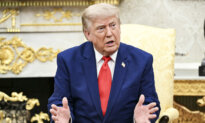


President Donald Trump invoked the Defense Production Act June 16 to boost weapons production, saying the existing conditions of the munitions industry and supply chains in the United States could pose a national defense threat.
Trump’s memo authorizes Secretary of War Pete Hegseth to start making agreements and plans to kickstart production of key items.
The 1950 law grants the president executive authority to shape national defense preparedness programs and control domestic industry when national security is threatened to ensure materials and services are available for military needs or emergencies.
The presidential memo, which will be published in the Federal Register June 17, states “conditions exist” in the U.S. military’s munitions industry that could create a threat to national defense or its preparedness programs.
Trump also determined the nation’s munitions industry was bogged down by bottlenecks, limited production capacity, fragile supply chains, long wait times for materials, and other production problems that hinder the country’s ability to produce, sustain, and expand its munitions, missiles, and equipment needed for national defense.
The memo didn’t detail which weapons systems, missiles, or equipment were needed.
Over the past weekend, Hegseth told CBS’ “Face the Nation with Margaret Brennan” that concerns over the weapons stockpile in the United States were a “manufactured story.”
“Our stockpiles are strong and will only get stronger in the future,” Hegseth said.
The secretary said some munitions take more time than others to produce but the country had “lots of them” and was building “more than ever before.”
The secretary’s comment was prompted by a question from host Margaret Brennan about prior statements that he made before a Senate Armed Forces Committee hearing on April 30, where he estimated that it could take months or even years to replenish the weapons stockpile after the U.S. military started bombarding Iran.
The most intense fighting between the United States and Iran occurred from Feb. 28 until mid-April, when Trump announced a ceasefire agreement along with a blockade of Iranian ports in a bid to set up negotiations with Iran on its nuclear program and the reopening of the Strait of Hormuz.
U.S. and Iranian officials are due in Switzerland on June 19 to begin negotiations, opening a 60-day window for technical talks. These are expected to cover issues such as the future of Iran’s highly enriched uranium, the lifting of sanctions, and Iran’s nuclear program. More details about the deal will be released at a later date, Trump said.
The president said at the G7 meetings in France on the morning of June 16 that the text of the deal states clearly that Tehran will not have a nuclear weapon, and the full agreement would be made public in a formal setting in a few days.
The Department of War did not immediately respond to an Epoch Times request for comment on June 16.
Reuters contributed to this report.
 Friends Read Free
Copy
Facebook
Tweet
Friends Read Free
Copy
Facebook
Tweet