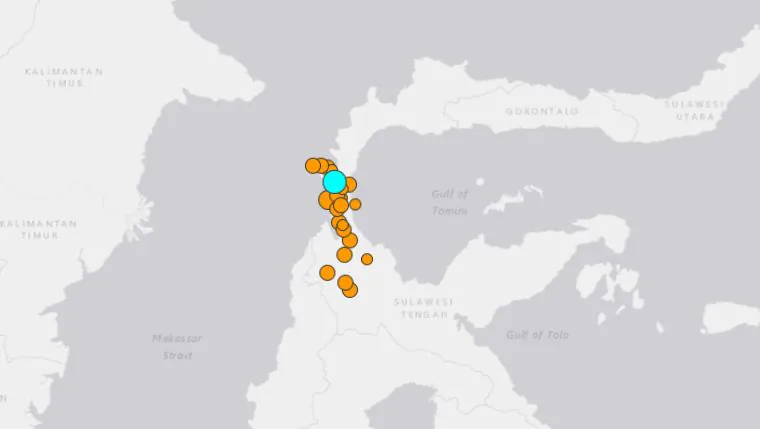
At least 15 moderate-strength aftershocks hit around the area where a 7.5-magnitude earthquake struck Indonesia, according to data from the U.S. Geological Survey (USGS).
Many of the aftershocks after the initial, 7.5-magnitude quake were 5.0-magnitude or greater on the Richter scale, according to the agency.
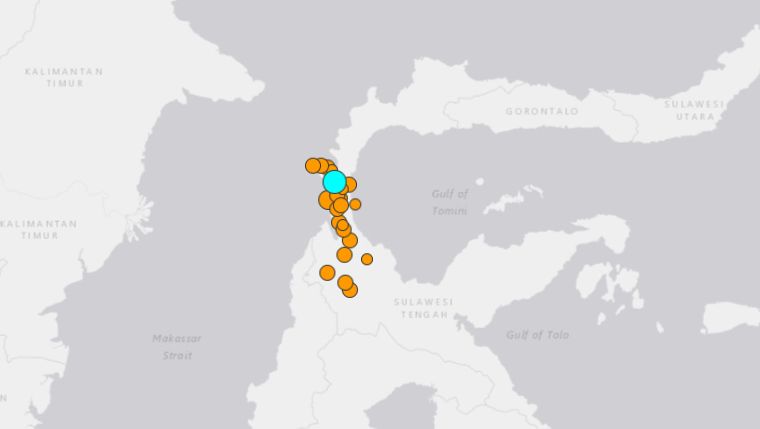 A USGS map shows the 7.5-magnitude earthquake in blue and aftershocks and foreshocks in orange. (USGS)
At least four moderate earthquakes struck before the 7.5-magnitude quake hit. All of the aftershocks and foreshocks listed on the USGS’s website were at least 4.6-magnitude or greater.
The Associated Press reported that at least one person was confirmed dead in the quake and ensuing tsunami. The tremor hit the island of Sulawesi and reportedly destroyed buildings.
An official with the country’s disaster agency said that “many houses have collapsed,” AP reported. “It happened while we still have difficulties in collecting data from nine villages affected by the first quake,” he told AP. “People ran out in panic.”
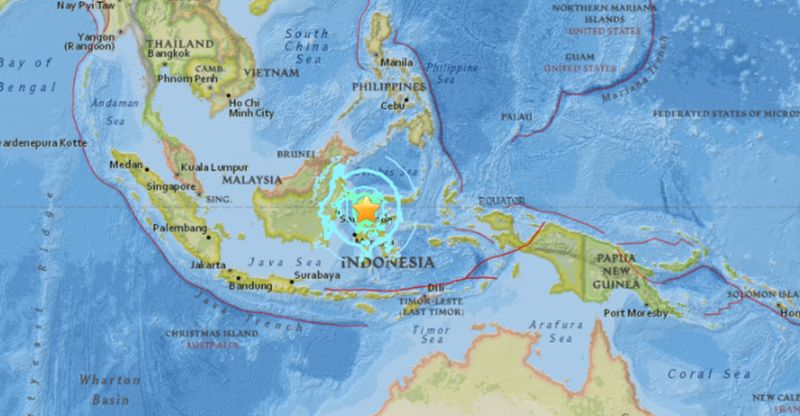 A massive 7.5-magnitude earthquake hit the Indonesian island of Sulawesi and triggered a tsunami in Palu and Donggala. (USGS)
Video footage that is believed to have been shot in Palu shows a massive moving wall of water hitting buildings and inundating streets.
This footage shows the catastrophic moment when #tsunami hit the city of Palu after 7.7 magnitude #earthquake shook the city this evening. #prayforpalu #prayforindonesia pic.twitter.com/I8JBi4dZjz
— Ramadhani Eko P (@ramadhaniep) September 28, 2018
Disaster agency spokesman Sutopo Purwo Nugroho told AP that people need to be vigilant due to the aftershocks.
“People are encouraged to remain vigilant,” Sutopo said. “It is better not to be in a house or building because the potential for aftershocks can be dangerous. People are encouraged to gather in safe areas. Avoid the slopes of hills.”
Dwikorita Karnawati, the chief of Indonesia’s meteorology and geophysics agency, told Reuters that the tsunami “receded,” but it caused severe damage. The news agency reported that the number of casualties is currently “unknown.” He said the tsunami was about 6 feet high.
“The situation is chaotic. People are running on the streets and buildings have collapsed,” Karnawati told Reuters. “There is a ship washed ashore.”
In 2004, an earthquake hit the Indonesian island of Sumatra, triggering a massive tsunami across the Indian Ocean, killing 226,000 people in 13 countries. More than 120,000 died in Indonesia.
The quake and aftershocks came about a month after an earthquake killed as many as 500 on the island of Lombok in Indonesia, according to The Weather Channel.
The national search and rescue agency will deploy a large ship and helicopters to aid the operation, said agency chief Muhammad Syaugi, adding he had not been able to contact his team in Palu. The armed forces and police will also provide troops and equipment to support the emergency response, officials said. Oil company Pertamina said its fuel depot in Donggala had been damaged in the incident though there was no oil spill. Fuel tanks had shifted in the quake and ship loading facilities were disabled among other damage.
The Palu airport was closed as a result of the tremor, Reuters reported.
Indonesia lies on the seismically active Pacific Ring of Fire and is regularly struck by earthquakes.
Reuters contributed to this report.
 Friends Read Free
Copy
Facebook
Tweet
Friends Read Free
Copy
Facebook
Tweet