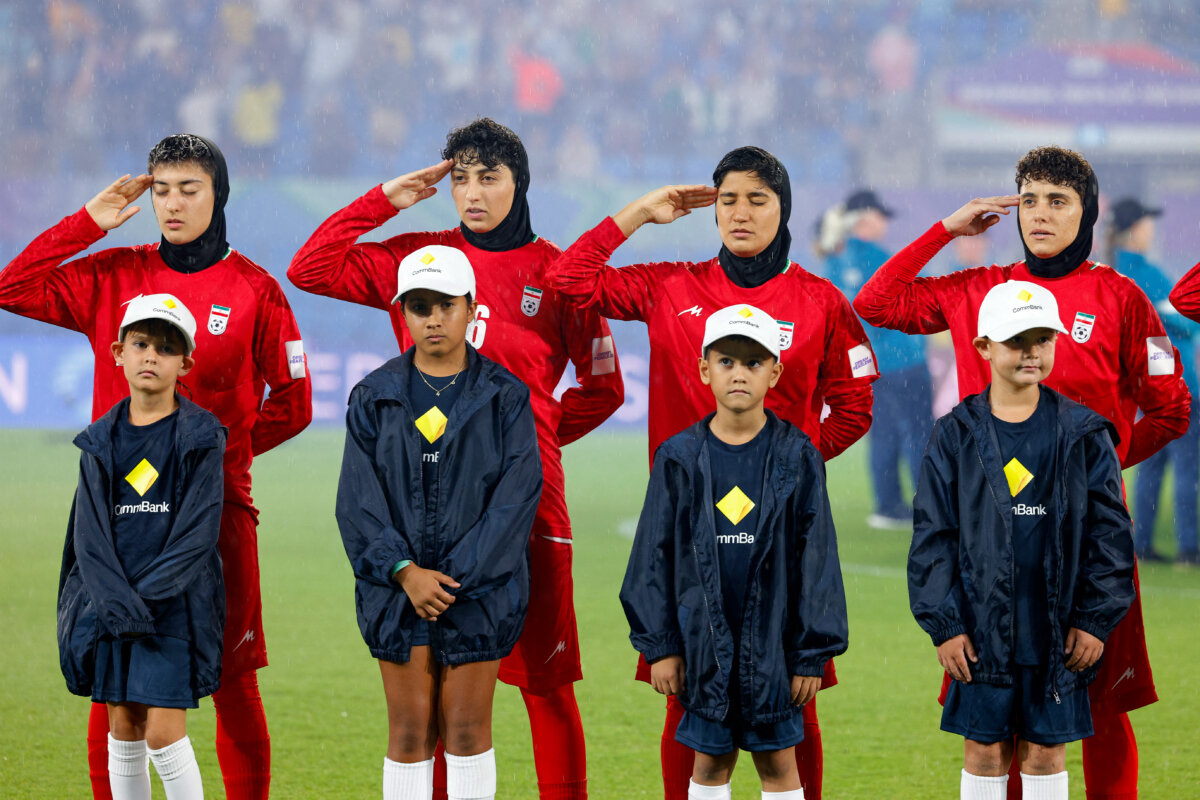

An Iranian women’s soccer player has reversed a decision to defect to Australia after initially being granted asylum by authorities.
She was one of two additional members of the national team—along with the earlier five—who accepted a humanitarian visa from the federal government.
Home Affairs Minister Tony Burke initially confirmed that a player and a member of the support staff chose not to leave the country with the rest of the squad.
“With the assistance of the Australian Federal Police they were separated from the rest of the group and taken to a safe location. They then met with me … I made them the same offer that I had made the five players the night before,” Burke told reporters on March 11.
The minister said the visas would provide a pathway to permanent residency.
Yet hours later, the minister confirmed one individual had reversed that decision.
“I was advised that one of the two who had made the decision to stay last night had spoken to some of the teammates who had left and had changed her mind,” he confirmed to media.
“In Australia, people are able to change their mind, people are able to travel. So, we respect the context in which she has made that decision.”
The initial five players were granted humanitarian visas after concerns emerged about their safety following the team’s decision not to sing the Iranian national anthem ahead of their match against South Korea at the Asian Cup.
U.S. President Donald Trump, after responding on social media to Australian activist Drew Pavlou about the plight of the players, called Prime Minister Anthony Albanese to discuss offering asylum.
“I just spoke to Prime Minister Anthony Albanese, of Australia, concerning the Iranian National Women’s Soccer Team. He’s on it! Five have already been take care of, and the rest are on their way,” Trump wrote on social media.
“Some, however, feel they must go back because they are worried about the safety of their families, including threats to those family members if they don’t return. In any event, the prime minister is doing a very good job having to do with this rather delicate situation.”
Hours later, Home Affairs Minister Burke confirmed the initial batch of players would remain in the country.
The remainder of the squad left Australia on March 10, two days after their elimination from the tournament.
Private Interviews and Free Choice
The government said all members of the Iranian delegation were given the opportunity to consider their options privately.
Burke explained that players and support staff were individually interviewed without minders present to ensure they could make decisions independently.
“What we made sure of was there was no rushing, there was no pressure. Everything was about ensuring the dignity for those individuals to make a choice,” Burke said.
Some players contacted family members before deciding whether to accept the offer.
Burke said that after these conversations, most of the team ultimately chose to return home.
Security Agencies Involved
Burke confirmed that ASIO Director-General Mike Burgess was also involved.
“Mike Burgess said that was all clear for each of the individuals,” he said.
In a statement, the Australian Federal Police (AFP) said it had assisted the Department of Home Affairs during the operation to ensure the safety of the players.
“The AFP has long and enduring relationships with the Iranian diaspora through the AFP’s Community Liaison Teams,” the statement said.
“The AFP acknowledges the community leaders, not-for-profit groups and ordinary Australians for their assistance and advocacy in this matter.”
Opposition Leader Angus Taylor also backed the government’s decision to grant humanitarian protection to the players.
“We very much welcome the decision and announcement made by the government to support our allies in their work against this regime,” Taylor told reporters at Parliament House on March 10.
New Bill Targets 7,000 Iranian Visas
The episode has also prompted the government to introduce new legislation aimed at tightening visa controls during global crises.
Under the proposed law, the government would gain the power to temporarily block travellers holding temporary visas from entering Australia for up to six months if overseas events significantly increase the risk they may be unable to return home.
Burke said there are currently around 7,000 Iranian visitor visas issued to people who are not presently in Australia.
He noted that the government already has the authority to cancel visas but only on an individual basis.
“I want the decisions about who comes here permanently to be deliberate decisions made by the Australian government, not an accident of who was coming here for a holiday,” Burke said.
He added that visa assessments can become complicated when global circumstances shift.
“If you sought a visa at a time that your country was not a war zone, and then it becomes a war zone, there are visas out there that in the current context we would not have issued.”
 Friends Read Free
Copy
Facebook
Tweet
Friends Read Free
Copy
Facebook
Tweet