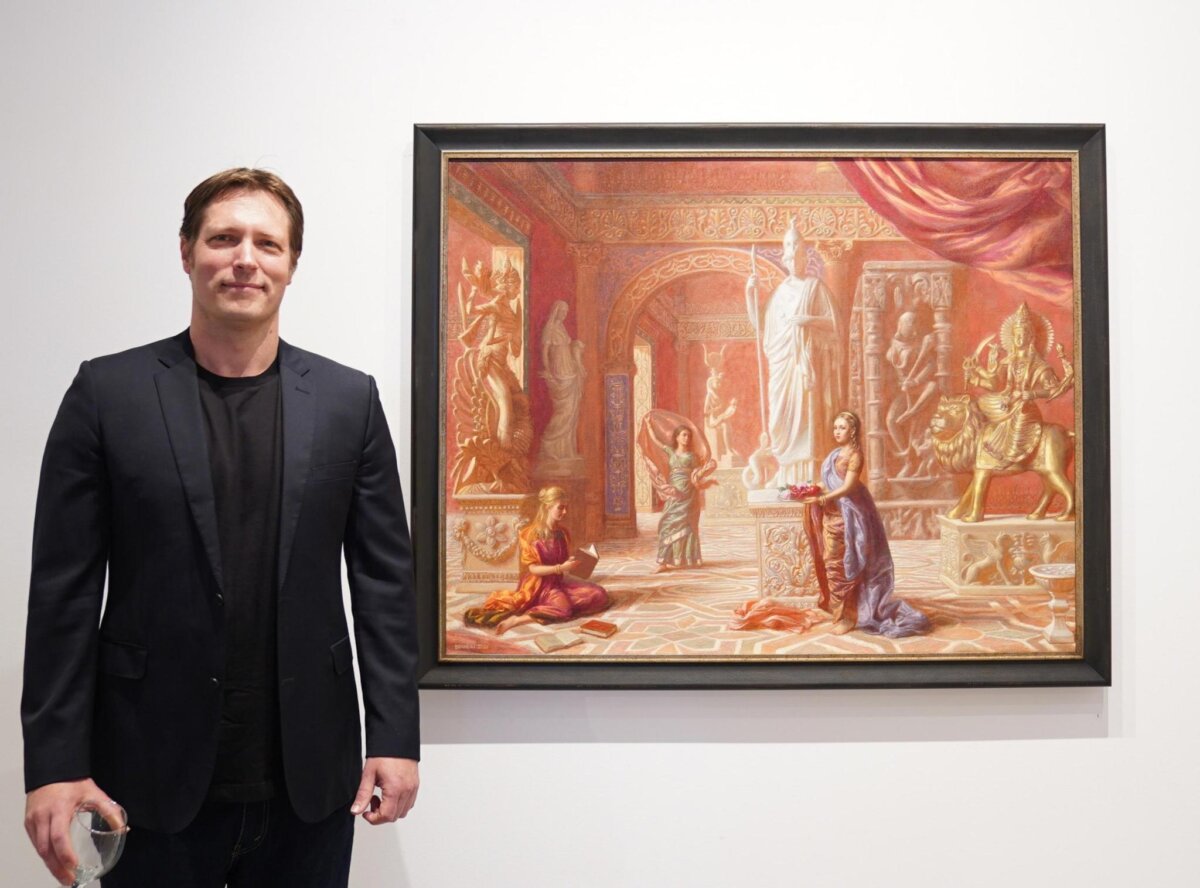
It’s an unlikely place to encounter Gods.
Amid the restaurants, bars and the trendy vibe of Melbourne’s Richmond, Andrew Bonneau’s latest exhibition has been on display at the contemporary Lennox Street Gallery.
One canvass features the Greek mythical musician Orpheus, while others are inspired by ancient astronomy and alchemy—all painstakingly rendered onto canvass in lifelike detail.
For centuries, this was the pinnacle of Western art, accurate depictions of ancient stories, divine beings, heroes, and battles—paintings that grip the viewers’ emotions and impart important moral lessons of the past.
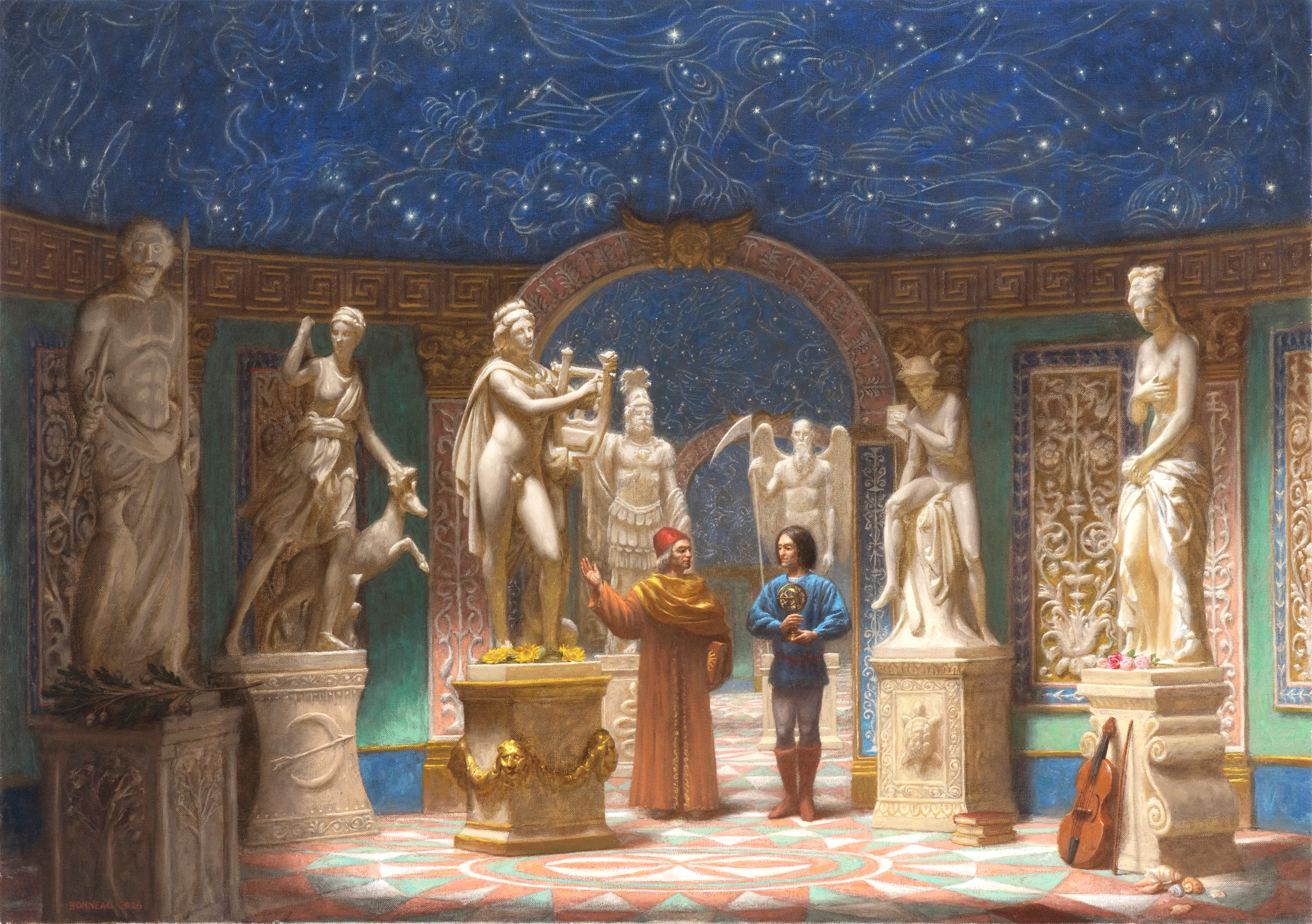 Andrew Bonneau’s oil painting, “Marsilio Ficino and Lorenzo Di Medici in the temple of the planets,” inspired by Renaissance era astronomy. (Courtesy of Andrew Bonneau)
“I wanted to understand the language of traditional European painting, especially the tradition from the Renaissance up to the 19th century, and that whole language of figurative painting, and the work that I saw coming out of that school in New York really impressed me,” Bonneau told The Epoch Times.
“I thought I’d love to go there, and made it a goal, and eventually spent three years studying there,” the classical artist said.
Bonneau is referring to the Grand Central Atelier, a leading school in the borough of Queens that teaches students classical drawing and sculpting techniques. Prior to that, he studied at the Julian Ashton Art School, founded in 1890 as the Sydney Art School.
“I think it’s the love of the tradition,” Bonneau explains. “Just loving the Renaissance, Raphael, Botticelli, Michelangelo, Leonardo, Titian, Veronese. I mean, these are some of the best painters in history.”
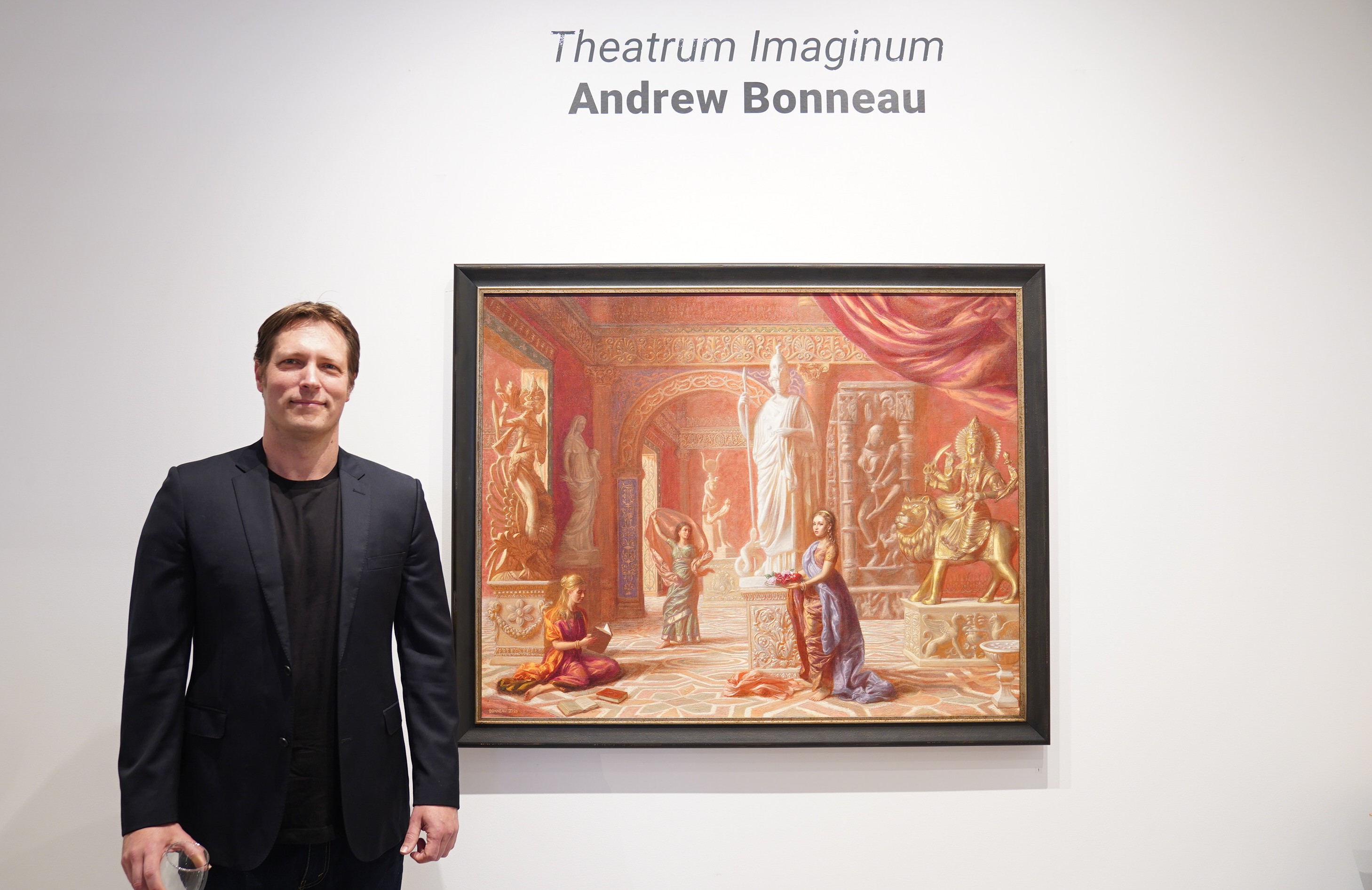 Andrew Bonneau standing in front of his oil painting, “House of the Goddess,” during his exhibition at Lennox Street Gallery in Melbourne, Australia on Sept. 19, 2026. (Tien Nguyen/The Epoch Times)
“I think modernism is essentially a kind of improvisation around that tradition. Without the tradition, it wouldn’t exist—so I’d like to get to the core of it.”
Bonneau’s preparation is methodical. During the planning stage, he uses clay to create a miniature diorama of the scene he is painting.
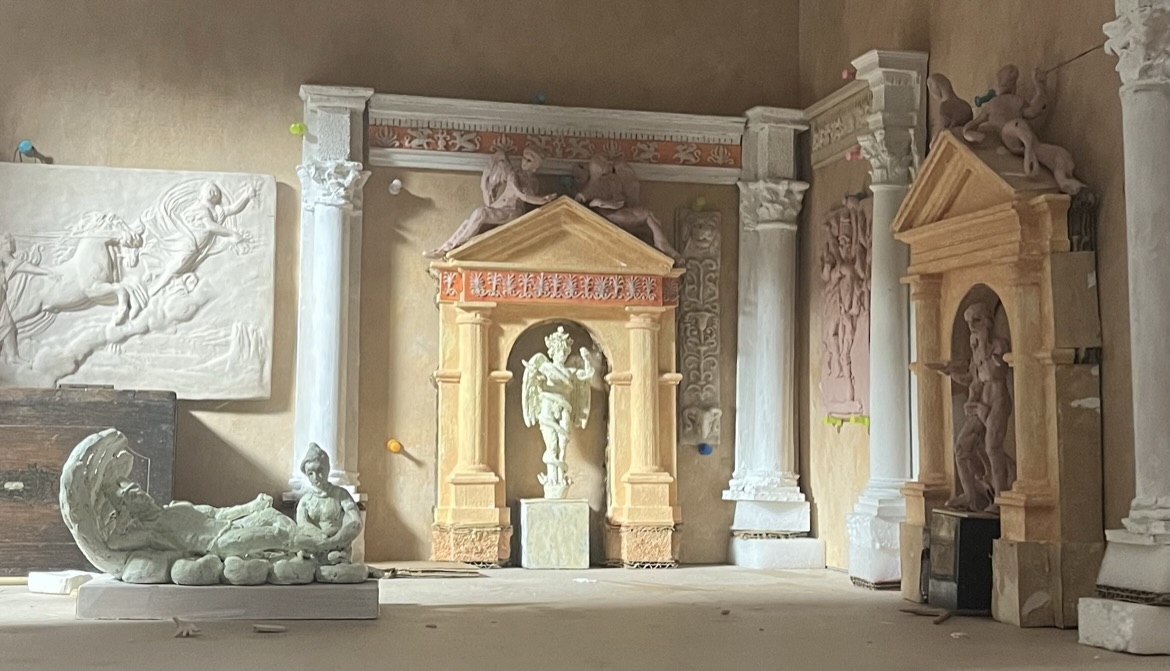 A clay diorama of Andrew Bonneau’s oil painting, “Time is the moving image of eternity,” which depicts different divine beings. (Courtesy of Andrew Bonneau)
His work: “Time is the moving image of eternity,” focuses on the theme of “time.”
It features the Greek personification of the Four Seasons, the personification of death, Thanatos, and the God of Time, Chronos. The title is also based on the text by Plato, “Timaeus,” a dialogue on the creation of the world.
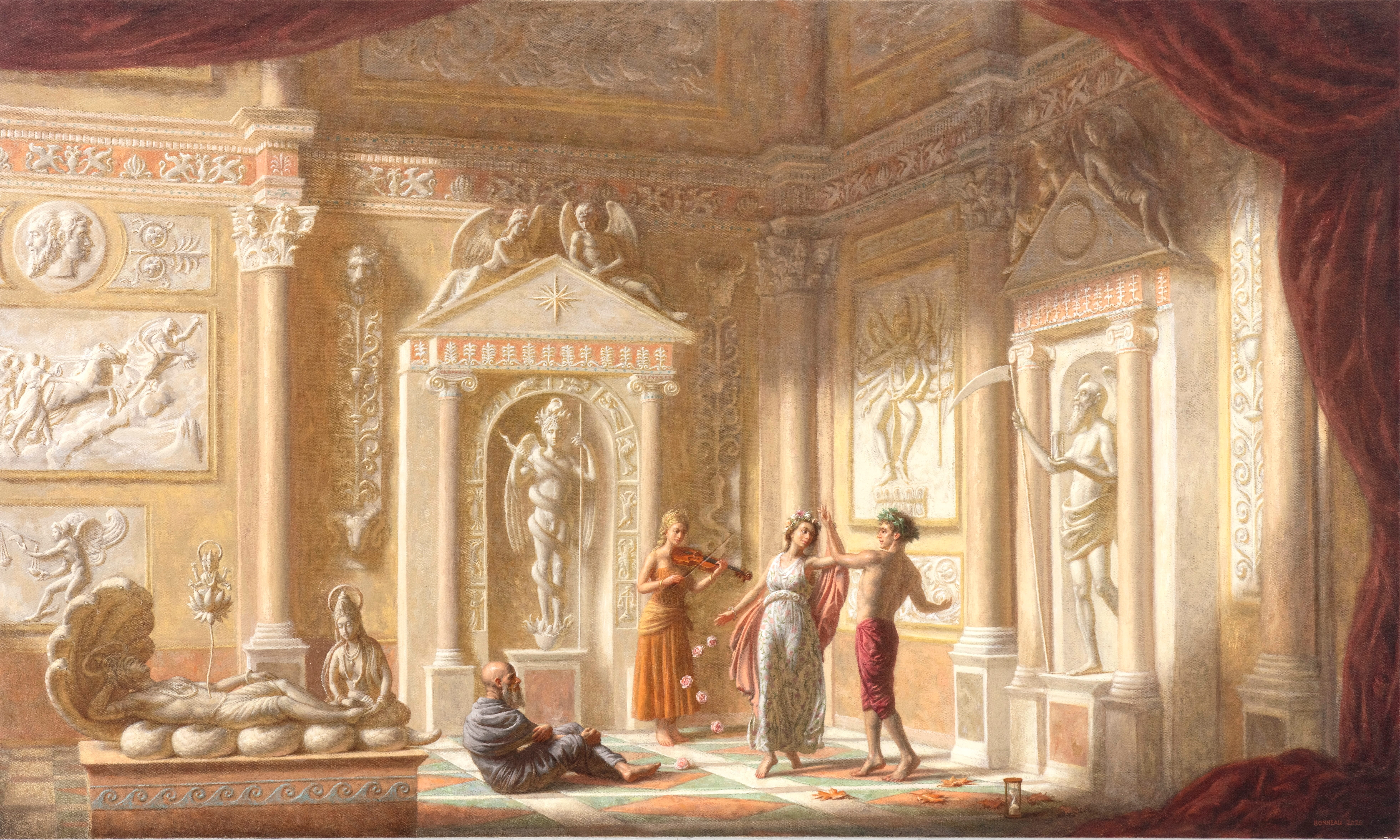 Andrew Bonneau’s oil painting, “Time is the moving image of eternity,” which depicts different divine beings. (Courtesy of Andrew Bonneau)
Félibien, historian for King Louis XIV, famously outlined a hiearchy that placed still lifes of everyday objects at the bottom, followed by paintings of animals, landscapes, scenes of everyday life, and portraits. At the top were history paintings, encompassing mythology, spirituality, major events, and the “virtues of great men.”
Félibien’s standards largely held for over 200 years until the invention of photography and the gradual dissemination of Marxist theories in the 1800s.
Together, these twin influences—as well as the World Wars—kickstarted the erosion of the prevailing standards of artistic creation, quality, beauty, and divine inspiration.
“Georg Lukács, the Hungarian cultural commissioner of the Communist International and founder of Western Marxism, [influenced the creation of] the Frankfurt School [in 1923]. One of its tasks was to establish a ‘new cultural form’ by abandoning traditional culture. This new cultural form set about excluding art that sought to represent the divine,” says The Epoch Times’ series, The Spectre of Communism.
In this vein, the founder of the French “realist” school Gustave Courbet, himself a participant in the Paris Commune, later devoted himself to “transforming the old system and establishing new artistic directions”—Courbet moved away from idealising a subject, and instead indulged in the mundane or the “proletariat.”
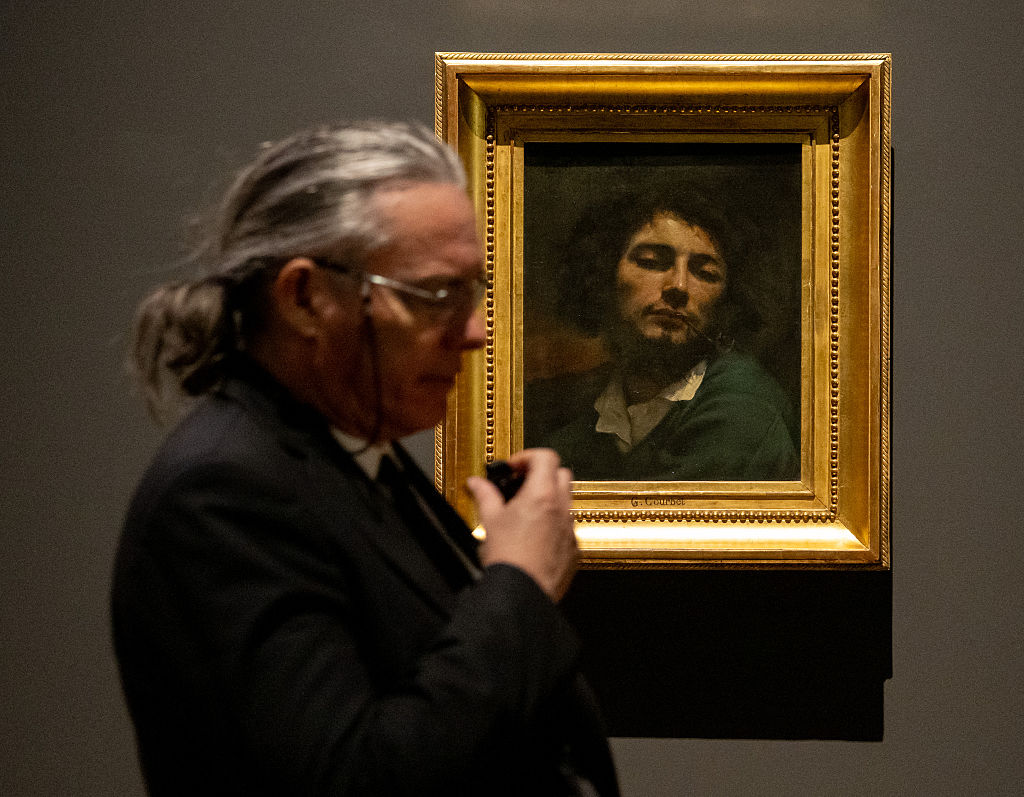 A security man walks past the self-portrait of the French painter Gustave Courbet, “Man with a Pipe,” during the opening of the first solo exhibition dedicated to Gustave Courbet (1819-1877) at the Leopold Museum in Vienna, Austria on Feb. 18, 2026. (Joe Klamar/AFP via Getty Images)
In an ironic twist of fate in the 1950s, the American CIA promoted and funded abstract expressionist exhibits as a representation of individual freedom against the Soviet Union during the Cold War, despite the fact many abstract painters or critics had deep Marxist-leaning ideals.
Current Australian “living master” of the U.S.-based Art Renewal Center, Gordon Hanley, called this the “cliff face” for traditional Western art.
“The cliff face was abstract expressionism, which basically said, ‘Well, the subject doesn’t matter. All the things you learned in art school, none of those matter either,’” he previously told The Epoch Times.
“A great piece of art is one that can elicit an emotional response, where the artist can establish a dialogue more or less with the viewer, even if the artist is long dead,” Hanley said.
It’s a point echoed by Bonneau, who says classical art is also a “shared culture” between the artist and the public.
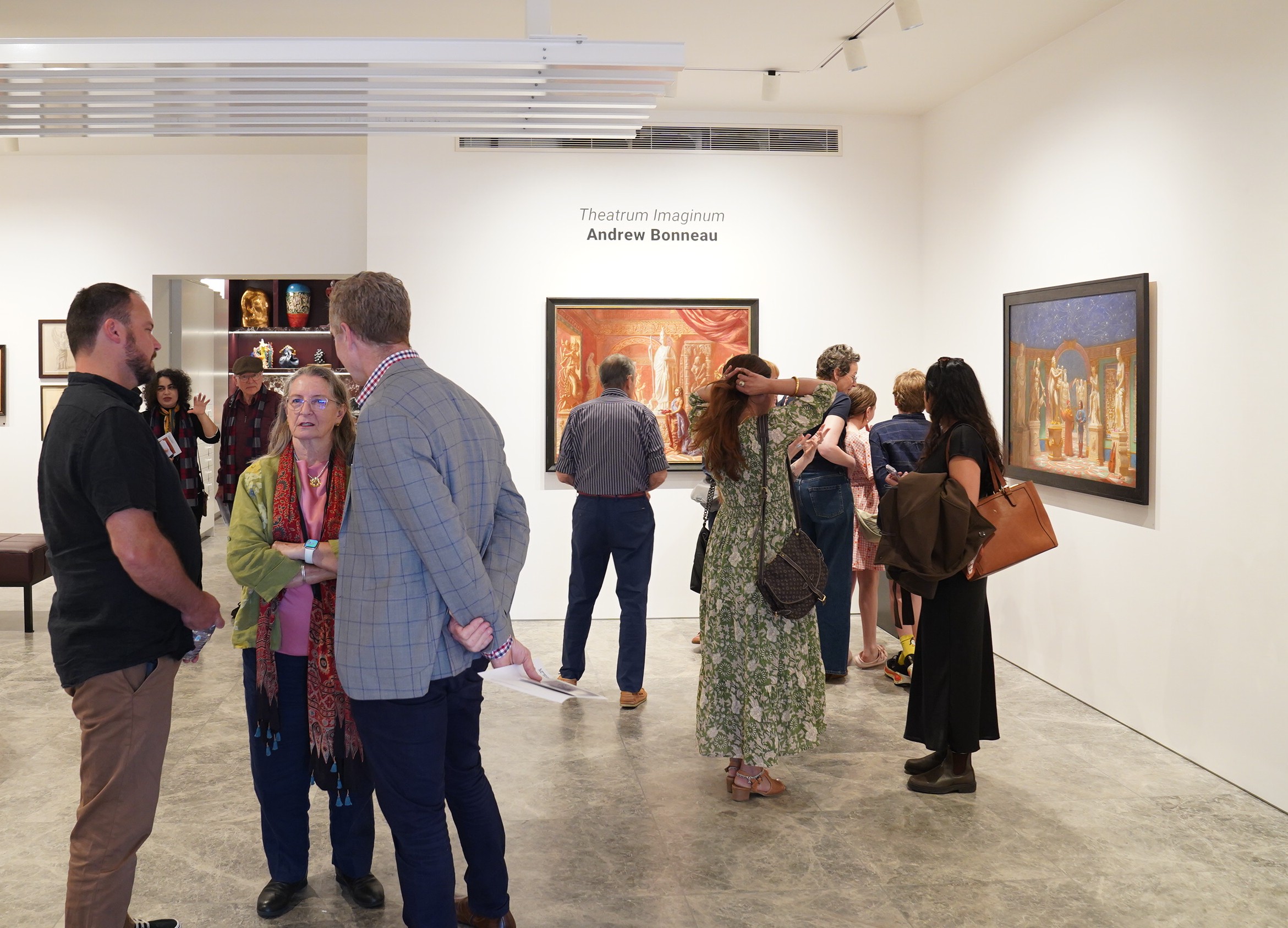 A crowd attends Andrew Bonneau’s exhibit, “Theatrum Imaginum,” at the Lennox Street Gallery in Melbourne, Australia on Sept. 19, 2026. (Tien Nguyen/The Epoch Times)
“It might be meaningful to the artist, but it doesn’t necessarily share the language which can be meaningful to others.”
Minh Anh contributed to this story.