
With the Aug. 17 expiration of the 60-day memorandum of understanding between the United States and Iran, there’s little indication either side is backing down from dueling narratives about who controls access to the Persian Gulf through the Strait of Hormuz.
It remains a tale of two straits.
Tehran maintains that the 104-mile-long waterway is closed to ships unless they enter and exit the Gulf through the Iranian Unilateral Scheme, or northern route, that previously was exclusively used for inbound traffic.
Global shippers refute any Iranian claim of sovereignty and Washington maintains that ships are moving through the United Nations’ authorized southern route along the Omani coast, which was formerly designed for outbound traffic into the Gulf of Oman, under the protection of U.S. Navy destroyers.
U.S. Energy Secretary Chris Wright on Aug. 14 said that between 14 million and 15 million barrels of crude per day were being exported from the Gulf, including 5 million to 7 million daily by Kuwait, Saudi Arabia, and the United Arab Emirates via a “shuttle system” in which large tankers transit the southern route and offload to ships in the Gulf of Oman. That’s about three-quarters of the volume before the war began on Feb. 28.
But ship-tracking services such as Kpler, Lloyd’s List Intelligence, and MarineTraffic maintain that those claims cannot be verified because, it appears, much of this traffic is in “dark transits,” meaning without transponders and other electronic navigation beacons on.
U.S. President Donald Trump said this traffic through the southern route affirms that the strait is open for all but Iranian ships, re-emphasizing that the U.S. Navy will sustain its global blockade of Iranian shipping and that it is slowly strangling Tehran’s economy.
“The Naval Blockade remains in full force and effect,” Trump wrote in an Aug. 18 Truth Social post. “The Hormuz Strait is open and operating. All water mines have been removed or detonated.”
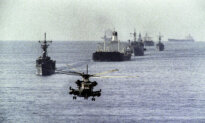
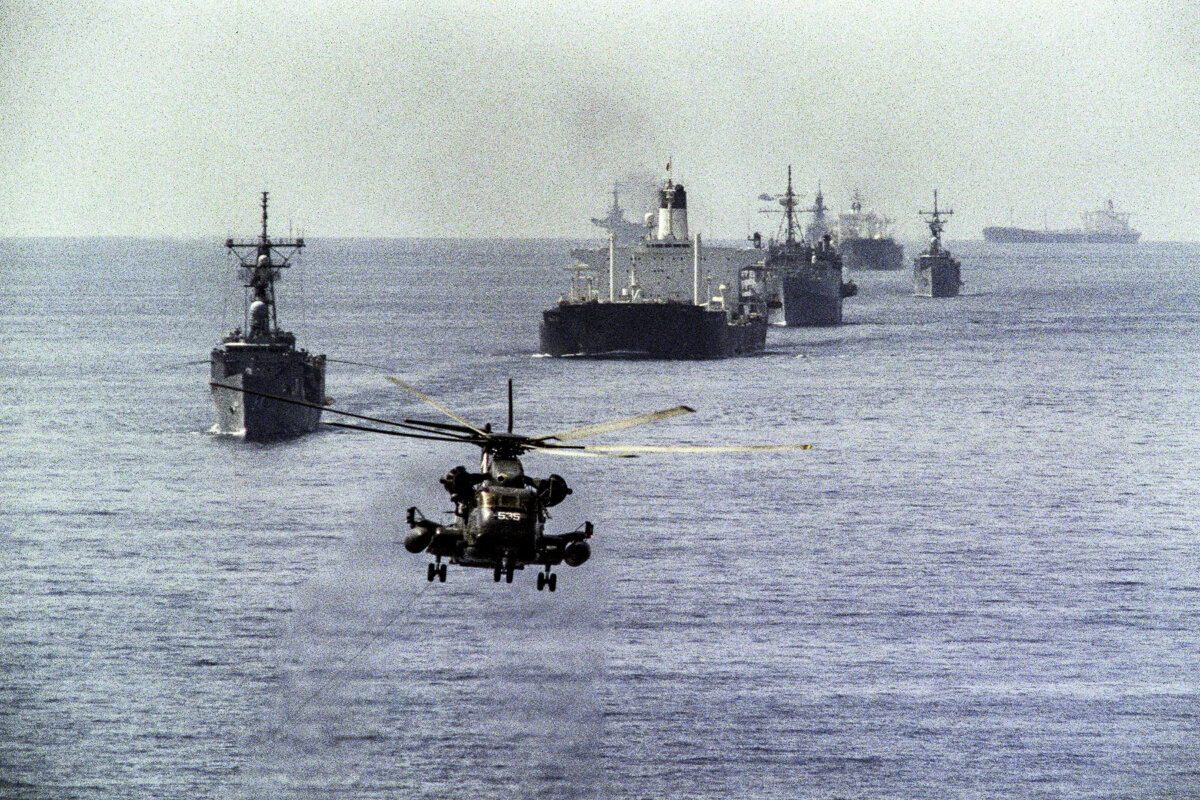
There are, on average, 20 U.S. Navy warships in the Gulf of Oman, spearheaded by an ever-present carrier battle group—the USS Abraham Lincoln remains on station awaiting relief from the USS George Washington—with destroyers moving in and out of the Persian Gulf through the strait as a shield for commercial shipping through the southern route.
U.S. Treasury Secretary Scott Bessent, in numerous recent media comments, has confirmed that the U.S. Navy blockade, and the economic isolation it imposes, is how the Trump administration aims to negotiate with Iran while the Navy protects shipping on the southern route.
According to Belgium-based Kpler, which tracks ships using transponders and satellite data, more than 80 percent of the ships entering and leaving the Persian Gulf have taken the southern route under the U.S. Navy’s protection since a spate of hostilities in July.
Analysts, including Kpler’s Homayoun Falakshahi, noting that Iran’s oil exports are at record lows, said that there were only a few ships using the southern route in July but that ships are now increasingly making the run, proving that Iran cannot claim that it controls the strait.
However, since the expiration of the memorandum of understanding and the Iranian strike on a cargo ship tracing the Omani coast on Aug. 18, shipping traffic has slackened.
Kpler and MarineTraffic reported that only 10 ships–six leaving, four entering—transited the strait on Aug. 18, down from an average of 12 to 15 per day the previous two days, including five that used the Iranian Unilateral Scheme.
According to Kpler, even before the memorandum’s expiration and the latest Iranian attack, “confirmed” shipping traffic was slowing.
“Traffic through the Strait of Hormuz weakened last week, with confirmed crossings falling 19.5 percent to 95 and reaching just three on 16 August,” Kpler reported on Aug. 17.
“Routing also remained constrained, with vessels using the Iranian Unilateral Scheme or undetermined routes, while no crossings were recorded through the Hormuz TSS [standard shipping lanes established in 1968] or Omani routes.”
“Confirmed crossings” means ships running the strait with all their electronics on. As Lloyd’s List senior maritime intelligence analyst Tomer Raanan said during an Aug. 13 update, there’s no way to accurately assess “dark” strait traffic until ships turn their transponders on and reappear downstream.
Meanwhile, Iran continues to demand payment for passage through the Strait of Hormuz as Washington maintains free passage as the cornerstone of global commerce. Those engaged in global commerce appear to prefer Washington’s version of the tale of two straits.
As Dan Pickering, founder of Pickering Energy Partners, wrote in an Aug. 12 analysis, there is grudging willingness to consider a deal in which Oman and Iran receive some compensation for jointly managing the strait, but shippers will undermine Iran’s ability to enforce the fee and transit permit scheme its Parliament is set to adopt soon.
“Depending on the exact oil price and volumes, a [proposed] 5 percent fee per barrel would create an annual windfall for Iran anywhere from $18 billion to $25 billion—and trigger inflationary cost hikes globally,” Pickering wrote, calling it “a mafia-style protection racket.”
“Giving Iran fee-collection authority would allow the regime to escalate at any time, denying maritime access, for example, to any country that hosts a U.S. military base,” he said.
 Friends Read Free
Copy
Facebook
Tweet
Friends Read Free
Copy
Facebook
Tweet