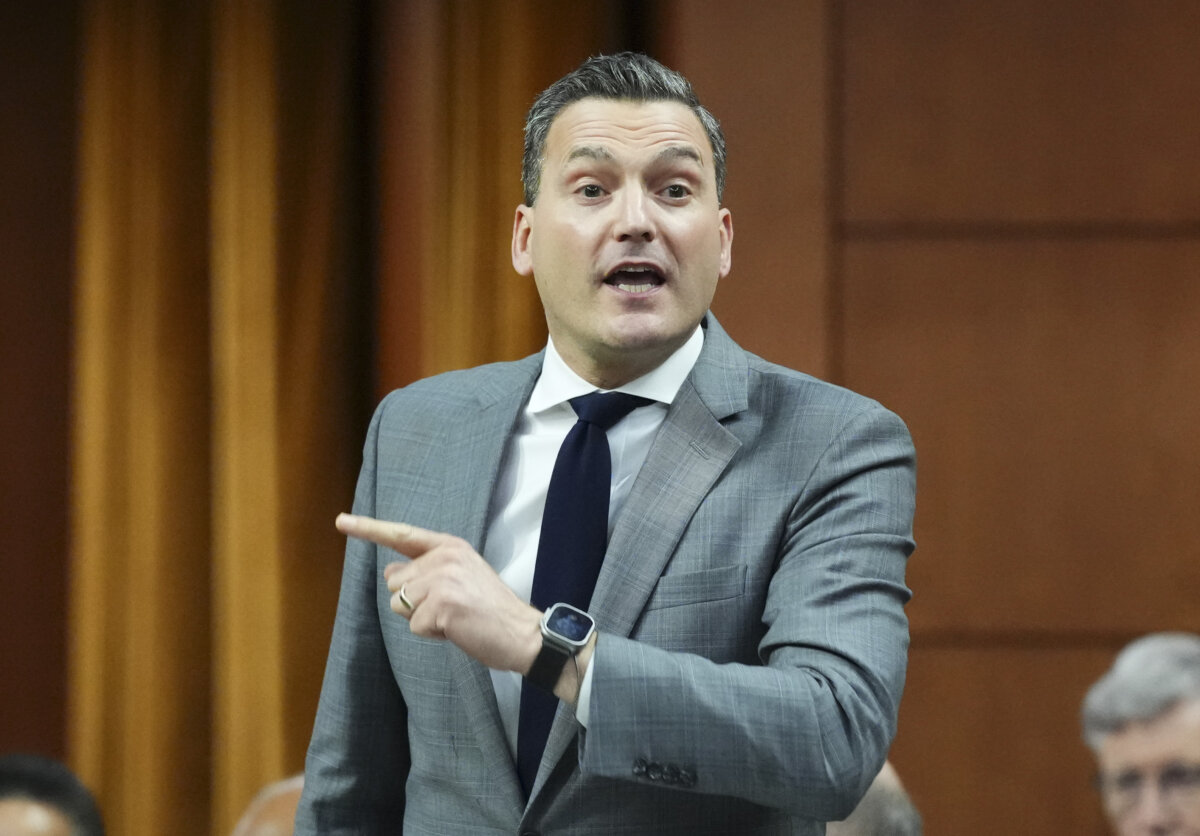

Minister of AI Evan Solomon says a new privacy bill tabled by the federal government will safeguard digital data, counter AI deepfakes, guard Canadians from surveillance pricing at grocery stores, and require stronger protections from companies who collect and use the data of minors.
The proposed legislation, entitled the Protecting Privacy and Consumer Data Act, was tabled June 15 as Bill C-36.
The new bill comes just days after the Liberal government introduced Bill C-34, the Safe Social Media Act, which proposes to ban social media accounts for minors under 16 and enforce stricter safety rules on social media and artificial intelligence (AI) chatbot platforms.
“This is also a powerful addition to the Safe Social Media Act that we tabled last week with our colleague Marc Miller,” Solomon said during the June 15 press conference from Parliament Hill.
“One bill is about safer digital spaces for children. This one is about stronger protection for personal information.”
Solomon said the legislation forms part of Canada’s new AI policy framework “AI for All,” which was announced June 4 by Prime Minister Mark Carney and Solomon.
The overall strategy is built on the three pillars of “trust, opportunity, and sovereign control,” according to Solomon.
‘Our Laws Need to Catch Up’
Solomon said the new online privacy bill is a long-needed modernization of Canada’s laws in order to catch up with the realities of the digital age.
“Canada’s consumer privacy laws are 25 years old. They were written before the iPhone. It was a different time, before AI, before deep fakes,” Solomon said.
“So much of our lives right now, especially our kids’ lives, have been shaped by platforms, apps, and digital services. We’re living in a different world, and our laws need to catch up.”
Differently from the Safe Social Media Act, which proposes a ban on having social media accounts for minors under 16, the Protecting Privacy and Consumer Data Act defines minors as those under 18.
5 Key Elements
Solomon said the bill contains five key elements, namely stronger protections on children’s data, safeguards against “surveillance pricing,” more transparency requirements for algorithms, a right to deletion, and easier ability to transfer information between service providers and online platforms.
Specifically, Solomon said the bill proposes stricter rules around how companies use, store, or share information they collect about minors and a right by all Canadians to request private companies to delete personal data they have gathered or disseminated, including deepfakes.
“Canadians will have a practical way to fight back against harmful deepfakes,” Solomon said. “They will have more power to require companies to delete personal information they should no longer hold.”
Although the bill creates a right to request deletion of personal information, the legislation notes that companies can legally refuse such requests in certain cases, including when the information is needed for legal purposes, the request is made in bad faith, or deleting it would negatively affect another person’s data or significantly harm the organization’s operations.
In terms of making it easier for Canadians to transfer their data between platforms and services, the bill says that these rights would not apply universally and would necessarily depend on future regulations setting out when and how personal information can be transferred between organizations.
The minister added that the bill also proposes more transparency in algorithms that perform important tasks such as suggesting mortgages or insurance plans.
“Canadians should not be left in the dark,” Solomon said. “They should know what information and criteria are being used.”
‘Surveillance Pricing’
The minister also pointed to proposed restrictions in the bill on using personal information for “surveillance pricing” at stores.
“Companies should not have the ability to use your behaviour, your location, your profile, your vulnerabilities, or your personal information to charge unfair prices,” Solomon said. “Your personal information should not be used against you for price gouging.”
Surveillance pricing is a term referring to the use of information about a consumer—such as their behaviour, location, purchasing history, demographics, or other characteristics—to determine the price they are offered.
Solomon said the bill would target this use of personal data to unfairly raise prices but have a carve-out to still allow loyalty and rewards points programs to continue offering benefits to consumers.
The text of the bill does not mention “surveillance pricing,” but Solomon said this would be resolved via a new regulator who would determine what use of personal data by a company is reasonable and does not contribute to unfair practices.
New Regulator
Solomon said enforcement of the bill’s proposals would be carried out by a new regulator who would have the authority to conduct investigations and levy fines.
“This is not a voluntary code. These are real rules with real consequences,” he said, noting that penalties could climb up to $10 million or 3 percent of revenues.
He said that establishing the new regulator will take roughly 18 months, until which time existing privacy protections under the Personal Information Protection and Electronic Documents Act and Office of the Privacy Commissioner will continue to apply.
Criticism
The legislation comes in the midst of broader debate over digital privacy and government regulation of online activity, with critics of Ottawa’s recently introduced Bill C-22, the Lawful Access Act, and Bill C-34, the Safe Social Media Act, saying they have unresolved concerns about access to personal information required by the bills.
Conservative Leader Pierre Poilievre has not yet publicly commented on Bill C-34, while Tory MP Roman Baber has raised concerns the bill could lead to privacy issues and censorship, pointing to a variety of Liberal bills and laws introduced or adopted in recent years that he says have crossed the line into infringing on the privacy rights of Canadians.
Critics of Bill C-22 such as Ottawa internet-law expert Michael Geist and Thompson Rivers University law professor Robert Diab argue that the bill’s granting of retention of metadata and access to subscriber information by authorities may violate Section 8 of the Canadian Charter of Rights and Freedoms pertaining to protection from unreasonable search and seizure.
The Safe Social Media Act and the Protecting Privacy and Consumer Data Act are the third and fourth attempts by a Liberal government to legislate a new framework of digital regulations, after past efforts introduced in 2020 and 2023 in the form of Bill C-36 and Bill C-63 failed to become law.
Both Bill C-36 and Bill C-63 met with considerable criticism from civil liberties groups, legal scholars, and opposition parties who said parts of the bills proposing changes to the Canadian Human Rights Act and hate speech legislation would give federal regulators overly broad authority and chill free expression.
In 2024, in response to such criticisms over Bill C-63, then-Justice Minister Arif Virani indicated the government was considering separating the child-protection and hate-speech provisions into separate pieces of legislation.
 Friends Read Free
Copy
Facebook
Tweet
Friends Read Free
Copy
Facebook
Tweet