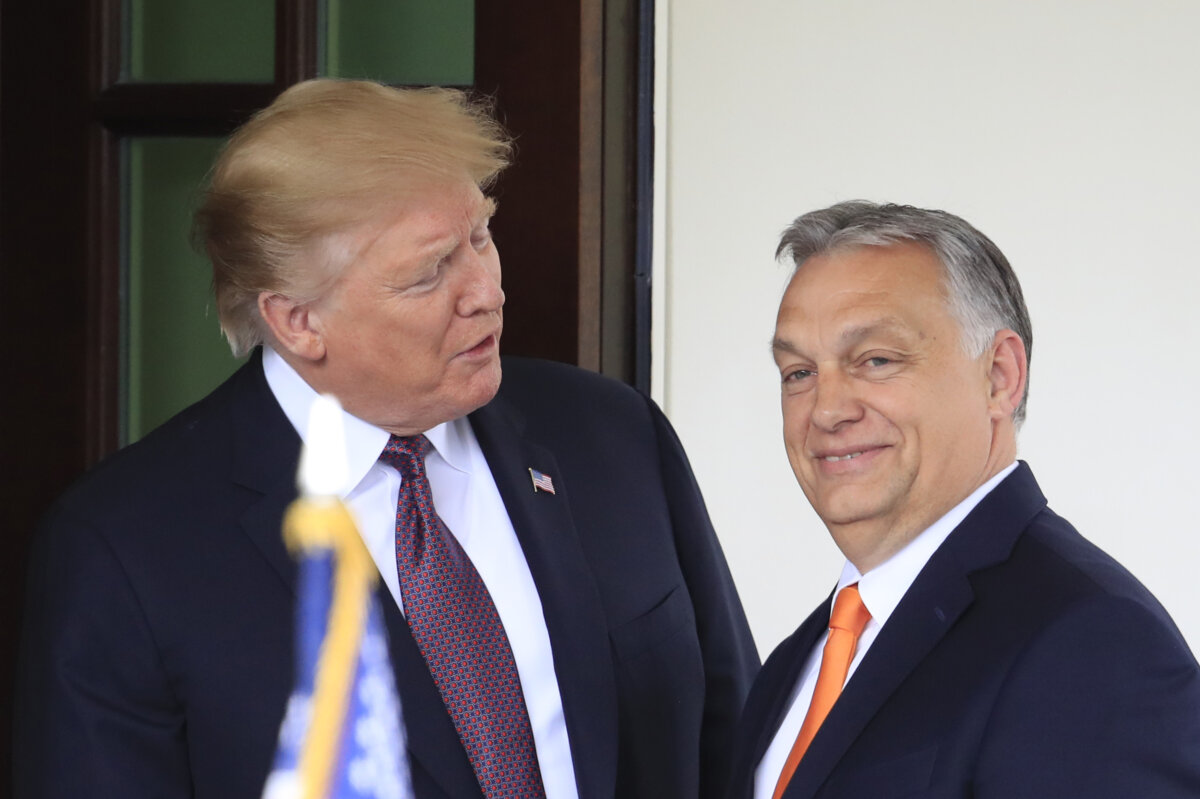

U.S. President Donald Trump is turning up the pressure on Europe to curb Russian oil imports, singling out Hungary and Slovakia for their reliance on Moscow.
But the landlocked nations of Central and Eastern Europe are digging their heels in, determined to keep cheap crude flowing through the Druzhba pipeline, a 4,000-kilometre (roughly 2,485-mile) artery carrying Russian oil into the heart of Europe.
Brussels, Washington, and analysts say existing infrastructure, chiefly Croatia’s Adria pipeline, can cover both countries’ needs while draining the Kremlin’s war coffers and its leverage.
But Budapest, Bratislava, and Hungarian oil giant MOL say the shift is unworkable, warning that it would raise costs, strain capacity, and endanger energy security.
‘Hungarian Economy Would Be on Its Knees’: Orban
Hungarian Prime Minister Viktor Orban spoke by phone with Trump on Sept. 25 about Russian oil and other issues.
In comments to state radio on Sept. 26, Orban said he told Trump that dropping Russian energy imports would be an economic “disaster” for Hungary.
“I told the U.S. president … that if Hungary is cut off from Russian oil and natural gas, immediately, within a minute, Hungarian economic performance will drop by 4 percent,” Orban said. “It means the Hungarian economy would be on its knees.”
He said that when it comes to energy sources, “it is clear what is in Hungary’s interest, and we will act accordingly.” Hungary and the United States “are sovereign countries.”
“There is no need for either of us to accept the arguments of the other. America has its arguments and interests, and Hungary does too,” he said.
Reliance on Russian Fuel
In his address to the U.N. General Assembly in New York City on Sept. 23, Trump criticized NATO members for continuing to buy Russian energy.
“But inexcusably, even NATO countries have not cut off much Russian energy and Russian energy products,” he said. “Think of it, they’re funding the war against themselves.”
According to the Russian news agency Interfax, Russia supplied 4.78 million metric tons of oil to Hungary via the southern branch of the Druzhba oil pipeline in 2024 and 956,000 metric tons from January 2025 to February 2025.
For decades, Europe’s energy system was built on Russian supply. The European Union has pledged to phase out Russian energy purchases entirely by 2028, although Washington has pushed for a faster timeline, in part to open space for U.S. exports.
Before the Ukraine–Russia war in 2022, Moscow provided about 40 percent of the EU’s natural gas imports, along with significant volumes of crude oil and coal. Pipelines such as Nord Stream 1 powered Germany’s industrial base, while countries such as Hungary, Slovakia, and the Czech Republic grew heavily reliant on Russian deliveries.
Pipelines
Both Hungary and Slovakia depend on two crude pipelines: the Druzhba, one of the biggest crude oil pipeline networks in the world, which delivers exclusively Russian crude via Ukraine.
The Adria pipeline, operated by the state-owned Croatian company JANAF, transports non-Russian crude from the Omisalj Oil Terminal on the Adriatic coast.
Druzhba still represents more than 80 percent of Slovakia’s and Hungary’s total oil imports, with the remaining 20 percent imported via the Adria pipeline through Croatia.
Druzhba’s flows are handled by MOL Group, which also operates the main refineries in Szazhalombatta, Hungary, and Bratislava, Slovakia.
This week, MOL Group disputed the results of tests carried out by JANAF that suggested that the Adria pipeline could supply enough crude to replace Russian imports.
The operator of the Adria pipeline rejected MOL’s claim.
“The only reason for the decreased flow was the direct demand by MOL Group and there were no obstacles on JANAF’s part to achieving the planned flow,” the Croatian company JANAF stated.
Dilemma
Andy Mayer, energy analyst at the Institute of Economic Affairs think tank, told The Epoch Times by email that Hungary may ultimately have to do a deal with the United States.
He noted that on the technical side, MOL and JANAF of Croatia continue to dispute that there is sufficient capacity.
“It looks to me that if the numbers are correct at Druzhba 5 million tons (mt) and Adria 14 mt per annum capacity that the Croatians are correct,” he said.
“While the Hungarians are correct to note that reducing two options to one [increases] security of supply risks and would need thoughtful agreement to manage that concern.
“[However,] the rest of Europe and now the White House reasonably regards the Kremlin’s provocations and insincere engagement with peace efforts as making such choices necessary.
“Unusually, this is a situation that might benefit from Trump facilitating a deal or the EU stepping up to prove he doesn’t need to.”
Critics say that whether to rely on Druzhba or switch to the Adria pipeline is less an economic calculation than a political one.
A joint report in May by Clean Air and Energy and the Center for the Study of Democracy (CSD) states that Hungary and Slovakia “show no real signs of decoupling from Russian crude despite the EU legal text stating this was the exemption’s purpose.”
It notes that phasing out Russian oil is “fully feasible” for the two countries, since the Adria pipeline can meet their combined needs.
The report also states that Hungary and Slovakia have “significantly ramped up their imports via the TurkStream pipeline, transforming Hungary into a strategic Kremlin-backed gas hub … that undermines EU diversification efforts, and reinforces opaque, politically captured networks that entrench Russian influence.”
EU Decoupling Efforts
The EU is keen to ramp up its Moscow energy decoupling.
It had previously planned a phase-out by Jan. 1, 2028, but Trump has repeatedly urged the bloc to end Russian energy purchases faster. EU foreign policy chief Kaja Kallas said on Sept. 19 that the new proposal aimed “to speed up the phase-out of Russian liquefied natural gas (to be complete) by Jan. 1, 2027.”
The EU can approve new sanctions only unanimously. Hungary and Slovakia can veto, meaning that there’s no true “nuclear option” without Orban’s and Slovak Prime Minister Robert Fico’s consent.
Instead, Brussels has economic leverage over member states.
The EU uses its funds as a tool to enforce compliance and is sitting on 19 billion euros currently frozen for Hungary for rejecting its values.
Security Risks Amid War
There’s a chance that war could make that decision for both countries.
In August, Ukraine struck the Druzhba pipeline.
“The Druzhba oil pipeline is resting,” wrote Robert “Madyar” Brovdi, Ukraine’s drone chief, on X on Aug. 18.
At the time, Hungarian Foreign Minister Peter Szijjarto said that “the Ukrainian army is not harming Russia primarily with these attacks, but Hungary and Slovakia, as this pipeline plays a key role in our country’s energy supply, without which it would be physically impossible to supply the country with oil.”
“Endangering our energy supply and causing damage as a result is unacceptable!” he said.
After a third strike in September, the foreign ministers of Hungary and Slovakia sent a joint letter to the European Commission, demanding Brussels act to protect critical infrastructure from further attacks.
A spokesman for the Hungarian government pointed The Epoch Times to a statement by Orban posted on X on Sept. 26.
“Hungary is landlocked,” Orban said.
“As President Donald Trump rightly pointed out: we cannot be blamed for lacking seaports or alternative pipelines, and we appreciate his recognition of this reality. Cut us off from Russian oil and gas, and our economy would tumble 4 percent, families would suffer, and energy bills would skyrocket. We will not bow to Brussels’ demands, our energy security and our families must come first.”
The Slovak government did not respond to The Epoch Times’ request for comment.
The Associated Press and Reuters contributed to this report.
 Friends Read Free
Copy
Facebook
Tweet
Friends Read Free
Copy
Facebook
Tweet