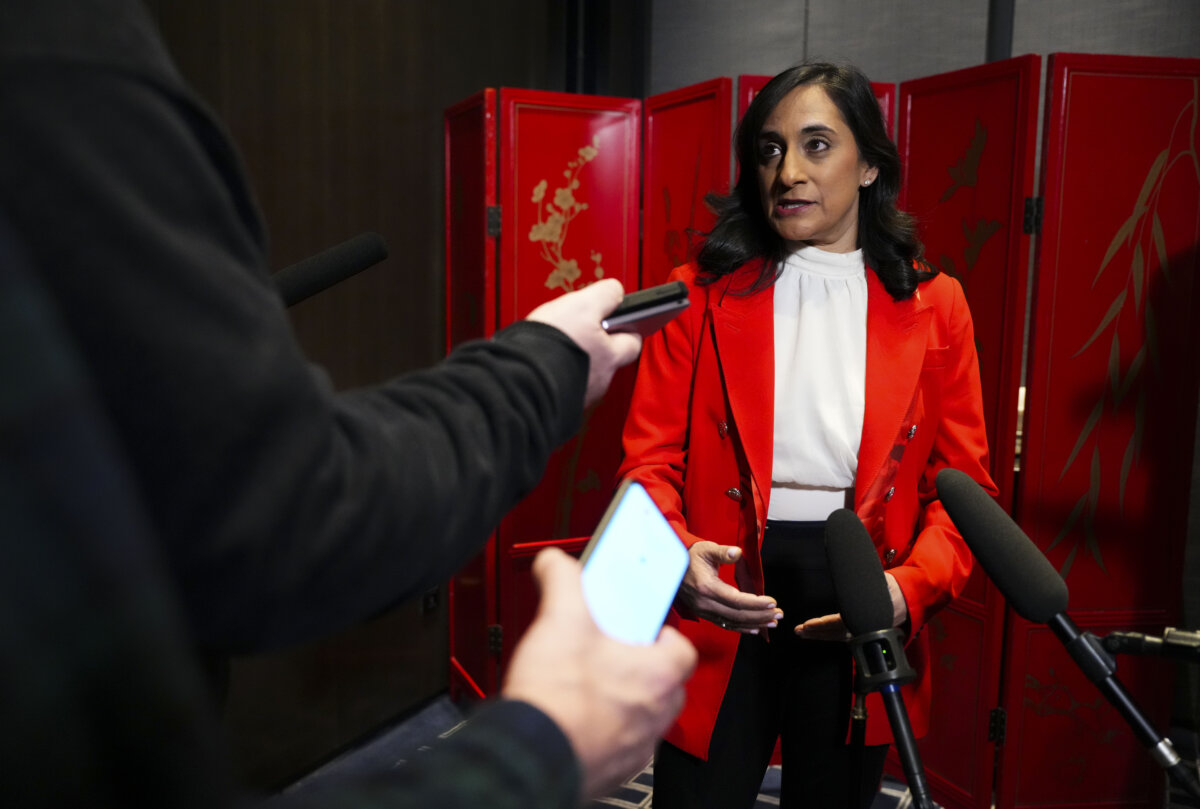

Foreign Affairs Minister Anita Anand said Ottawa will continue to have “hard conversations” around human rights issues with Beijing, when pressed by reporters on whether Ottawa still considers China a “disruptive” global power.
“We will be at the table to have those conversations. At the same time, we need to continue building the Canadian economy,” Anand told reporters in French in Beijing on Jan. 14.
The term “disruptive” is a reference to Canada’s most recent policy toward Asia, the 2022 Indo-Pacific Strategy, which called China “an increasingly disruptive global power.”
When pressed to answer “yes” or “no” about China being “disruptive,” Anand said it’s a “very complex relationship” and there are “many issues we need to address.”
“This is a new government with a new prime minister, a new foreign policy, in a new geopolitical environment,” Anand told reporters. “In this moment of economic stress for our country, it is necessary for us to diversify our trading partners and to grow non-U.S. trade by at least 50 percent over the next 10 years.”
She said in addition to recalibrating the two countries’ trade and economic relationship, Ottawa will explore “other opportunities” for collaboration with Beijing.
Relations between Canada and China began to reset after Anand travelled to China in October 2025, following which she described Ottawa’s ties with Beijing as a “strategic partnership.” Carney then met with Chinese leader Xi Jinping in South Korea on Oct. 31, where he received an invitation to visit China, and afterwards spoke of a “turning point” in Ottawa’s relationship with Beijing.
Previously during the April 2025 election campaign, Prime Minister Mark Carney had called China the “biggest security threat” facing Canada due to its extensive involvement in foreign interference.
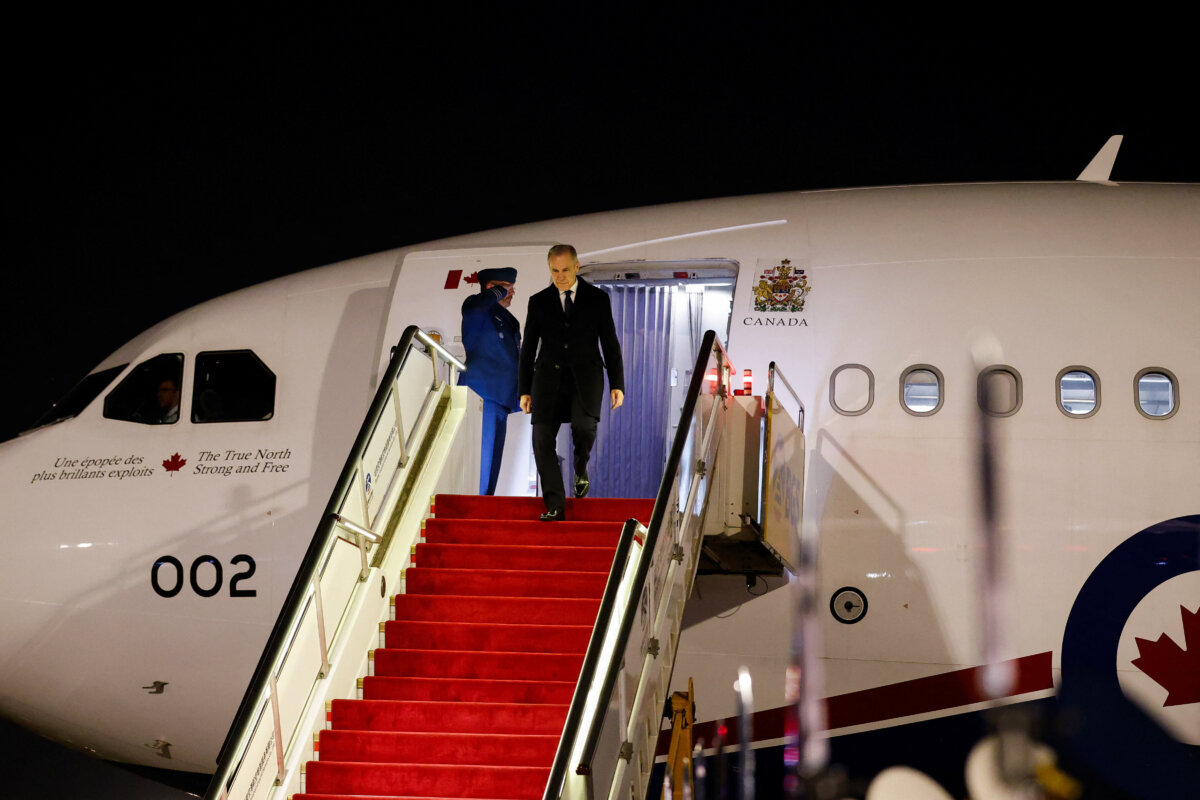
Carney arrived in Beijing, accompanied by a number of ministers and officials, on the evening of Jan. 14 and is set to meet with Chinese Premier Li Qiang on Jan. 15. He is also expected to meet with Chinese leader Xi Jinping, as well as business leaders, before the trip wraps up on Jan. 17, according to the Prime Minister’s Office (PMO).
The trip marks the first visit to China by a Canadian prime minister since 2017, as Carney has been looking to diversify trade away from the United States. The PMO has said discussions will revolve around “trade, energy, agriculture, and international security.”
“The relationship between Canada and China has created opportunities and prosperity on both sides of the Pacific,” Carney wrote in a Jan. 14 post on X as he landed in Beijing. “We’re ready to build a new partnership — one that builds on the best of our past, and responds to the challenges of today.”
‘Perpetrating Genocide’
Carney’s visit to China and efforts to repair relations between Ottawa and Beijing has been met with criticism from opposition parties and China watchers.
Tory Leader Pierre Poilievre said on social media that when it comes to engagement with China, “Canada’s interests must always come first” and that the Liberals should secure conditions to that effect during talks.
“The Liberals should tell Beijing they will cancel the $1 billion taxpayer-funded federal loan for Chinese made ferries if they keep tariffing our seafood, canola, peas, and agri-food products – and make it clear Beijing’s meddling in our democracy is unacceptable,” he said.
Conservative MP Matt Strauss called Carney’s Jan. 14 social media post “dark” and said that building a new partnership with China is “a bad strategy.”
“China is a communist dictatorship currently perpetrating genocide,” Strauss added in the Jan. 14 post on X.
Bloc Québécois leader Yves-François Blanchet also questioned the visit, saying China is a “75-year-old communist dictatorship that has meddled in each of Canada’s recent elections” and criticized the prime minister for not including human rights on the agenda during engagement.
“Conscience will be left in the locker room. What child labor? What slavery? What Uyghur genocide? What repression of regime opponents and journalists? What disappearance of the Tibetan nation?… Have we become this?” Blanchet said in a Jan. 14 post on X.
He said Canada must trade with China, “but with caution, and without naiveté about the regime,” adding that the Bloc proposes “a law to regulate Chinese practices in the production of imports to Canada.”
As Carney seeks to secure new investments with China, Tory MP Roman Baber noted that while 5 percent of Canada’s exports currently go to China, 80 percent still go to the United States.
“Instead of striking a deal w/our best customer, Carney is throwing our economy by cozying up to Communists who abuse human rights & undermine our democracy,” Baber said in a Jan. 14 post on X. “Play stupid games, win stupid prizes.”
Various China watchers and human rights organizations have warned against getting closer to China, with the Canadian Coalition on Human Rights in China saying Carney needs to take “strong and effective action” to address the Chinese regime’s widespread human rights violations, including its engagement in transnational repression in Canada.
Noé Chartier contributed to this report.
 Friends Read Free
Copy
Facebook
Tweet
Friends Read Free
Copy
Facebook
Tweet