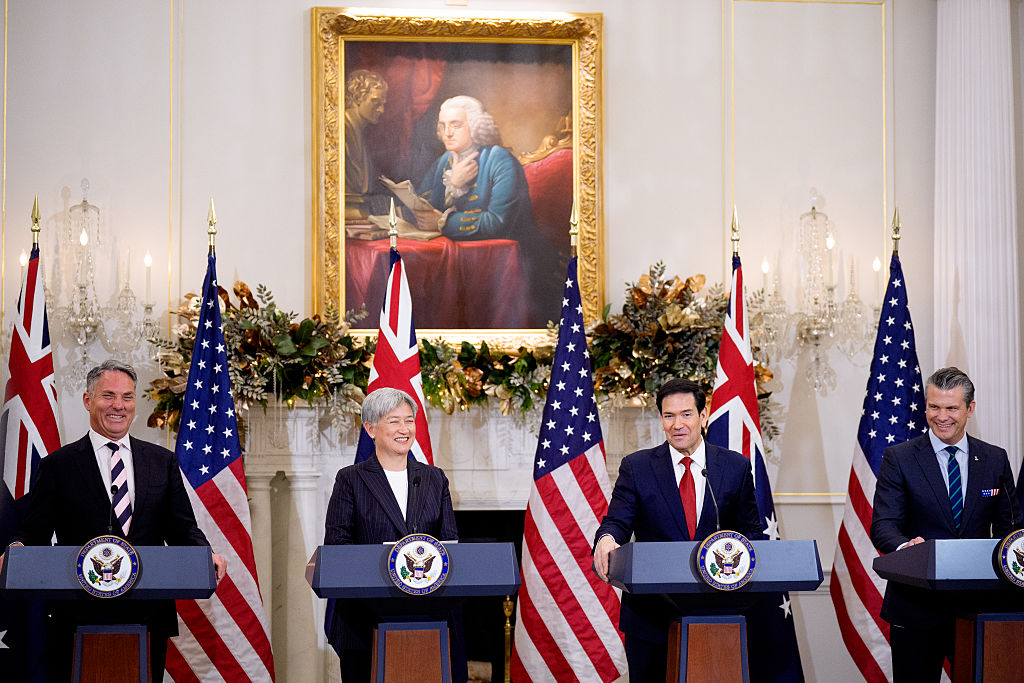

The U.S. government has reconfirmed the AUKUS agreement is “full steam ahead” as Australian Foreign Minister Penny Wong and Defence Minister Richard Marles met with U.S. Secretary of State Marco Rubio and Defense Secretary Pete Hegseth in Washington.
In a statement issued on Dec. 9, Wong said the Australia-U.S. Ministerial Consultations (AUSMIN) had focused on regional stability in the Indo-Pacific, as well as strengthening Australia’s alliance with the U.S. and shoring up national security via economic cooperation.
Australia and the U.S. will confer once again in 2026 with the upcoming signing of the 75th ANZUS treaty between Australia, New Zealand and the States.
AUKUS Agreement
The AUKUS agreement got confirmation of the green light once again, following the June announcement of a Pentagon review into the British, Australian, and U.S. alliance.
AUKUS was given the nod of approval during Australian Prime Minister Anthony Albanese’s visit to Washington in October.
During AUSMIN, Rubio and Hegseth also gave strong reassurances that the alliance was in full swing.
“We are strengthening AUKUS so that it works for America, for Australia, and for the UK,” Hegseth said.
“There’s a lot we are going to do together in the months ahead.”
“The stronger we are together, the more we can deter the kinds of conflicts neither of us want to see. And this is a deepening of that partnership.”
Rubio noted Australia’s role in America’s wars, and that Australia had supported the United States in every one.
Wong’s U.S. counterpart said Albanese’s meeting with Trump had given the alliance momentum.
“We truly have no better friend,” Rubio said in a statement.
Wong says the two nations have advanced key priorities, including acknowledgement of the work underway to deliver priority infrastructure works and a workforce uplift plan in support of an enhanced trilateral submarine industrial base.
Australia will soon deliver its next billion-dollar payment to the U.S. to help expand the U.S. submarine production capacity, bringing Australia’s total contribution to $2 billion (US $1.32b).
Peace In the Indo-Pacific
A key topic of the meeting of the leaders was recognising the threats to peace in the Indo-Pacific and the need to build resilience against economic coercion.
Discussions centred around increased alliances with the Philippines and Japan, as well as the U.S. partnering with Australia to provide Papua New Guinea (PNG) with digital infrastructure.
Australia and the United States will also continue to work together on economic initiatives for PNG, including Australia redeveloping the Lae Port, while the United States will bolster cargo inspection and screening infrastructure.
Another initiative will bring about an $80 million project financed by the United States and Australia, in partnership with Taiwan, New Zealand and Japan, to support the development of trusted data transmission cables across the Indo-Pacific.
National Security
Japan will jump aboard the Critical Minerals Framework, which will see swift movement towards producing gallium—an alloy used in nuclear weapons—from 2026.
The parties also welcomed EFA and the U.S. EXIM Bank issuing coordinated letters offering up to US$600 million to Tronox to help expand its rare earth and minerals projects in Australia, supporting a key U.S. critical minerals supply chain.
“I know we have also signed a landmark critical minerals framework agreement,” Rubio said.
“This is something we share in common, not just with Australia, but with many of our allies around the world–the desire to diversify supply chains.
“And the belief that, in order for us to be able to do anything—whether it’s defend our countries, defend our allies or defend each other but also to build our economies into prosperous economies–we have to have critical mineral supplies and supply chains that are reliable and that are diverse.
“This is something that you will find the U.S. and Australia working very closely on. And it’s at the cornerstone of everything we plan to do together in the months and years to come.”
The United States will also upgrade air bases in Queensland and the Northern Territory, allowing for U.S. bomber rotations.
In turn, logistics infrastructure in Darwin will be revamped to allow rotational U.S. marine deployments and pre-positioning of MV-22 Osprey aircraft.
Global Entry
On the friendship front, the United States will also extend “global entry” to Australian citizens, providing faster arrival in America by bypassing long immigration lines.
Australia and the United States will also work together to investigate customs law violations.
“Our relationship with the United States is the most important relationship that we have,” Marles said.
“And indeed, our alliance with the United States is really the cornerstone of Australian strategic and foreign policy.”
Opposition to Alliance
Greens Senator David Shoebridge called the ongoing alliance “cringeworthy.”
“Even more U.S. military assets coming to Australia,” he said on X.
“More U.S. bases. More U.S. weapons. Celebrating a dominant foreign government sending its military into our harbours and cities and taking multiple footholds here … it’s cringeworthy, tragic, and wrong.”
Meanwhile, former Labor Senator Doug Cameron said the deal was an abandonment of sovereignty.
“‘Full steam ahead’ on AUKUS. Hegseth ‘applauds’ another $1 billion of our money handed over to the U.S. military industrial complex,” he wrote.
“Wong claims it’s a win for Australia. Abandoning our sovereignty, preparing for war with our most important trading partner, is a disaster not a win.”
 Friends Read Free
Copy
Facebook
Tweet
Friends Read Free
Copy
Facebook
Tweet