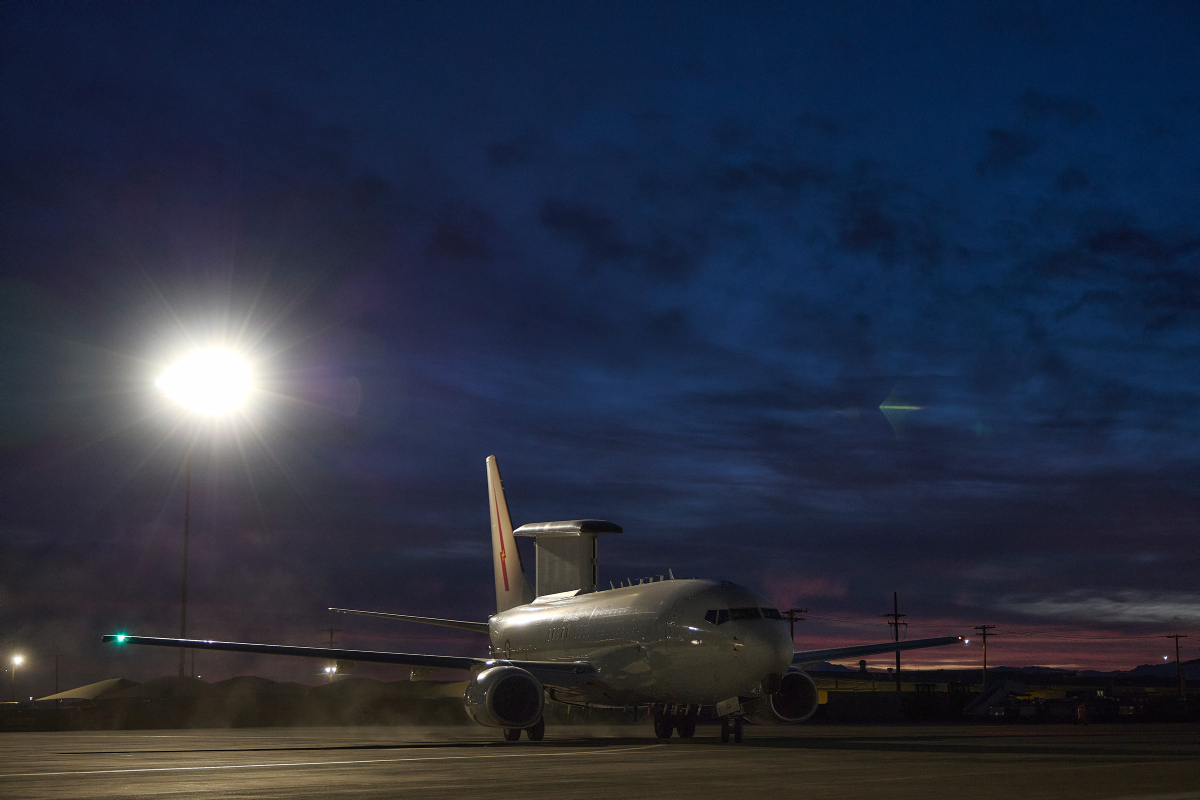

A Royal Australian Air Force (RAAF) E-7A Wedgetail aircraft and 100 Australian Defence Force (ADF) personnel will be deployed to Ukraine in August to bolster efforts to contain Russia, the government has announced.
The deployment comes at the request of the North Atlantic Treaty Organisation (NATO) and Poland.
Defence Minister Richard Marles, speaking from The Hague for the NATO Leaders’ Summit, said the move will “showcase [Australia’s] ability to operate from Europe, alongside NATO and partners, in support of Ukraine and international peace and security.”
The Wedgetail, manufactured by Boeing and based on the 737 Next Generation design, is equipped with an active electronically scanned array radar capable of monitoring up to 80 aircraft, as well as land and sea targets, with a range of over 600 kilometres.
Australia operates six of the twin-engine aircraft.
The Wedgetail being sent to Europe will help protect a vital international gateway for humanitarian and military assistance into Ukraine.
Under Operation Kudu—previously limited to training Ukrainian personnel in the United Kingdom—up to 100 ADF personnel will accompany the aircraft.

The government expects the deployment to conclude by November, but hasn’t specified whether the personnel will also return at that time.
This latest support builds on the more than $1.5 billion committed by Australia since the start of Russia’s invasion.
Marles also announced further travel bans on seven people and financial sanctions on seven entities that are part of Russia’s war effort. The goal, he says, is “to further weaken Russia’s war economy.”
These sanctions target Russia’s defence, energy, transport, insurance, electronics, and finance sectors, as well as those spreading “Russian disinformation and propaganda.”
During the summit, Australia also signed an agreement with NATO’s Support and Procurement Organisation (NSPO), strengthening Australia’s cooperation with NATO partners on capability acquisition, systems support, and logistics.
Under the agreement, the ADF will be able to participate in collaborative procurement efforts with NATO partners, as well as offering Australian defence firms access to new markets across NATO supply chains.
“Signing the NSPO Agreement opens the door to new partnerships for us to deliver capability and operational responsiveness for the Australian Defence Force,” Marles said.
Foreign Minister Penny Wong issued a statement supporting the measures against what she called “Russia’s illegal and immoral war.”
“Australia remains steadfast in our support for Ukraine and in our commitment to a comprehensive, just, and lasting peace,” she said.
“Our targeted sanctions reflect our close coordination with key NATO partners, including the UK, Canada, and the European Union.”
Australia has now imposed more than 1,500 sanctions in response to Russia’s full-scale invasion of Ukraine.
 Friends Read Free
Copy
Facebook
Tweet
Friends Read Free
Copy
Facebook
Tweet