
Australia will deploy a Royal Australian Air Force E-7A Wedgetail surveillance aircraft to the Middle East after its trade partner, the United Arab Emirates (UAE), requested assistance.
The move is aimed at helping the Middle Eastern nation protect airspace and civilians in the wake of retaliatory attacks from Iran that have hit a swathe of neighbouring Gulf nations.
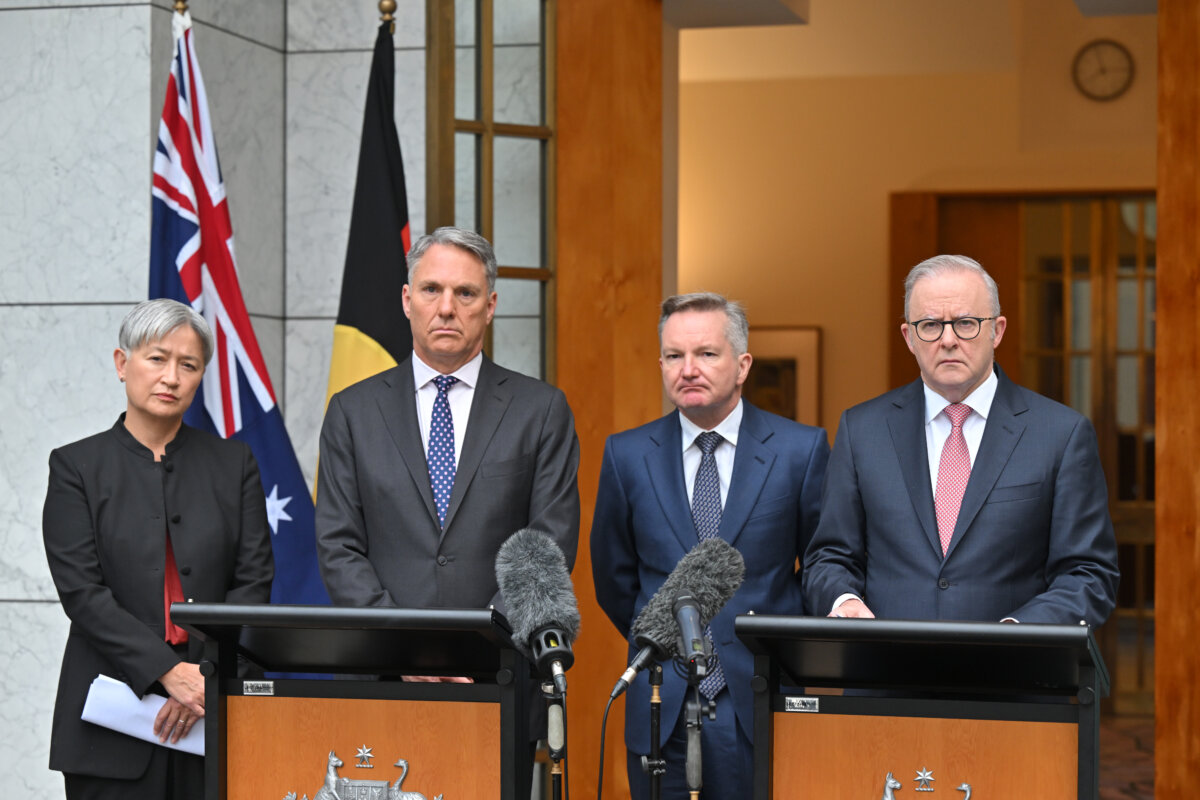
Prime Minister Anthony Albanese confirmed the deployment on March 10 in a joint press conference along with Deputy Prime Minister Richard Marles, Foreign Affairs Minister Penny Wong, and Energy Minister Chris Bowen.
“The first priority of my government is, and always will be, to keep Australians safe. There are around 115,000 Australians in the Middle East, around 24,000 of those in the UAE,” Albanese said.
The Wedgetail aircraft will provide long-range surveillance and command capability, helping monitor and secure airspace above the Gulf.
Around 85 Australian Defence Force personnel will accompany the aircraft for an initial four-week mission supporting the collective defence of Gulf states.
Australia will also supply advanced medium-range air-to-air missiles to the UAE following a request from the Emirati government.
Marles said the E-7A Wedgetail is among the world’s most advanced airborne surveillance platforms.
“And we are one of the leading nations in the use of the E7 what this aircraft will be doing is very similar to the role that it has played in recent times from Poland in respect of the defence of Ukraine.”
Marles said the aircraft would depart Australia immediately.
“The airframe will be leaving Australia today, and the expectation is that it will be in the region in the middle of the week, and operational by the end of the week.”
Albanese said the assistance follows an escalation in attacks across the region linked to Iran.
“The United Arab Emirates alone has been forced to shoot down over 1,500 rockets and drones. This growing wave of dangerous and destabilising attack from Iran puts civilian lives at risk, of course, including Australian lives,” he said.
The prime minister said he had spoken directly with UAE President Mohammed bin Zayed and emphasised that helping Gulf partners would also protect Australians in the region.
He reiterated that Australia would not participate in direct offensive operations against Iran.
On Feb. 28, the Trump administration and Israel combined to launch airstrikes across key targets in the Iranian Republic almost wiping out its entire top leadership class, including Supreme Leader Ayatollah Ali Khamenei, as well as military and government targets.
In response, Iran fired missiles and drones hitting civilian structures in the UAE, Saudi Arabia, Iraq, Oman, Kuwait, Bahrain, Qatar, Lebanon Azerbaijan, and Cyprus—an apparent attempt to escalate the situation to force the U.S.-Israel to back down.
One analyst says the Trump administration’s offence, while largely aimed at forcing regime change—Iran is blamed for sponsoring several terror groups across the Middle East—is also aimed at removing another key ally of the Chinese Communist Party.
“While all of those justifications are real and verifiable, one of the most significant impacts for the United States and its national security is the setback this conflict is dealing to the global power ambitions of the Chinese Communist Party (CCP),” wrote Antonio Graceffo, in The Epoch Times.
Coalition Supports, Greens Reject
Australian shadow cabinet minister Dan Tehan said the decision meant Australia was now participating in the war.
“I think by the very nature of that action, yes, we are [participants to this war]. And we’re doing that because we want to keep Australians safe and we want to see an end to this evil Iranian [regime],” he told RN Breakfast on March. 10.
Tehan said Australia’s involvement reflected a broader commitment to regional stability.
“We want to be doing our bit to keep the region safe and obviously bring this conflict to an end. You know, the best thing that can happen now is for the Iranian regime to say, enough’s enough.”
However, the left-wing Australian Greens strongly criticised the move, warning that Australia risks being drawn into another long-term conflict.
Greens leader Larissa Waters rejected the government’s description of the deployment as defensive.
“Labor shouldn’t be sending troops to help a military that’s killed 150 schoolchildren in a primary school bombing. That will only escalate an illegal conflict that’s already spiralling out of control, and leave Australia trapped in yet another forever war,” she said in a statement.
Australians Leaving the Middle East
The federal government also said four commercial flights from Dubai to Sydney, Melbourne, and Perth were scheduled to depart on March 11, though travel conditions remain uncertain.
About 2,697 Australians have already returned home from the UAE on 18 direct flights so far.
Foreign Minister Wong said the government continues to urge Australians to leave the region using commercial flights where possible.
“This is because the security situation is deteriorating and it is likely to get worse before it gets better,” she said.
With Kuwait airport closed, Australian officials have arranged bus transport to Riyadh in Saudi Arabia, allowing travellers to continue their journeys on commercial flights.
Similar land transport options are being organised from Bahrain, while most Australians in Qatar have now departed Riyadh on commercial flights.
 Friends Read Free
Copy
Facebook
Tweet
Friends Read Free
Copy
Facebook
Tweet