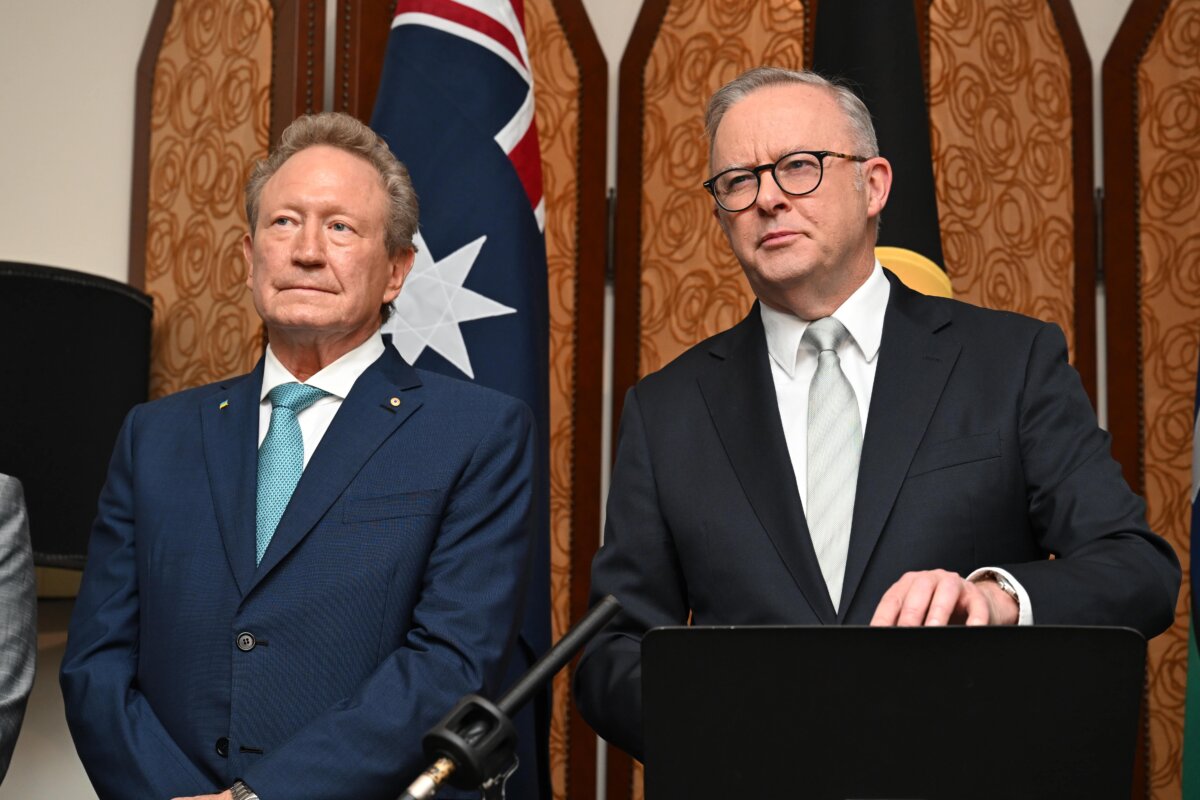

Prime Minister Anthony Albanese has called on Chinese steelmakers to help decarbonise steel production, develop “green steel,” and address China’s overcapacity problem.
Compared to traditional efforts, “green steel” is supposed to be produced at lower or near-zero carbon emissions.
“Australia and China’s iron ore and steel sector partnership has contributed to both countries’ economic development for decades,” Albanese said on July 14 in the opening remarks of Steel Decarbonisation Roundtable, a high-level meeting between Australian iron ore producers and Chinese steelmakers.
The roundtable discussions included major industry CEOs such as BHP’s Geraldine Slattery, Fortescue’s Andrew Forrest, and Rio Tinto’s Kellie Parker.
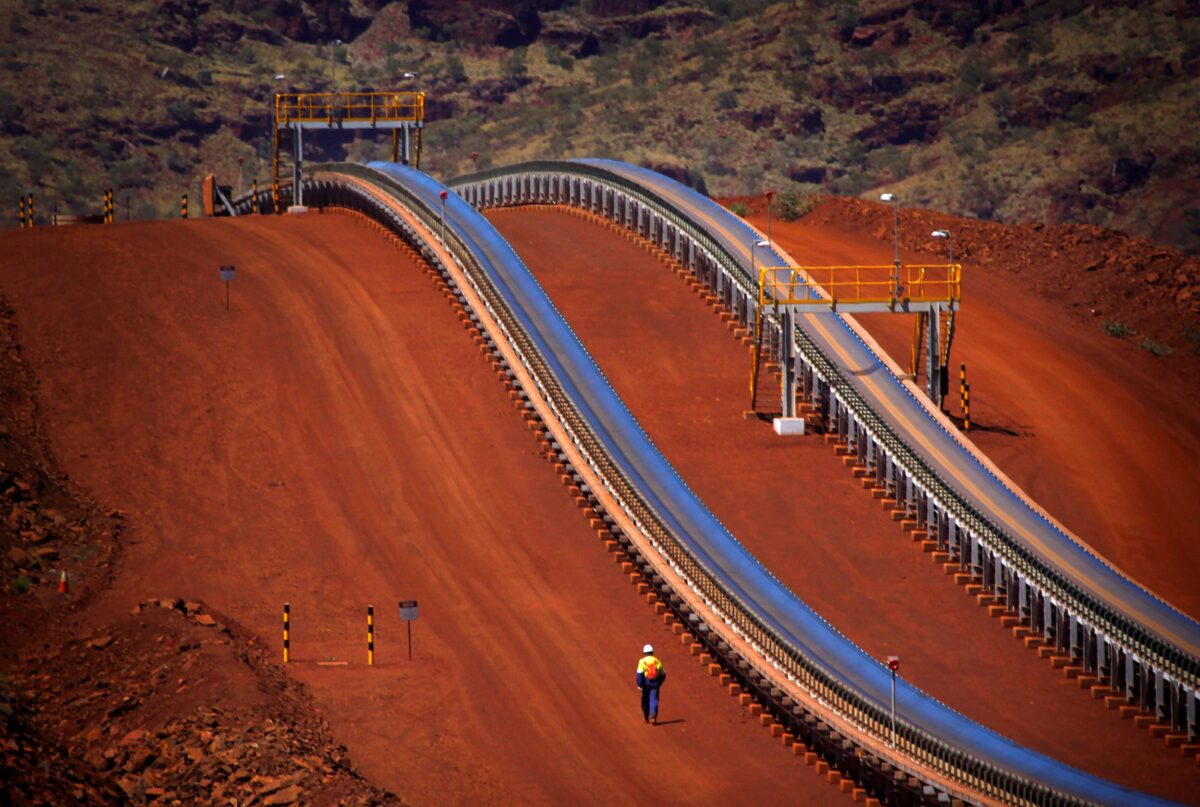
In 2024, Australian iron ores and concentrates exports to China were valued at approximately $103.95 billion (US$69.3 billion)—the country’s largest export sector.
Iron ore comprised nearly 60 percent of Australia’s goods exports to China over the year to May 2024.
Decarbonisation, Steel Overcapacity Highlighted
Prime Minister Albanese highlighted the climate change topic and called for deeper cooperation in transitioning toward low carbon steel production, saying steelmaking value chains were “responsible for 7 to 9 percent of global emissions.”
“Achieving the goals of the Paris Agreement will require the decarbonising of steel value chains, presenting an opportunity for Australia and China to progress our long-term economic interests,” he said.
The Paris Agreement, adopted by 196 countries in 2015, aims to limit global warming to by 2 degress Celsius—or ideally 1.5 degrees—and achieve net-zero emissions by mid-century. Both Australia and China have committed to the goals, with Australia targeting net-zero by 2050 and China by 2060.
Albanese admitted that the immature decarbonisation process presented “a range of challenges.”
“What we need are enabling policy environments, extensive investments in research to develop new technologies, and collaboration across academia, industry, and government,” he said.
Another issue was overcapacity of steel in global markets.
“As both countries cooperate to advance decarbonisation, we also need to work together to address global excess steel capacity. It is in both countries’ interests to ensure a sustainable and market-driven global steel sector,” he said.
China, the world’s largest steel producer accounts for half of global steel output, which has led to major oversupply causing price crashes.
In 2023, China produced approximately 1.02 billion metric tonnes of crude steel, accounting for about 54 percent of global steel output.
For Australia, the overcapacity put pressure on iron ore prices. The oversupply in the steel market reduced demand for Australian iron ore, impacting the nation’s mining sector and overall trade balance.
In a live Q&A session with Australian Broadcasting Corporation (ABC) later in the day, the prime minister talked about opportunities in the Asia-Pacific.
“There’s enormous opportunities going forward there, but I think Australia’s support for free and fair trade does provide potential opportunities for Australia in this region as well, not just with China, but with ASEAN (Association of Southeast Asian Nations) young nations,” said Albanese.
“The world is looking at Australia as, I think, a country that where we are a good trading nation. One in four of our jobs is [built?] on trade.”
 Friends Read Free
Copy
Facebook
Tweet
Friends Read Free
Copy
Facebook
Tweet