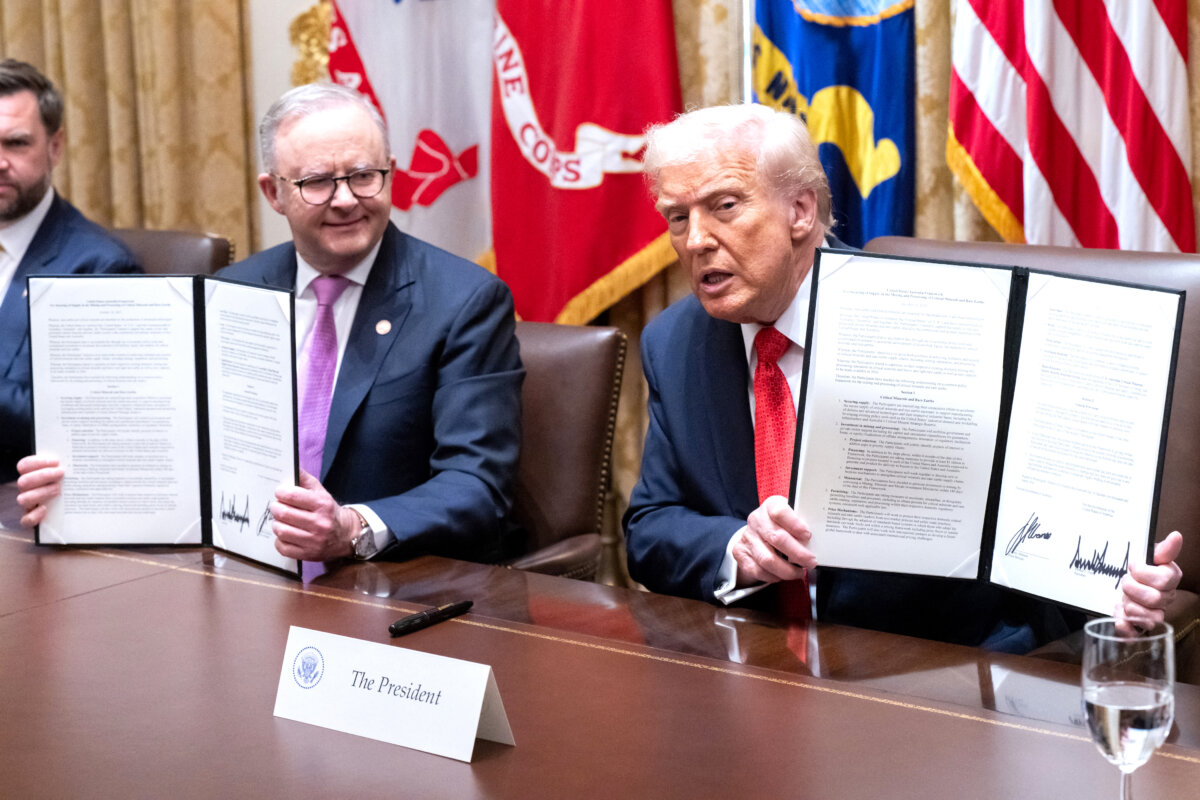

Australia’s Prime Minister Anthony Albanese and the federal opposition have rejected new 12.5 percent tariffs implemented by the Trump administration.
The duties were announced on June 2 and follow an investigation by the Office of the U.S. Trade Representative (USTR) into 60 countries that have allegedly “failed to impose and effectively enforce” bans on goods made with forced labour.
The USTR determined Australia had no forced labour import ban in place, meaning it was slapped with a 12.5 percent tariff, meanwhile, countries with such bans, or that have committed to one, face a lower 10 percent rate.
Chinese producers and manufacturers, who underpin numerous global supply chains, are often accused of using forced labour.
‘Ideological Disagreement’: Albanese
In response, Prime Minister Anthony Albanese rejected the tariffs, saying no early notice was provided.
“It seems there is an ideological disagreement where the United States administration has broken with what was decades-long understanding that tariffs are not positive for the country that is imposing them, that they increase the costs of goods and services in the country that is applying them to its consumers, and that free trade is in the interest of the global economy,” he said on ABC AM on June 4.
“We continue to use every opportunity that we have to advocate that U.S. tariffs imposed in Australia are unwarranted.”
Australian Trade Minister Don Farrell defended Australia’s record on dealing with forced labour.
“Australia has robust, comprehensive and world-leading legislation addressing forced labour and modern slavery,” he told reporters.
Meanwhile, Opposition Leader Angus Taylor also pushed back against the tariffs.
“They’re a great friend, and they shouldn’t do it to a friend. We’ve fought with them in every war, every major war. They shouldn’t be imposing tariffs. It’s not what we want to see, and we’ll fight against these rotten tariffs,” he told reporters in Canberra.
Australia’s Anti-Slavery Commissioner Chris Evans has pointed out that Chinese online retailers, like Temu, are not subject to local laws against slavery.
Temu has made about $2.6 billion (US$1.7 billion) from Australian customers in the year to June 2025, according to survey company Roy Morgan, but does not provide any reports on slavery even though it sits above the benchmark.
“We have some of the weakest border controls in terms of human rights protection and goods coming across the border,” Evans said during a panel hosted by Ethical Clothing Australia on Oct. 30 last year.
“Our due diligence law, the Modern Slavery Act, is really very light-touch reporting only; it’s probably the weakest of any of the regimes in the world.”
Evans also praised the Trump administration for being the “most effective” at dealing with forced labour practices.
“The largest bicycle company in the world, Giant, got pinged in Taiwan for having modern slavery and supply chains.”
The USTR tariffs are not yet final, with public comment open until July 6 and a hearing the next day.
Exemptions apply to energy, rare earths, organic chemicals, pharmaceuticals, and some metals.
‘Unlevel Playing Field’: Greer
U.S. Trade Representative Ambassador Jamieson Greer explained that use of forced labour had created an uneven playing field against American companies and workers.
“The failure of our most important trading partners to address the importation of goods made with forced labour is unacceptable,” he said in a statement.
“This creates a dynamic where American workers are forced to compete globally on an unlevel playing field.”
Greer acknowledged some progress had been made but said it was not enough.
“Some trading partners have taken initial steps to prevent the importation of forced labor goods, including through USMCA and commitments in Agreements on Reciprocal Trade,” he added.
The latest move comes after the US Supreme Court struck down Trump’s earlier tariff regime in February 2026. A temporary 10 per cent global surcharge was imposed in its place and is due to expire on July 24.
 Friends Read Free
Copy
Facebook
Tweet
Friends Read Free
Copy
Facebook
Tweet