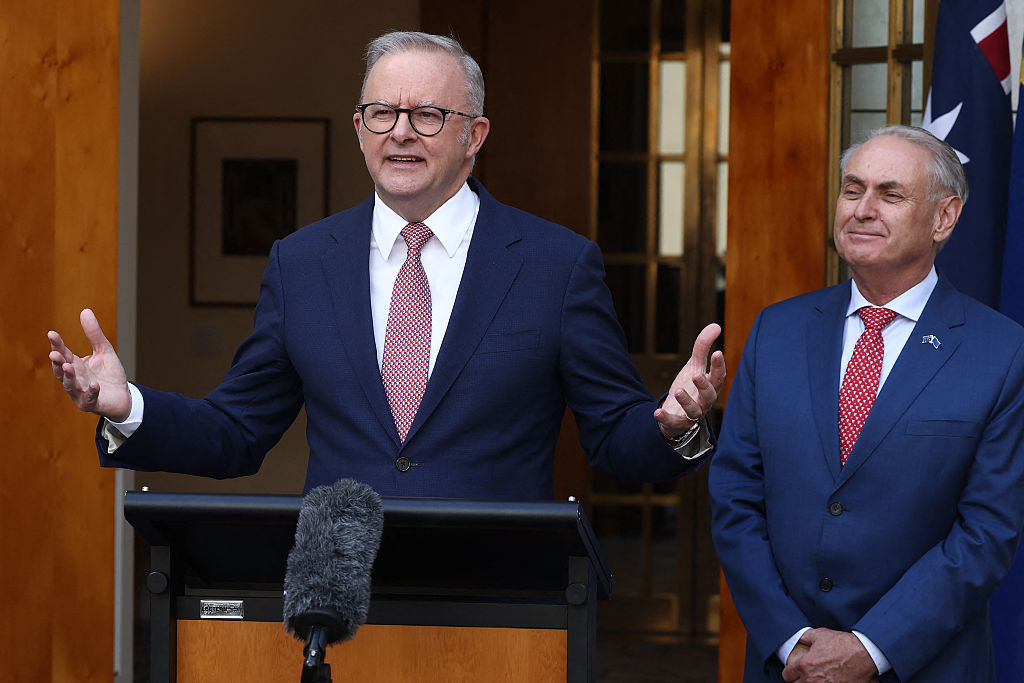

Australian Prime Minister Anthony Albanese will travel to Singapore later this week for talks aimed at securing additional shipments of fuel as global disruptions linked to the Iran War continue to strain markets.
Albanese confirmed he will meet Singapore Prime Minister Lawrence Wong, describing the visit as part of a broader effort to strengthen energy security.
“The visit follows Australia-Singapore’s joint commitment to keep fuel flowing between both countries and to work together to strengthen energy supply chain resilience,” he told reporters in Canberra on April 7.
Australia’s fuel supply situation is precarious as 90 percent of its needs are fulfilled by imports.
According to NRMA, Australia imports the bulk of its unleaded petrol from Singapore, which accounts for 54.7 percent (5,974.7 megalitres), followed by South Korea at 22.5 percent, India at 11.5 percent, and Malaysia contributing a further 10 percent.
Diesel is a bit more diversified but still concentrated in the region, led by South Korea (28.8 percent), Singapore (15.4 percent), and Malaysia (14.4 percent), alongside Taiwan, Brunei, and India.
In turn, these refiners import about 60 percent of their raw crude from the Middle East.
Meanwhile at the same press conference, Energy Minister Chris Bowen said fuel supply pressures remain manageable despite a sharp spike in demand over Easter.
“Despite the fact that demand for petrol and diesel was 30 percent higher this Easter than last Easter, we continue to see, each day, the service-station outages fall,” he told reporters.
According to his latest figures, in New South Wales, 125 service stations remain without diesel—about 5 percent of sites—while 34 have no fuel at all.
Victoria has 40 sites without diesel, representing 2 percent of service stations, alongside 29 without unleaded petrol.
Queensland recorded 34 stations without diesel and 30 without unleaded petrol, while smaller numbers were reported in South Australia, Western Australia, Tasmania, the Northern Territory and the ACT.
Nationally, Bowen said 241 service stations—around 3 percent—are currently without diesel.
At the same time, supply levels remain steady
Australia holds 39 days of petrol, equivalent to 1.7 billion litres, alongside 30 days of jet fuel—847 million litres—and 29 days of diesel.
In response, the Coalition continued to press the government on its handling of the crisis.
Nationals Leader Matt Canavan renewed calls for increased domestic production, including expanded drilling and alternative fuel technologies.
“Let’s look at all types of technology, put everything on the table, including converting our coal to liquids. We have enormous amounts of energy in this country,” he told Sky News.
“We’re only energy poor because this government has made a conscious choice not to use Australian energy and instead be reliant on foreign energy.”
 Friends Read Free
Copy
Facebook
Tweet
Friends Read Free
Copy
Facebook
Tweet