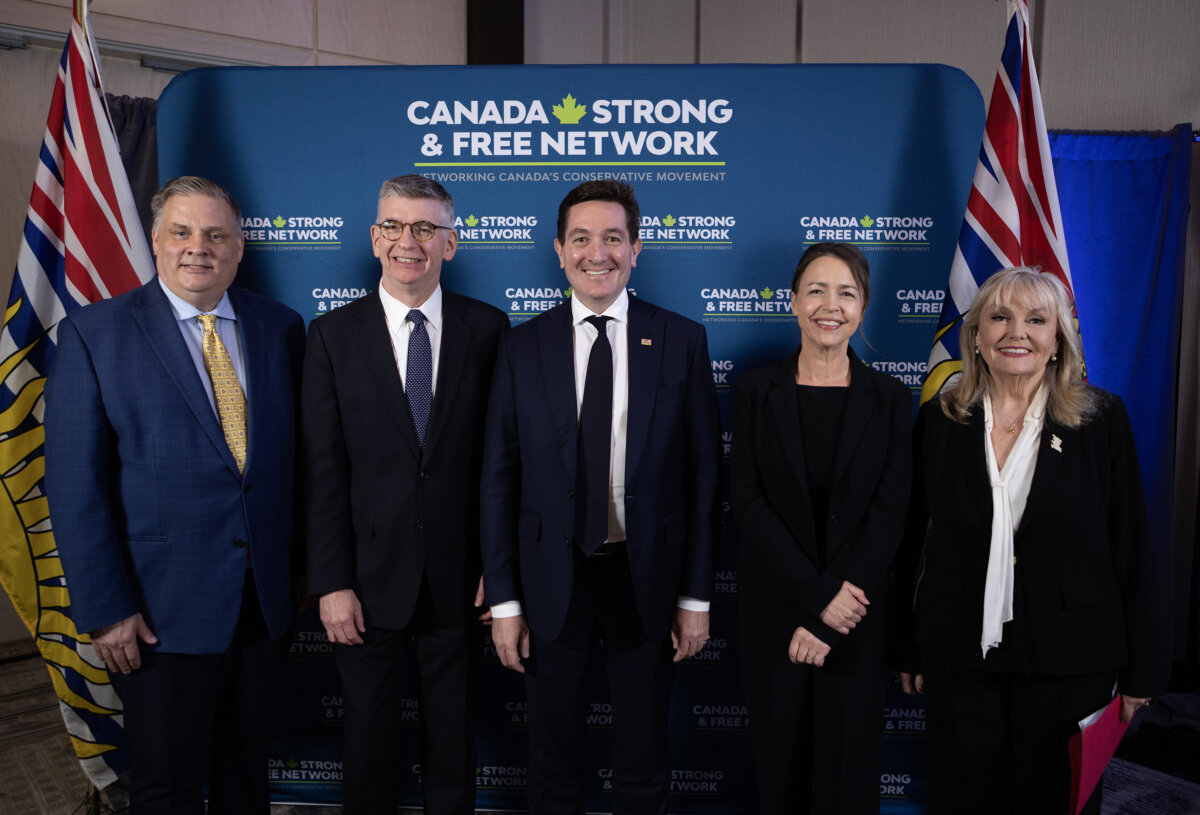
The five remaining B.C. Conservative leadership hopefuls all agreed on repealing a key provincial indigenous rights law, but clashed over the future scope and focus of the party during a debate on April 28.
The event in Vancouver, which opened with a First Nations land acknowledgment from co-host Stuart McNish, saw fault lines emerge over whether the party should seek to be a big tent or move further right to accommodate right-wing rival party OneBC and avoid a potential split vote.
“We lost the last election because we split the vote on the right,” said entrepreneur Yuri Fulmer. “I am the only candidate who can make that promise today, that we will not split the vote on the right.”
Fulmer signed a “unite the right” agreement on March 30 to stop vote-splitting in the event he becomes party leader and leads the party into a provincial election. The agreement commits that OneBC won’t field candidates in 88 of the province’s 93 ridings in return for B.C. Tories agreeing to “clear the path” for OneBC in five targeted ridings.
Fellow candidate former MP and federal cabinet member Kerry-Lynne Findlay disagreed with Fulmer on the need to form an accord and work with OneBC. She dismissed Fulmer’s reference to a recent Research Co. poll suggesting 61 percent support for some form of a deal between OneBC and the B.C. Tories among 2024 B.C. Conservative voters.
“I believe that the reason you see the kind of polling results you do right now is because there is no leader of the Conservative Party of BC,” Findlay said. “If we have a strong leader with a bold vision, people are going to want to vote for us.”
In addition to Findlay and Fulmer, lawyer and political commentator Caroline Elliott, sitting MLA Peter Milobar, and former B.C. Liberal cabinet minister Ian Black are running to head the party.
Voting packages are set to be sent out May 9, with a winner to be announced May 30.
Black rejected Fulmer’s seat-sharing agreement and said he would be putting forward candidates in all 93 ridings, while Milobar also took exception to Fulmer’s plan. Elliott said the focus should be on the need to counteract what she considers the harmful policies of the governing NDP.
Back-and-Forth
The Declaration on the Rights of Indigenous Peoples Act (DRIPA) was passed by the B.C. legislature in 2019.
The legislation made B.C. the first province to pass the United Nations Declaration on the Rights of Indigenous Peoples (UNDRIP) into law. The global pact, introduced in 2007, calls for commitments to indigenous land, consent, and governance rights.
DRIPA has become the centre of increasing political focus after a series of consequential legal decisions citing the legislation. This includes a decision last year by the B.C. Supreme Court granting the Cowichan Nation title rights to large areas in Richmond, B.C., and other nearby regions, with implications for private property rights.
Both Milobar and Black supported passage of DRIPA in the provincial legislature in 2019. However, both now support repealing it if in power. All the rest of the candidates share this position.
“I thought I’d said that about 100,000 times. Yes,” Elliott said when asked by McNish if she supports overturning the law.
“I think everyone here has said that,” she added.
However, both Milobar and Black cautioned that repealing DRIPA would trigger serious legal, political, and economic complexities that would have to be carefully managed. Milobar, for his part, pushed back particularly sharply on criticisms of his credibility due to his past vote on DRIPA.
“My wife and my children are indigenous,” Milobar said. “It doesn’t change my position on [repealing] DRIPA.” He added that the law ended up being implemented in a way he now disagrees with.
Pitches
Milobar said he will run the most credible government, and as party leader, he said he would focus on building a disciplined party by strengthening riding associations and recruiting strong candidates.
“You build a party … by actually rebuilding the trust and rebuilding the relationships that we have with our riding associations,” he said.
Black said he is the best candidate to effectively build a big-tent party that welcomes everyone, adding that the party should stick to “basic conservative values” but without engaging in ideological gatekeeping.
He said the road to victory for the party lies in reaching out to voters of all beliefs who are frustrated with government dysfunction and economic stagnation, presenting himself as a free enterprise, civil libertarian.
Old B.C. Social Credit governments under W.A.C. Bennett and Bill Bennett formed long-lasting centre-right governing coalitions via a big-tent approach, according to Black, who said: “They didn’t do that by identifying who fits in and who doesn’t. They did that by saying, ‘We believe in basic conservative values.'”
For her part, Elliott sharply criticized the B.C. NDP’s “radical land-back agenda” and said she’s always been against DRIPA and government overreach, as opposed to some “late converts” among the candidates who only came around to opposing these issues after it became politically expedient to them.
Elliott’s campaign has criticized Fulmer’s business website for previously featuring indigenous land acknowledgments.
Elliott added that she would govern by striking a balance between all wings of the party and focus on challenging the core ideology behind the province’s governing NDP, saying the party’s economic and social agenda are part of a harmful whole.
“These things are one and the same,” Elliott said. “It’s not either or, it’s both, and if we don’t recognize that fundamental ideology underlying all of it, we may win some battles; we will never win the war.”
Findlay, meanwhile, presented herself as an experienced manager and party unifier, vowing to consolidate support behind the B.C. Tories through strong leadership, and promising to bring together voters from across the centre-right by offering what she called a “broad, bold, exciting vision of hope and prosperity.”
“We need to get our province back on track, but we need focused discipline and hard work to do it, and our party will be unified,” she said. “I am a unifier.”
Fulmer said his background in business and community leadership gives him the practical know-how to rebuild B.C.’s economy and restore competency to the government. He added that he can rebuild confidence in the province and consolidate the right behind a single electable coalition.
“I’ve owned and operated my own business in this province. I’ve had 2,000 to 3,000 employees rely on the decisions I make in order to support their families, and I’ve been a community volunteer for 30 years,” Fulmer said. “That’s what I want to bring to this job.”
Home Stretch
As the party’s leadership race enters the home stretch, the field is unified around repealing DRIPA but appears divided about how the party should define its ideological and governing focus.
This included disagreements about whether the focus should be solely economic or also include social issues.
While Elliott said B.C. Conservatives must not make the mistake of seeing B.C.’s problems as isolated policy mistakes and should recognize they’re the consequence of the “fundamental ideology underlying all of it,” Milobar said the coming election will be less about ideology than about competence and governmental stability.
This also led into a wider debate on whether the party should be more defined as a free-enterprise coalition or join in culturally contentious subjects around social issues.
Elliott said the party should confront all these issues head-on. Findlay and Milobar, meanwhile, both emphasized their government experience, while Fulmer highlighted his private sector credentials, and Black said he brings an ideal mix of public and private know-how.
The debate ended before candidates could turn to planned topics of discussion on health care, involuntary care, and the opioid crisis.
 Friends Read Free
Copy
Facebook
Tweet
Friends Read Free
Copy
Facebook
Tweet